
Free Safe Operating Procedure (Wheelchair Handling) Template
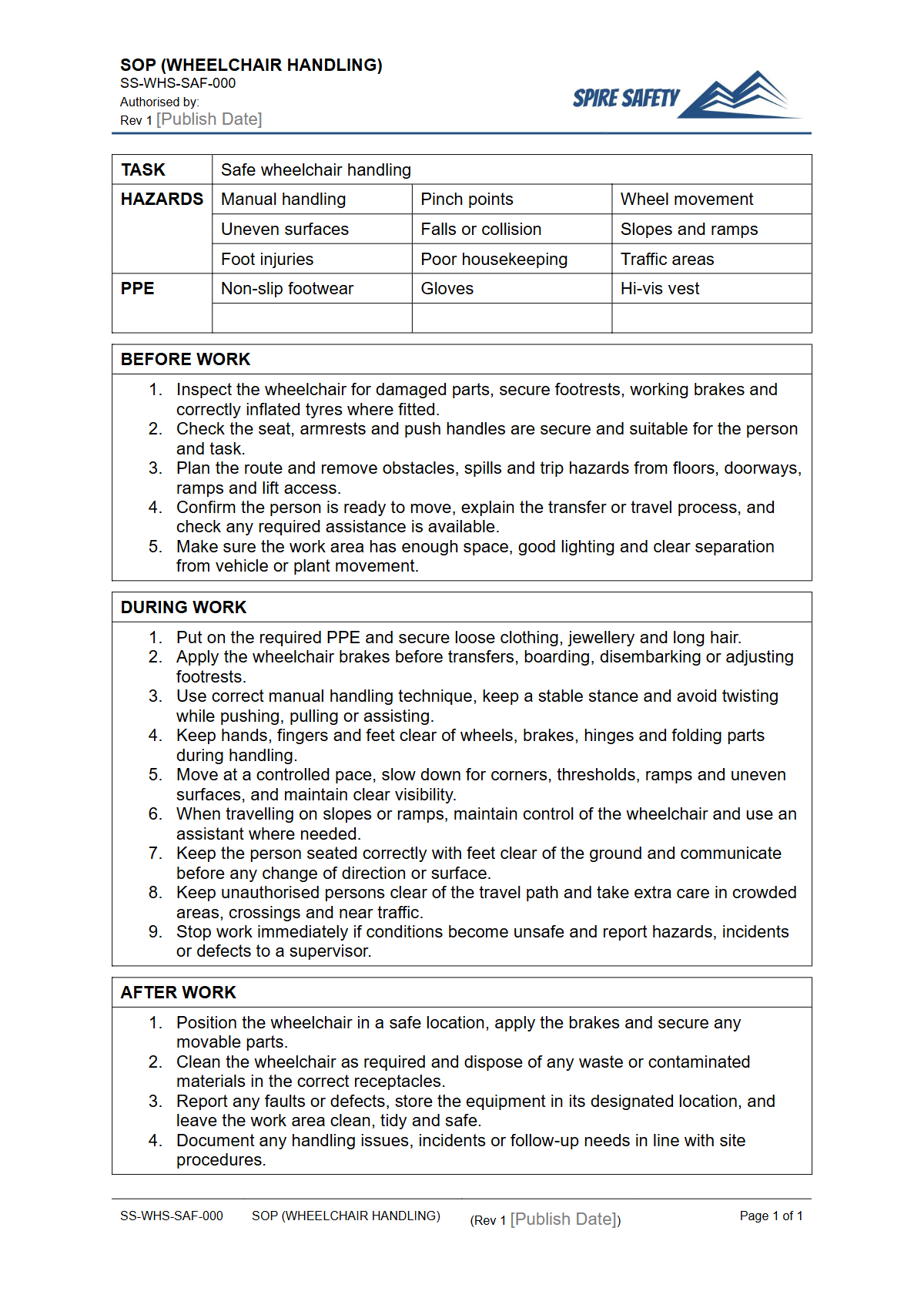
Our free Safe Operating Procedure template for wheelchair handling helps you document safe work practices. Download the customisable DOCX to get started.
Free Safe Operating Procedure (Wheelchair Handling) Template
DOCX • 126 KB + PDF
Updated Oct 2026
No signup required
Purpose of the Free Safe Operating Procedure (Wheelchair Handling) Template
Assisting individuals with mobility challenges is a critical task in many Australian workplaces, from aged care to community health. Our Free Safe Operating Procedure (Wheelchair Handling) Template provides a structured starting point for documenting the safe methods required for this activity.
Using this template helps your organisation formalise procedures to minimise the risk of injury to both care staff and the person being assisted. It addresses significant hazards, particularly musculoskeletal disorders (MSDs) for workers caused by awkward postures, overexertion, and repetitive motions, as well as the risk of falls or discomfort for the person in the wheelchair.
This Safe Operating Procedure (SOP) is designed to guide you in creating a document that is aligned with Australian WHS principles. By clearly outlining pre-operational checks, step-by-step instructions, and emergency responses, you can promote a consistent, safe approach across your team.
A well-developed SOP is a fundamental tool for hazard management, training, and demonstrating due diligence in managing workplace health and safety risks associated with manual tasks.
Video walkthrough
How to use the Free Safe Operating Procedure (Wheelchair Handling) Template
This resource is available for download as a DOCX file, which is fully editable in Microsoft Word or other compatible software, and a print-ready PDF. The template provides a comprehensive framework, but it is not a complete, ready-to-use document.
It is essential that you adapt its contents to reflect the specific circumstances of your workplace. Integrating this SOP effectively is a key part of maintaining robust WHS management systems.
Important: This is a template that you must customise. We are not familiar with your specific worksite, equipment, or personnel.
You must consult with your team, including the workers performing the task, to identify all potential hazards and establish controls that are relevant and effective for your business. Be sure to fill in all fields and remove any instructional text before finalising the document.
Key Areas for Customisation
- Types of Wheelchairs: Detail the specific models used (manual, electric, bariatric) and their unique features, such as brake mechanisms and removable parts.
- Work Environment: Include instructions for navigating specific layouts, including ramps, lifts, uneven surfaces, and tight corridors unique to your facility.
- Individual Needs: Add provisions for communicating with and accommodating the specific physical and cognitive needs of the people you assist.
- Emergency Contacts: Update the document with your site-specific emergency phone numbers and personnel contact details.
When to use a Wheelchair Handling SOP
A Safe Operating Procedure for wheelchair handling should be used as a primary reference document in any setting where employees assist people with wheelchairs. This includes aged care facilities, hospitals, disability support services, rehabilitation centres, and patient transport organisations.
The SOP should be a core part of your safety framework and integrated into daily operations. It is particularly useful for new employee inductions, annual refresher training, and as a guide for pre-task risk assessments.
It serves as a clear benchmark for expected safe work behaviour, helping to standardise practice across all shifts and team members.
Regular reviews of your SOPs are crucial. They should be revisited whenever a new type of wheelchair is introduced, after an incident or near miss occurs, or when a change in the work environment affects the task.
Conducting periodic WHS compliance auditing can help verify that your documented procedures are being followed correctly in practice and remain effective.
Who should use it
This procedure is intended for use by all personnel involved in assisting with wheelchair use. This primary group includes nurses, aged care workers, disability support workers, patient care assistants, and allied health professionals.
It is their guide to performing the task safely and consistently. Additionally, supervisors and WHS managers should use the SOP as a tool for training, supervision, and incident investigation.
It provides a clear standard against which performance can be measured and helps ensure that all legal and organisational obligations for safety are being met.
For businesses seeking expert guidance on developing procedures for hazardous manual tasks, engaging professional WHS consulting can provide tailored solutions and ensure best practice is implemented. You can also explore our free WHS resources library for other templates and guides to support your safety management efforts.
Common mistakes
Common mistakes to avoid
- Failing to perform pre-operational checks on the wheelchair's brakes, tyres, and frame.
- Using poor body mechanics, such as twisting the back or overreaching during a transfer.
- Not communicating clearly with the person in the wheelchair before and during movement.
- Forgetting to clear the path of travel of obstacles and hazards before starting.
Legal references
Legal considerations
The following legal requirements may be relevant to this type of work.
- Work Health and Safety Act (Harmonised) — Provides the primary duties for protecting workers and other people from work health and safety risks.
- Work Health and Safety Regulations (Harmonised) — Sets out requirements supporting the management of workplace hazards and risks.
The following codes may be relevant to this type of work.
- Managing WHS Risks Code of Practice — Provides practical guidance on identifying hazards, assessing risks and applying effective controls.
- Work Health and Safety Consultation, Cooperation and Coordination Code of Practice — Provides practical guidance on consulting workers and coordinating with other duty holders.
- Managing the Work Environment and Facilities Code of Practice — Provides practical guidance on safe work environments, workplace facilities and related controls.
Did you know
Manual Task Injuries
The healthcare and social assistance industry has one of the highest rates of serious workers' compensation claims in Australia, with hazardous manual tasks being a leading cause of injury.
Code of Practice
Safe Work Australia provides a model Code of Practice for Hazardous Manual Tasks, which offers detailed guidance for employers on how to identify, assess, and control risks associated with tasks like wheelchair handling.
FAQ
Frequently asked questions
01What are the main risks of improper wheelchair handling?
02Is a Safe Operating Procedure a legal requirement for wheelchair handling?
03How often should wheelchair handling procedures be reviewed?
04What kind of training is needed for safe wheelchair handling?
Share this resource
Free Safe Operating Procedure (Wheelchair Handling) Template
Browse Categories
How To Use It
- 1Download and open in Word or PDF.
- 2Replace the placeholders with your business details.
- 3Get it reviewed by a WHS specialist before rollout.
Need it customised?
Our WHS consultants can adapt this template to your site, run a gap analysis, or audit what you already have in place.
Book a Free Consultation WHS consulting servicesor call 1300 156 382
Related templates
- Free Safe Operating Procedure (Wheelchair Lap Belt) Template
- Free Safe Operating Procedure (Wheelchair Lift Use) Template
- Free Safe Operating Procedure (Wheelchair Ramp Setup) Template
- Free Safe Operating Procedure (Wheelchair Ramp Use) Template
- Free Safe Operating Procedure (Wheelchair Repair Check) Template
- Free Safe Operating Procedure (Wheelchair Scale Use) Template