
Free Safe Operating Procedure (Wheelchair Ramp Setup) Template
Standardise the setup of portable wheelchair ramps to prevent injuries and ensure safe access.
Free Safe Operating Procedure (Wheelchair Ramp Setup) Template
DOCX • 126 KB + PDF
Updated Oct 2026
No signup required
Purpose of the Free Safe Operating Procedure (Wheelchair Ramp Setup) Template
Setting up portable or temporary wheelchair ramps involves multiple risks, including manual handling injuries, slips and trips, and the potential for ramp failure. A Safe Operating Procedure (SOP) provides clear, step-by-step instructions to ensure the task is performed safely and consistently every time.
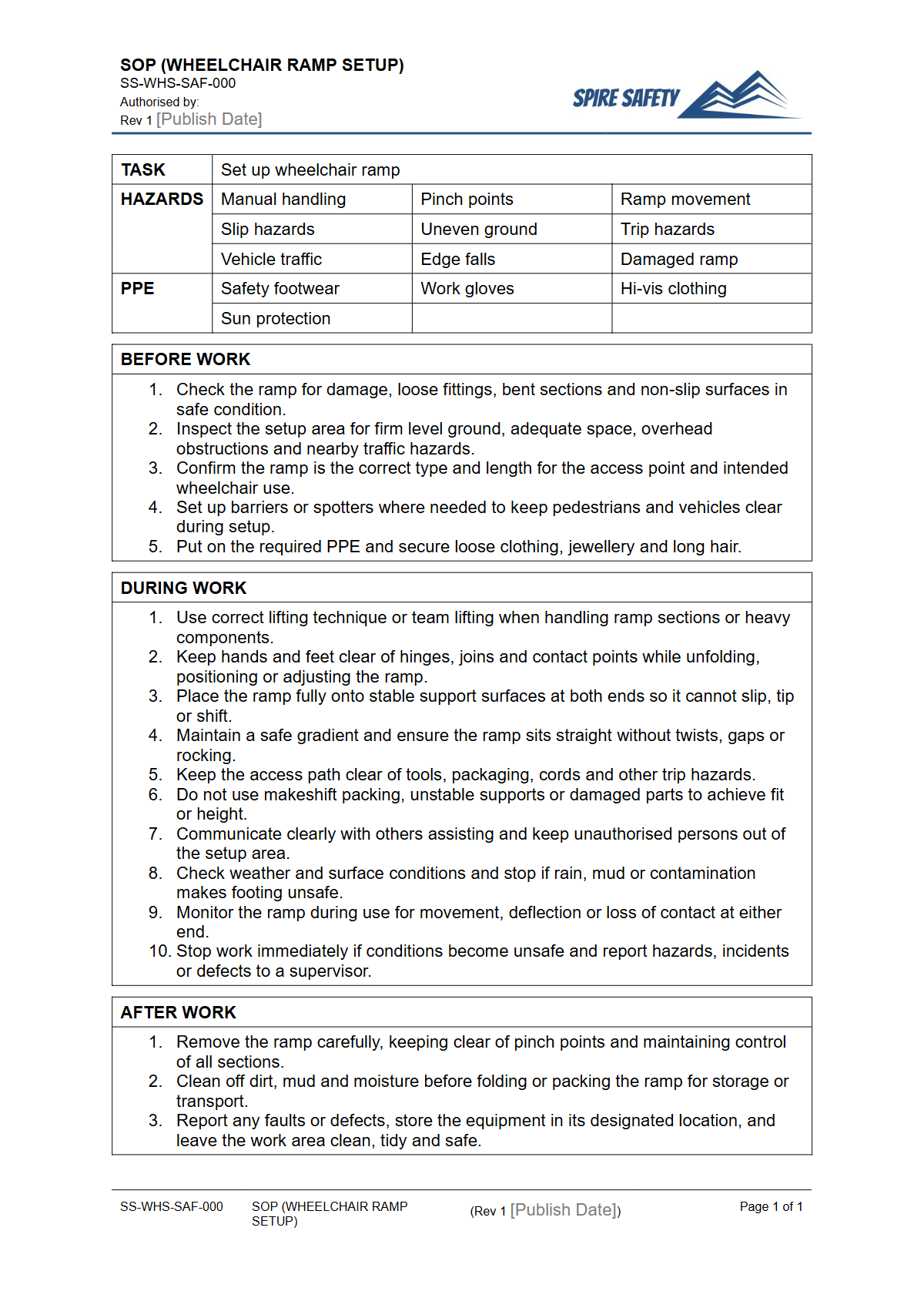
This Free Safe Operating Procedure (Wheelchair Ramp Setup) Template provides a structured starting point for your organisation to document its process for deploying, inspecting, and dismantling ramps. Using a formal procedure helps minimise the risk of injury to both workers and ramp users by addressing hazards such as incorrect gradients, unstable surfaces, and improper securing. It forms a critical part of your overall safety framework and demonstrates a commitment to effective WHS management systems.
Video walkthrough
How to use the Free Safe Operating Procedure (Wheelchair Ramp Setup) Template
This downloadable document is a template, not a finished procedure. To use it effectively, you must adapt it to your specific workplace context.
This involves consulting with workers who perform the task, incorporating details of the specific ramp models you use, and aligning the procedure with your site-specific risk assessments.
Important Note: We have created this template as a guide. You must customise it to reflect your unique operational environment, equipment, and legal obligations.
A generic document is not sufficient for ensuring safety; a detailed, site-specific procedure is essential. The effectiveness of your documented procedures can be verified through a systematic process like a WHS compliance auditing program.
To implement this SOP:
- Download the DOCX file and open it for editing.
- Insert your company name, logo, and other relevant details.
- Review each section with supervisors and workers who will be using the ramps.
- Modify the steps to match your equipment and environment. Pay close attention to manufacturer's instructions for your specific ramp models.
- Define clear responsibilities for each stage of the process.
- Once finalised, train all relevant personnel on the procedure and document the training.
- Schedule regular reviews of the SOP to ensure it remains current.
When to use it
This SOP should be used whenever a temporary or portable wheelchair ramp is set up or dismantled. This includes a wide range of scenarios, such as providing temporary access during construction or events, in community care settings, or for vehicle access.
The procedure should be used as a primary training document for new employees and as a pre-task reference for all workers. Just as you would require a documented process before operating machinery using a FREE Circular Saw SOP (Safe Operating Procedure) Template, a formal procedure for ramp setup is essential for managing accessibility and manual handling risks.
Who should use it
This procedure is intended for all personnel involved in the handling and setup of wheelchair ramps. This includes:
- Facilities and maintenance staff
- Event crew and site managers
- Community health and support workers
- Delivery and logistics personnel
- Supervisors responsible for overseeing accessibility provisions
Managers and WHS advisors should also use this document to ensure it is correctly integrated into the broader safety system. If you need assistance embedding procedures like this into your organisation's safety culture, engaging external expertise through WHS consulting can provide valuable guidance and support.
Documented procedures ensure everyone understands their role in maintaining safety, whether they are operating complex machinery covered in a FREE Telehandler SOP (Safe Operating Procedure) Template or performing critical manual tasks like this one.
Key Elements of a Wheelchair Ramp Setup SOP
A comprehensive SOP for wheelchair ramp setup should be broken down into logical phases of work. Our template guides you through documenting these key stages to ensure no critical step is missed.
Pre-Operational Checks
Before any setup begins, a thorough inspection of the equipment and area is vital. This includes checking the ramp for any signs of damage like cracks, warping, or worn anti-slip surfaces.
Verifying all locking pins and securing components are present and functional is also critical, a universal safety step similar to what is outlined in our Free Air Compressor SOP (Safe Operating Procedure) Template. The procedure should also prompt an assessment of the setup location for level, stable ground clear of obstructions.
Step-by-Step Setup Procedure
The core of the SOP details the physical process of setting up the ramp. This section must include instructions on safe manual handling techniques to prevent musculoskeletal injury.
It should specify the method for positioning the ramp to achieve a safe gradient (e.g., 1:14), how to secure it firmly at the top and bottom landings, and a final verification step to test for stability before allowing any use.
Post-Operational Tasks
Once the ramp is no longer needed, a safe procedure for dismantling, cleaning, and storing it is required. This section should outline the reverse of the setup process, again emphasising safe handling.
It should also include instructions for reporting any damage or defects identified during use or pack-down, ensuring the equipment is safe for its next deployment. This SOP is one of many valuable documents available in our free WHS resources library to help you build a safer workplace.
Common mistakes
Common mistakes to avoid
- Setting up on uneven or unstable ground, causing the ramp to shift or become unstable during use.
- Failing to secure the ramp correctly with locking pins, clamps, or other mechanisms.
- Creating a gradient that is too steep for safe independent or assisted use.
- Ignoring the specific manufacturer's instructions for a particular ramp model, including its load capacity.
Legal references
Legal considerations
The following legal requirements may be relevant to this type of work.
- Work Health and Safety Act (Harmonised) — Provides the primary duties for protecting workers and other people from work health and safety risks.
- Work Health and Safety Regulations (Harmonised) — Sets out requirements supporting the management of workplace hazards and risks.
The following codes may be relevant to this type of work.
- Managing WHS Risks Code of Practice — Provides practical guidance on identifying hazards, assessing risks and applying effective controls.
- Work Health and Safety Consultation, Cooperation and Coordination Code of Practice — Provides practical guidance on consulting workers and coordinating with other duty holders.
- Managing the Work Environment and Facilities Code of Practice — Provides practical guidance on safe work environments, workplace facilities and related controls.
Did you know
Gradient Matters
A ramp that is too steep can be a tipping hazard for wheelchair users and creates significant strain for anyone assisting them. The difference between a safe 1:14 gradient and a dangerous 1:10 gradient can be difficult to judge by eye alone.
Manual Handling Risk
Portable ramps can be heavy and awkward. Musculoskeletal injuries from lifting and carrying ramps are a primary hazard for workers, often overlooked in favour of focusing on the user's safety.
FAQ
Frequently asked questions
01What is the correct slope for a wheelchair ramp in Australia?
02Does this SOP cover permanent, fixed ramps?
03Who is responsible for providing a Safe Operating Procedure?
04How often should I review my Safe Operating Procedures?
Share this resource
Free Safe Operating Procedure (Wheelchair Ramp Setup) Template
Browse Categories
How To Use It
- 1Download and open in Word or PDF.
- 2Replace the placeholders with your business details.
- 3Get it reviewed by a WHS specialist before rollout.
Need it customised?
Our WHS consultants can adapt this template to your site, run a gap analysis, or audit what you already have in place.
Book a Free Consultation WHS consulting servicesor call 1300 156 382
Related templates
- Free Safe Operating Procedure (Wheelchair Ramp Use) Template
- Free Safe Operating Procedure (Wheelchair Repair Check) Template
- Free Safe Operating Procedure (Wheelchair Scale Use) Template
- Free Safe Operating Procedure (Wheelchair Seat Cleaning) Template
- Free Safe Operating Procedure (Wheelchair Storage) Template
- Free Safe Operating Procedure (Wheelchair Tie-Down) Template