
Free Safe Operating Procedure (Wheelchair Scale Use) Template
Standardise the use of wheelchair scales to protect staff and patients. Download our Free Safe Operating Procedure (Wheelchair Scale Use) Template now.
Free Safe Operating Procedure (Wheelchair Scale Use) Template
DOCX • 126 KB + PDF
Updated Oct 2026
No signup required
Purpose of the Free Safe Operating Procedure (Wheelchair Scale Use) Template
Using wheelchair scales is a common task in healthcare, aged care, and disability support settings. While seemingly simple, it involves significant risks, including manual handling injuries for staff and fall risks for the person being weighed.
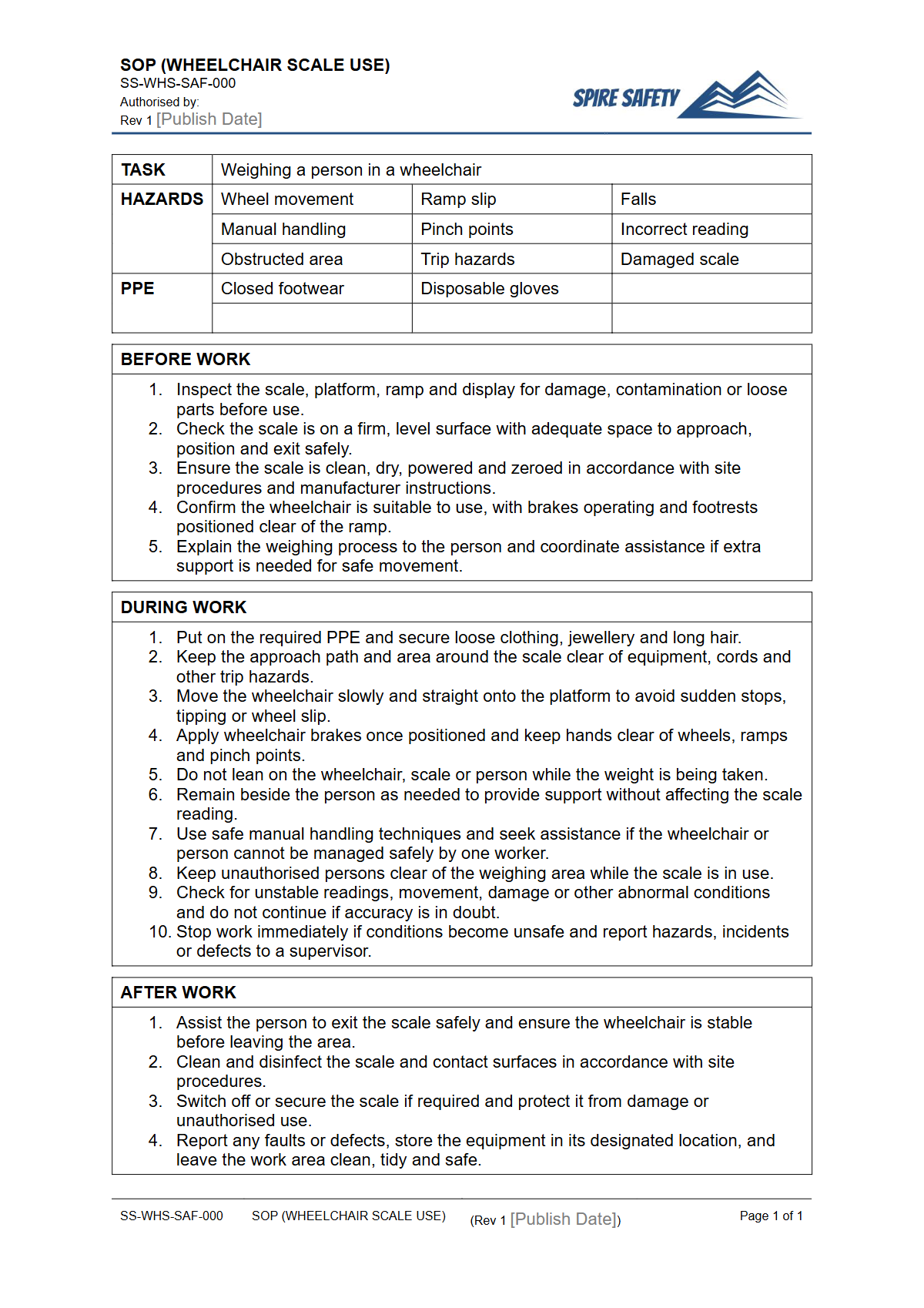
This Safe Operating Procedure (SOP) template provides a structured framework for documenting the correct, safe, and consistent method for operating wheelchair scales. Its primary purpose is to minimise risk by outlining pre-operational checks, step-by-step instructions for the weighing process, and post-use procedures.
Implementing a clear SOP helps ensure the dignity and safety of individuals while protecting workers from injury.
A well-defined SOP is a critical control measure and a fundamental part of demonstrating due diligence. It forms an essential document within comprehensive WHS management systems, providing clear instruction and a basis for training and competency assessment.
By standardising this procedure, your organisation can reduce variability in practice, improve the accuracy of clinical data, and create a safer environment for everyone involved.
Video walkthrough
How to use the Free Safe Operating Procedure (Wheelchair Scale Use) Template
This template is available in both DOCX and PDF formats for your convenience. The DOCX file is fully editable, allowing you to tailor the content to your specific workplace requirements.
The procedure for weighing a person in a wheelchair can vary significantly based on the model of the scale, the design of the environment, and the specific needs of the individual. Therefore, it is crucial that you customise this document to reflect your unique operational context.
Important: This document is a template, not a finished procedure. We have designed it to provide a structured starting point aligned with Australian WHS principles, but you must review, edit, and add site-specific details.
This includes specifying the make and model of your scales, identifying hazards unique to your facility, and detailing your emergency procedures. Your final SOP should be a practical tool that your team can genuinely use to guide their actions. In larger facilities, you may have procedures for other specialised equipment, such as the safe use of kitchen appliances documented in a Free Safe Operating Procedure (Deep Fryer).
When to use this Safe Operating Procedure
An SOP for wheelchair scale use should be an active, working document integrated into your daily operations. It is not a file to be written once and forgotten. It should be used in several key situations:
- During Staff Training and Induction: New employees must be trained on the correct procedure before they are permitted to operate the equipment independently.
- As a Pre-Task Refresher: Staff can refer to the SOP to refresh their memory on key steps, especially if they do not perform the task frequently.
- For Competency Assessments: Supervisors can use the SOP as a checklist to assess whether staff are performing the task safely and correctly.
- After an Incident or Near-Miss: The SOP should be reviewed and potentially updated as part of any incident investigation to identify and address procedural gaps.
- During Regular Audits: The SOP serves as the standard against which actual work practices are measured during safety audits. Regular verification is a key part of maintaining safety standards, often reviewed during a formal WHS compliance audit.
Who should use it
This Safe Operating Procedure is intended for all personnel who may be involved in the task of weighing a person in a wheelchair. This includes a wide range of roles across the health and community services sectors:
- Nurses and Healthcare Assistants: As frontline workers in hospitals and clinics, they frequently perform this task as part of patient assessment.
- Aged Care Workers: In residential aged care facilities, regular weighing is crucial for monitoring the health of residents.
- Disability Support Workers: Staff supporting individuals with mobility challenges in group homes or the community will use this procedure.
- Allied Health Professionals: Physiotherapists and occupational therapists may also be involved in this task.
- WHS Managers and Supervisors: These individuals are responsible for implementing the SOP, providing training, and ensuring compliance within their teams.
Proper procedures are vital for all equipment, from clinical devices to facility maintenance tools. For instance, maintenance teams in larger care facilities would have their own specific procedures, like those outlined in our Free Air Compressor SOP (Safe Operating Procedure) Template. For more templates covering a wide range of tasks and equipment, you can explore our complete free WHS resources library.
Common mistakes
Common mistakes to avoid
- Forgetting to engage the wheelchair brakes before transferring the person on or off the scale.
- Failing to zero the scale before the person moves onto it, leading to inaccurate readings.
- Poor communication with the individual, causing confusion, anxiety, or unsafe movements.
- Staff using awkward postures (e.g., bending, twisting) while manoeuvring the wheelchair, increasing their risk of a musculoskeletal injury.
Legal references
Legal considerations
The following legal requirements may be relevant to this type of work.
- Work Health and Safety Act (Harmonised) — Provides the primary duties for protecting workers and other people from work health and safety risks.
- Work Health and Safety Regulations (Harmonised) — Sets out requirements supporting the management of workplace hazards and risks.
The following codes may be relevant to this type of work.
- Managing WHS Risks Code of Practice — Provides practical guidance on identifying hazards, assessing risks and applying effective controls.
- Work Health and Safety Consultation, Cooperation and Coordination Code of Practice — Provides practical guidance on consulting workers and coordinating with other duty holders.
- Managing the Work Environment and Facilities Code of Practice — Provides practical guidance on safe work environments, workplace facilities and related controls.
Did you know
A Heavy Toll
The healthcare and social assistance industry has one of the highest rates of serious workers' compensation claims in Australia, with body stressing and manual handling injuries being a primary cause.
FAQ
Frequently asked questions
01What are the main hazards when using a wheelchair scale?
02How often should an SOP for a wheelchair scale be reviewed?
03Is specific training required to use a wheelchair scale?
04Why is an accurate weight measurement so important in a care setting?
Share this resource
Free Safe Operating Procedure (Wheelchair Scale Use) Template
Browse Categories
How To Use It
- 1Download and open in Word or PDF.
- 2Replace the placeholders with your business details.
- 3Get it reviewed by a WHS specialist before rollout.
Need it customised?
Our WHS consultants can adapt this template to your site, run a gap analysis, or audit what you already have in place.
Book a Free Consultation WHS consulting servicesor call 1300 156 382
Related templates
- Free Safe Operating Procedure (Wheelchair Seat Cleaning) Template
- Free Safe Operating Procedure (Wheelchair Storage) Template
- Free Safe Operating Procedure (Wheelchair Tie-Down) Template
- Free Safe Operating Procedure (Wheelchair Tyre Check) Template
- Free Safe Operating Procedure (Wheelchair Van Loading) Template
- Free Safe Operating Procedure (Wheelchair Washdown) Template