
Free Safe Operating Procedure (Wheelchair Washdown) Template
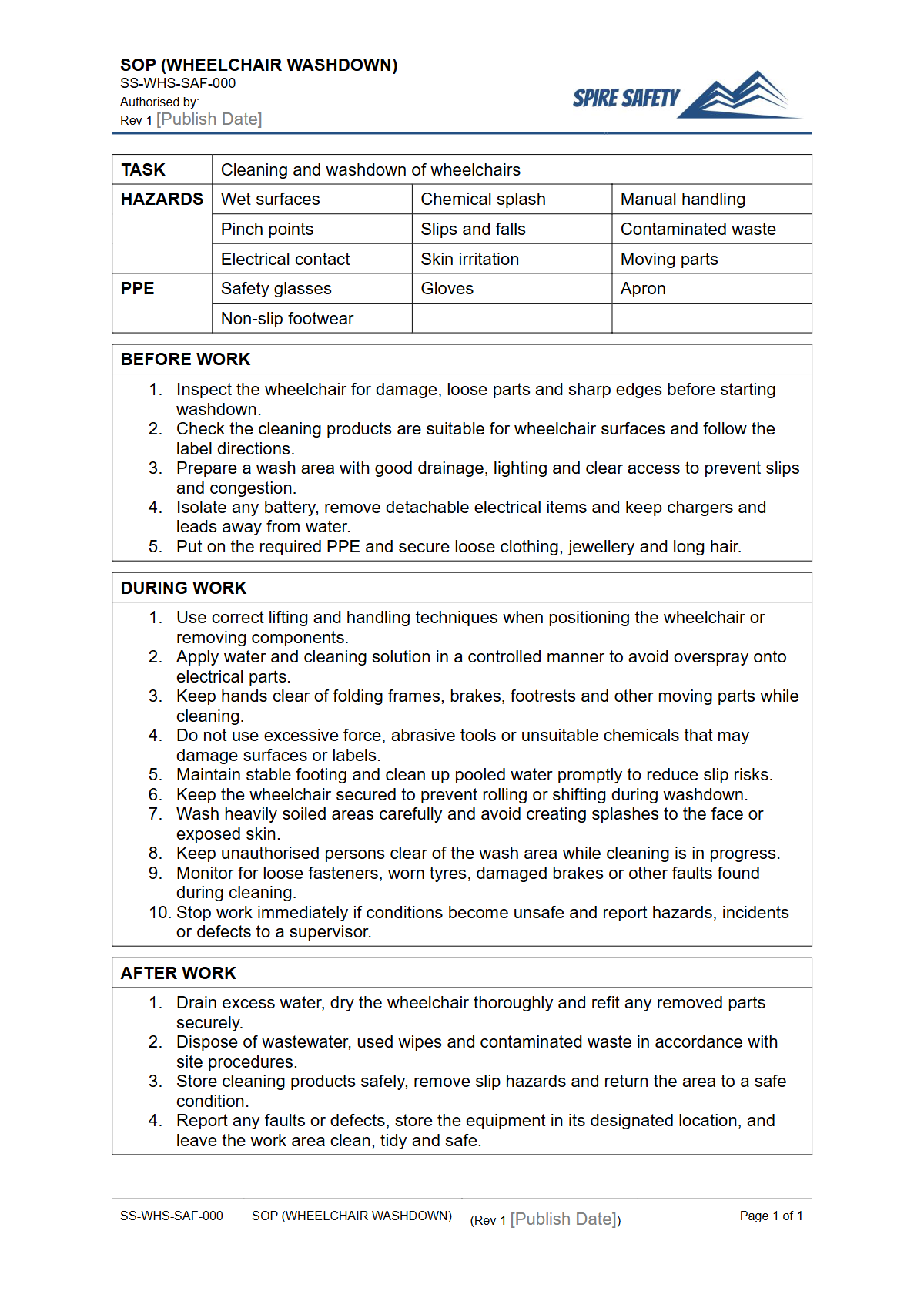
Download our free Safe Operating Procedure (Wheelchair Washdown) Template to formalise your cleaning processes. This customisable DOCX helps you control risks.
Free Safe Operating Procedure (Wheelchair Washdown) Template
DOCX • 126 KB + PDF
Updated Oct 2026
No signup required
Purpose of the Free Safe Operating Procedure (Wheelchair Washdown) Template
Establishing a clear, documented process for cleaning and sanitising wheelchairs is critical in many healthcare, aged care, and disability support settings. This Free Safe Operating Procedure (Wheelchair Washdown) Template provides a structured framework for outlining the required steps, safety precautions, and responsibilities.
Implementing a formal SOP helps ensure consistent hygiene standards are met, reducing the risk of cross-contamination and infection. It also addresses worker safety by identifying hazards associated with the task, such as manual handling, chemical exposure, and slip risks.
A well-defined procedure serves as a valuable training tool and demonstrates a commitment to managing health and safety risks proactively.
A robust SOP is a cornerstone of a functional safety system. It translates risk assessments into practical, repeatable actions for your team.
Integrating procedures like this one is a fundamental part of developing comprehensive WHS management systems that protect both workers and the people they care for.
Video walkthrough
How to use the Free Safe Operating Procedure (Wheelchair Washdown) Template
This document is a template and not a finished procedure. You must customise it to reflect the specific equipment, chemicals, and environment of your workplace. Download the DOCX file and adapt it by following these steps:
- Consult with Workers: Involve the staff who perform wheelchair washdowns. Their direct experience is invaluable for identifying practical steps and unforeseen hazards.
- Identify Hazards: Conduct a risk assessment for the task. Consider the wash bay area, the types of wheelchairs (manual, electric), the cleaning agents used, and the potential for musculoskeletal injuries.
- Detail PPE Requirements: Based on the risks and the Safety Data Sheets (SDS) for your cleaning chemicals, specify the exact Personal Protective Equipment (PPE) required, such as gloves, safety glasses, and waterproof aprons.
- Document the Step-by-Step Process: Clearly write out each stage of the washdown, from initial preparation and transport of the wheelchair to the cleaning/disinfection process, drying, and final checks.
- Include Emergency Procedures: Outline the response for incidents like chemical splashes, slips, or electrical faults with powered wheelchairs.
- Train and Supervise: Ensure all relevant employees are trained on the finalised SOP and that their understanding is verified. Supervision is key to confirming the procedure is followed correctly.
Thorough customisation is essential for creating a document that is truly effective. If your washdown area includes other machinery, such as for drying parts, you may need separate procedures.
For example, if compressed air is used, refer to our Free Air Compressor SOP (Safe Operating Procedure) Template to manage its associated risks.
When to use it
This Safe Operating Procedure should be the go-to guide whenever a wheelchair washdown is required. Its application is not limited to a single scenario. Use it to standardise processes for:
- Routine Cleaning: As part of a regular cleaning schedule to maintain hygiene and presentation for daily use.
- Infection Control: After a wheelchair has been used by a person with a known infectious condition or following a contamination event (e.g., fluid spills).
- Between Users: When a wheelchair is being re-assigned from one client or resident to another.
- Pre-Maintenance: To ensure the equipment is clean before being handled by maintenance or repair technicians.
- Post-Hire Returns: For businesses that rent mobility equipment, this SOP ensures each item is properly sanitised before being returned to stock.
Integrating this procedure into your operational workflows helps create a reliable and auditable system for equipment hygiene and safety.
Who should use it
This SOP is primarily for the employees tasked with cleaning the equipment. This may include roles such as:
- Healthcare Assistants
- Aged Care Workers
- Disability Support Workers
- Hospital Orderlies or Porters
- Dedicated Cleaning and Sterilisation Staff
- Maintenance Personnel
Beyond the direct user, supervisors and managers have a responsibility to ensure the procedure is available, understood, and followed. They should use it as a tool for training, competency assessment, and incident investigation. For organisations seeking higher levels of certification, such documented procedures are critical evidence of a systematic approach to OHS, a core principle in frameworks supported by ISO 45001 consulting.
Ultimately, a successful SOP relies on a shared understanding of its importance across the organisation. Regular reviews and audits can confirm that the documented procedure matches on-the-ground practice.
If you find discrepancies or need to validate your processes, a formal WHS compliance auditing service can provide external verification and identify areas for improvement. You can find many other helpful documents like this one in our complete free WHS resources library.
Common mistakes
Common mistakes to avoid
- Using incorrect or improperly diluted cleaning chemicals, causing damage or posing a health risk.
- Failing to protect or disconnect batteries and electronic controls on powered wheelchairs.
- Neglecting to wear the specified Personal Protective Equipment (PPE), especially gloves and eye protection.
- Performing the task in a poorly ventilated area, increasing the risk of inhaling chemical fumes.
Legal references
Legal considerations
The following legal requirements may be relevant to this type of work.
- Work Health and Safety Act (Harmonised) — Provides the primary duties for protecting workers and other people from work health and safety risks.
- Work Health and Safety Regulations (Harmonised) — Sets out requirements supporting the management of workplace hazards and risks.
The following codes may be relevant to this type of work.
- Managing WHS Risks Code of Practice — Provides practical guidance on identifying hazards, assessing risks and applying effective controls.
- Work Health and Safety Consultation, Cooperation and Coordination Code of Practice — Provides practical guidance on consulting workers and coordinating with other duty holders.
- Managing the Work Environment and Facilities Code of Practice — Provides practical guidance on safe work environments, workplace facilities and related controls.
Did you know
Infection Control Impact
Proper cleaning and disinfection of shared patient equipment like wheelchairs is a critical infection control measure that can significantly reduce the transmission of healthcare-associated infections (HAIs).
Asset Lifespan
Regular, documented cleaning procedures not only ensure hygiene but also create opportunities to identify early signs of wear, damage, or corrosion, extending the safe operational life of a wheelchair.
FAQ
Frequently asked questions
01What are the main hazards in wheelchair washdown tasks?
02How often should a Safe Operating Procedure for wheelchair cleaning be reviewed?
03Is training required for this Safe Operating Procedure?
04Can I use this template for motorised scooters as well?
Share this resource
Free Safe Operating Procedure (Wheelchair Washdown) Template
Browse Categories
How To Use It
- 1Download and open in Word or PDF.
- 2Replace the placeholders with your business details.
- 3Get it reviewed by a WHS specialist before rollout.
Need it customised?
Our WHS consultants can adapt this template to your site, run a gap analysis, or audit what you already have in place.
Book a Free Consultation WHS consulting servicesor call 1300 156 382
Related templates
- Free Safe Operating Procedure (Wildlife Nest Avoidance) Template
- Free Safe Operating Procedure (Windblown Debris Cleanup) Template
- Free Safe Operating Procedure (Windbreak Maintenance) Template
- Free Safe Operating Procedure (Window Cleaning) Template
- Free Safe Operating Procedure (Window Frame Cleaning) Template
- Free Safe Operating Procedure (Window Sill Cleaning) Template