
Free Safe Operating Procedure (Wildlife Nest Avoidance) Template
Protect native fauna and manage operational risks with our wildlife nest avoidance SOP template. Download your free, customisable Word document today.
Free Safe Operating Procedure (Wildlife Nest Avoidance) Template
DOCX • 126 KB + PDF
Updated Oct 2026
No signup required
Purpose of the Free Safe Operating Procedure (Wildlife Nest Avoidance) Template
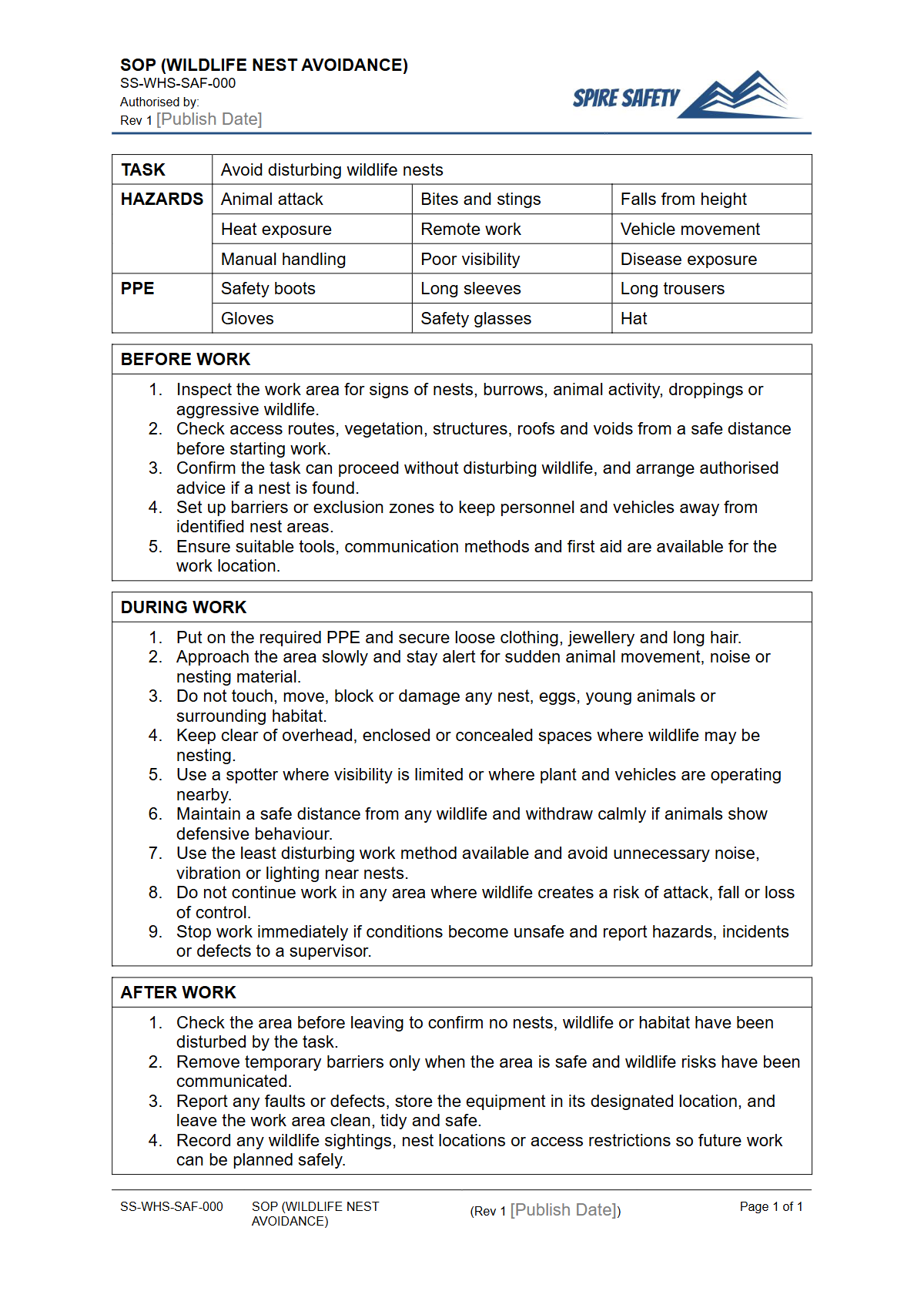
This Free Safe Operating Procedure (Wildlife Nest Avoidance) Template provides a structured starting point for developing a formal process to manage risks associated with native wildlife. It helps organisations formalise procedures for identifying, assessing, and controlling hazards related to disturbing active nests, dens, or hollows during operational activities.
Implementing a clear SOP demonstrates due diligence in meeting environmental protection and work health and safety obligations. A well-defined procedure ensures that workers are aware of their responsibilities and have clear steps to follow, reducing the likelihood of harm to fauna and avoiding potential legal penalties.
A documented SOP for wildlife interactions is a key component of a functional safety framework. Integrating this procedure into your broader WHS management systems ensures that ecological considerations are consistently addressed alongside traditional safety hazards, promoting a holistic approach to site management.
Video walkthrough
How to use the Free Safe Operating Procedure (Wildlife Nest Avoidance) Template
To effectively use our Free Safe Operating Procedure (Wildlife Nest Avoidance) Template, download the DOCX file and adapt it to your specific operational context. This includes detailing the types of machinery used, the specific tasks being performed (e.g., vegetation clearing, demolition, excavation), and the types of wildlife likely to be encountered in your geographical area.
The procedure should be reviewed by a competent person with knowledge of both your operations and local environmental regulations.
Important: This is a template only. It must be customised to suit the unique requirements and risks of your workplace.
We recommend consulting with an environmental specialist or a qualified wildlife handler to ensure your final procedure is robust and effective. For complex projects or sensitive habitats, professional guidance from our WHS consulting team can help ensure your approach is sound.
When to use it
This Safe Operating Procedure should be implemented before and during any on-site activity that has the potential to disturb wildlife and their habitats. Key scenarios include:
- Land clearing for construction, infrastructure, or residential development.
- Arboriculture and vegetation management, including tree lopping and removal.
- Earthmoving and excavation activities, especially near bushland, wetlands, or established trees.
- Agricultural operations such as ploughing, harvesting, and managing fence lines.
- Maintenance or demolition of old structures where animals may have taken up residence.
For example, prior to commencing work with heavy machinery, the procedure should guide pre-clearance surveys. If your project involves earthmoving, workers should also be familiar with the risks outlined in a specific FREE Scraper SOP (Safe Operating Procedure) Template.
Who should use it
This SOP is intended for all personnel involved in planning, supervising, and executing work in environments where wildlife may be present. This includes:
- Site Supervisors and Project Managers: Responsible for ensuring the SOP is implemented, understood, and followed by all workers.
- Plant and Machinery Operators: The primary individuals whose actions can directly impact wildlife habitats. They must be trained on observation, exclusion zones, and stop-work procedures.
- Environmental Officers: Responsible for providing specialist advice, conducting surveys, and liaising with regulatory bodies.
- Ground Crew and Labourers: All workers on site should have a basic awareness of the procedure and know who to report potential findings to.
Clear operational instructions are vital for every piece of equipment. Operators of a versatile machine like a telehandler, for example, must understand how their actions can impact the surrounding environment, a process reinforced by a specific FREE Telehandler SOP (Safe Operating Procedure) Template.
Once implemented, the effectiveness of this SOP should be periodically reviewed. A regular check ensures the procedure remains relevant and is being correctly applied in the field, which can be verified through a systematic WHS compliance auditing program.
In agricultural settings, the risk of disturbing ground-nesting birds is particularly high during seeding and cultivation. Integrating wildlife avoidance checks into the pre-start process for equipment like a seed drill is critical.
Our FREE Grain Drill SOP (Safe Operating Procedure) Template can be used alongside this procedure to create a comprehensive safety plan for farm work.
This document is one of many tools designed to improve workplace safety and environmental management. You can explore our complete free WHS resources library for a wide range of templates, checklists, and guides to support your organisation.
Common mistakes
Common mistakes to avoid
- Failing to conduct a pre-clearance survey by a qualified person before work commences.
- Assuming an area is 'clear' without checking for ground-nesting birds, reptiles, or small mammals.
- Incorrectly identifying a nest as inactive or abandoned without expert confirmation.
- Continuing work near a discovered nest without establishing proper exclusion zones or seeking advice.
Legal references
Legal considerations
The following legal requirements may be relevant to this type of work.
- Work Health and Safety Act (Harmonised) — Provides the primary duties for protecting workers and other people from work health and safety risks.
- Work Health and Safety Regulations (Harmonised) — Sets out requirements supporting the management of workplace hazards and risks.
The following codes may be relevant to this type of work.
- Managing WHS Risks Code of Practice — Provides practical guidance on identifying hazards, assessing risks and applying effective controls.
- Work Health and Safety Consultation, Cooperation and Coordination Code of Practice — Provides practical guidance on consulting workers and coordinating with other duty holders.
- Managing the Work Environment and Facilities Code of Practice — Provides practical guidance on safe work environments, workplace facilities and related controls.
Did you know
Hollow-bearing Trees
Tree hollows are critical nesting sites for over 300 native species in Australia. It can take 100-200 years for a tree to form hollows suitable for animals like possums, gliders, and parrots, making them an irreplaceable natural resource.
Breeding Seasons
Many Australian animals have specific breeding seasons when they are most vulnerable. Disturbing wildlife during these periods can cause parents to abandon their young, and may also carry higher legal penalties under state environmental laws.
FAQ
Frequently asked questions
01What's the difference between an SOP and a SWMS for wildlife management?
02Is this SOP valid in all Australian states and territories?
03What should I do if I find an active nest during work?
04Can our team relocate a bird's nest or animal ourselves?
Share this resource
Free Safe Operating Procedure (Wildlife Nest Avoidance) Template
Browse Categories
How To Use It
- 1Download and open in Word or PDF.
- 2Replace the placeholders with your business details.
- 3Get it reviewed by a WHS specialist before rollout.
Need it customised?
Our WHS consultants can adapt this template to your site, run a gap analysis, or audit what you already have in place.
Book a Free Consultation WHS consulting servicesor call 1300 156 382
Related templates
- Free Safe Operating Procedure (Windblown Debris Cleanup) Template
- Free Safe Operating Procedure (Windbreak Maintenance) Template
- Free Safe Operating Procedure (Window Cleaning) Template
- Free Safe Operating Procedure (Window Frame Cleaning) Template
- Free Safe Operating Procedure (Window Sill Cleaning) Template
- Free Safe Operating Procedure (Window Track Cleaning) Template