
Free Safe Operating Procedure (Window Track Cleaning) Template
Detail the safe method for cleaning window tracks to prevent injuries and property damage. Download our free Safe Operating Procedure template to get started.
Free Safe Operating Procedure (Window Track Cleaning) Template
DOCX • 126 KB + PDF
Updated Oct 2026
No signup required
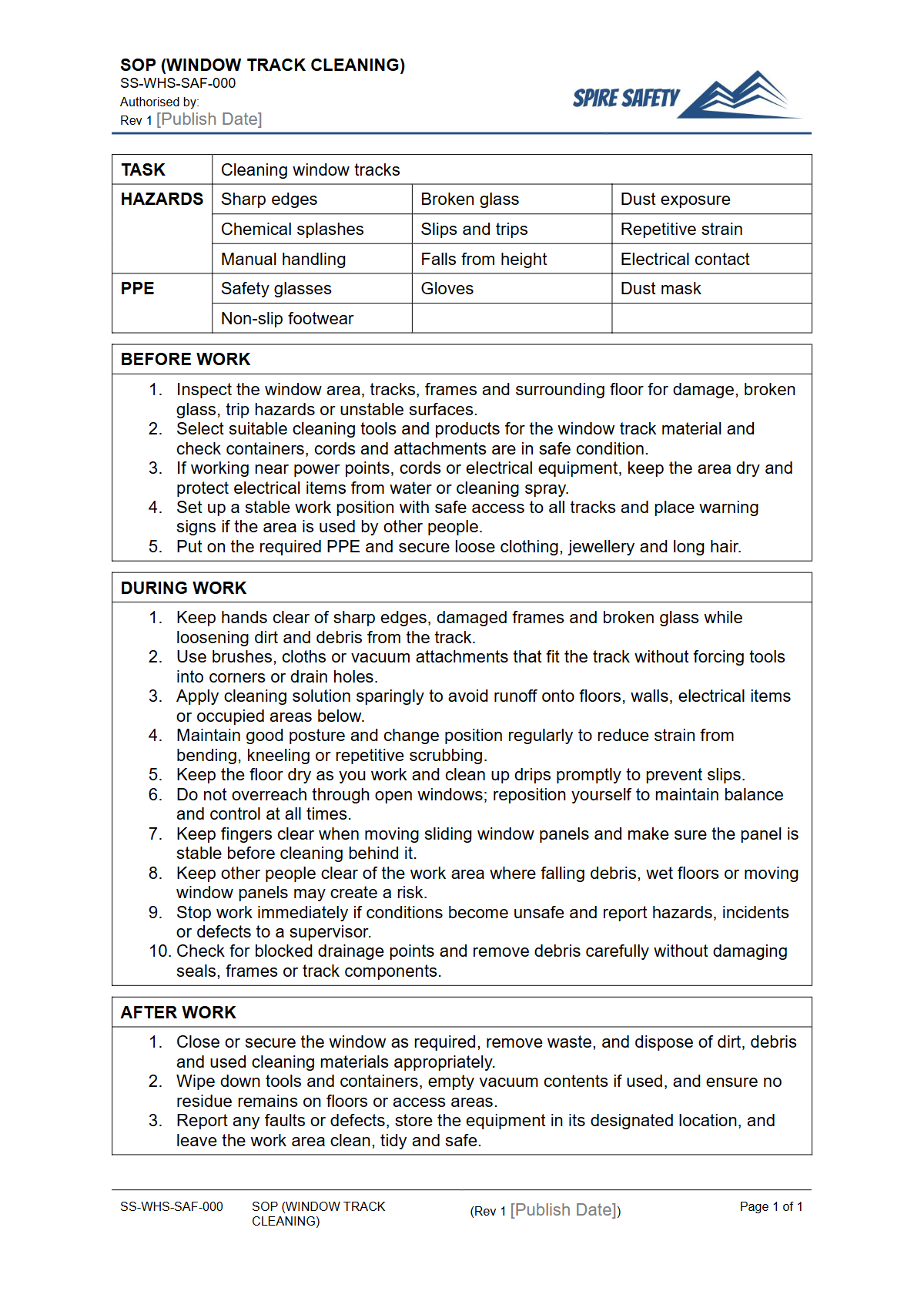
Purpose of the Free Safe Operating Procedure (Window Track Cleaning) Template
This Free Safe Operating Procedure (Window Track Cleaning) Template provides a structured framework for outlining the safest, most efficient method for cleaning window and sliding door tracks. Often overlooked, this task presents several hazards, including manual handling risks from awkward postures, slips from spilled water, and potential exposure to cleaning chemicals or accumulated biological matter like mould.
A documented Safe Operating Procedure (SOP) is a critical administrative control that helps standardise work practices, train new employees, and demonstrate due diligence in managing workplace risks.
Implementing task-specific SOPs is a fundamental part of building a robust safety framework. These documents serve as a key component within comprehensive WHS management systems, ensuring that all tasks, from routine cleaning to complex machinery operation, are performed with safety as the top priority.
By clearly defining the steps, required equipment, and necessary precautions, you reduce the likelihood of incidents and create a more predictable and secure work environment for everyone.
Video walkthrough
How to use the Free Safe Operating Procedure (Window Track Cleaning) Template
This template is provided in both DOCX and PDF formats for your convenience. The DOCX version is fully editable, allowing for extensive customisation.
It is crucial to adapt this document to the specific context of your workplace. You must review and modify the steps, risks, and controls to reflect your unique tools, cleaning agents, and work environment.
Effective safety procedures are not one-size-fits-all; they are living documents tailored to real-world conditions.
We strongly recommend a consultation process when customising this template. Involve the workers who will actually be performing the task.
Their direct experience is invaluable for identifying practical hazards and effective controls that might be missed in a purely theoretical assessment. This collaborative approach not only results in a more effective SOP but also improves worker buy-in and safety behaviour.
For businesses needing support with risk assessments and procedure development, engaging professional WHS consulting services can provide expert guidance.
When to use a Safe Operating Procedure
A Safe Operating Procedure for window track cleaning should be used whenever the task is performed as part of a work activity. This applies to a wide range of scenarios, including regular maintenance schedules in commercial buildings, specialised cleaning contracts, end-of-lease cleaning for property management, and post-construction clean-ups.
Using an SOP ensures consistency and safety regardless of who performs the task or how frequently it is done. It serves as a reliable reference point for workers and a training tool for new staff.
Standardising procedures is essential across all workplace activities, not just cleaning. For instance, using a Safe Operating Procedure (Deep Fryer - Standard Operation) template in a commercial kitchen serves the same function: it mitigates specific risks like burns and fires.
Documenting the correct process for every task, simple or complex, is a core principle of good work health and safety practice.
Who should use it
This SOP template is designed for use by any Person Conducting a Business or Undertaking (PCBU) whose workers or contractors perform window track cleaning. This includes commercial cleaning companies, facility management providers, property managers, maintenance departments, and construction companies.
It should be implemented by managers and supervisors to ensure their teams are equipped with clear, safe instructions. Workers themselves should use the finalised SOP as a guide for their day-to-day tasks to reinforce safe work habits and protocols.
Supervisors can also use the SOP as a basis for informal observations or more structured evaluations to confirm procedures are being followed correctly. The effectiveness of these procedures can be formally checked as part of a scheduled WHS compliance auditing program, helping to identify any gaps between the documented process and actual practice.
You can browse our entire free WHS resources library for more templates to support your organisation's safety management.
Common mistakes
Common mistakes to avoid
- Using the template without customising it for specific site conditions and chemicals.
- Failing to adequately train workers on the finalised SOP and confirm their understanding.
- Not providing the correct Personal Protective Equipment (PPE) specified in the procedure.
- Neglecting to review and update the SOP after an incident or when work practices change.
Legal references
Legal considerations
The following legal requirements may be relevant to this type of work.
- Work Health and Safety Act (Harmonised) — Provides the primary duties for protecting workers and other people from work health and safety risks.
- Work Health and Safety Regulations (Harmonised) — Sets out requirements supporting the management of workplace hazards and risks.
The following codes may be relevant to this type of work.
- Managing WHS Risks Code of Practice — Provides practical guidance on identifying hazards, assessing risks and applying effective controls.
- Work Health and Safety Consultation, Cooperation and Coordination Code of Practice — Provides practical guidance on consulting workers and coordinating with other duty holders.
- Managing the Work Environment and Facilities Code of Practice — Provides practical guidance on safe work environments, workplace facilities and related controls.
Did you know
Hidden Health Risks
Accumulated dust and mould in window tracks can become airborne during cleaning, posing a respiratory risk. A proper cleaning procedure using appropriate PPE protects not just the cleaner but also the building's occupants.
Ergonomic Impact
Repetitive, forceful movements while bending or kneeling to clean tracks are a significant cause of musculoskeletal disorders for professional cleaners. SOPs can help by specifying tools and techniques that promote better posture.
FAQ
Frequently asked questions
01What hazards are associated with cleaning window tracks?
02Does this SOP template cover working at heights?
03How often should a Safe Operating Procedure be reviewed?
04Can I use this template for both commercial and residential cleaning?
Share this resource
Free Safe Operating Procedure (Window Track Cleaning) Template
Browse Categories
How To Use It
- 1Download and open in Word or PDF.
- 2Replace the placeholders with your business details.
- 3Get it reviewed by a WHS specialist before rollout.
Need it customised?
Our WHS consultants can adapt this template to your site, run a gap analysis, or audit what you already have in place.
Book a Free Consultation WHS consulting servicesor call 1300 156 382
Related templates
- Free Safe Operating Procedure (Windscreen Removal) Template
- Free Safe Operating Procedure (Wine Bottle Handling) Template
- Free Safe Operating Procedure (Wine Cellar Stocking) Template
- Free Safe Operating Procedure (Wine Fridge Cleaning) Template
- Free Safe Operating Procedure (Wine Rack Handling) Template
- Free Safe Operating Procedure (Wire Bender) Template