
Free Safe Operating Procedure (Wine Fridge Cleaning) Template
Establish clear, safe steps for maintaining your commercial wine fridges. Download our free Safe Operating Procedure (Wine Fridge Cleaning) template to get started.
Free Safe Operating Procedure (Wine Fridge Cleaning) Template
DOCX • 126 KB + PDF
Updated Oct 2026
No signup required
Purpose of the Free Safe Operating Procedure (Wine Fridge Cleaning) Template
Maintaining hygiene and operational efficiency in hospitality settings requires clear, documented processes. This is especially true for specialised equipment like wine fridges.
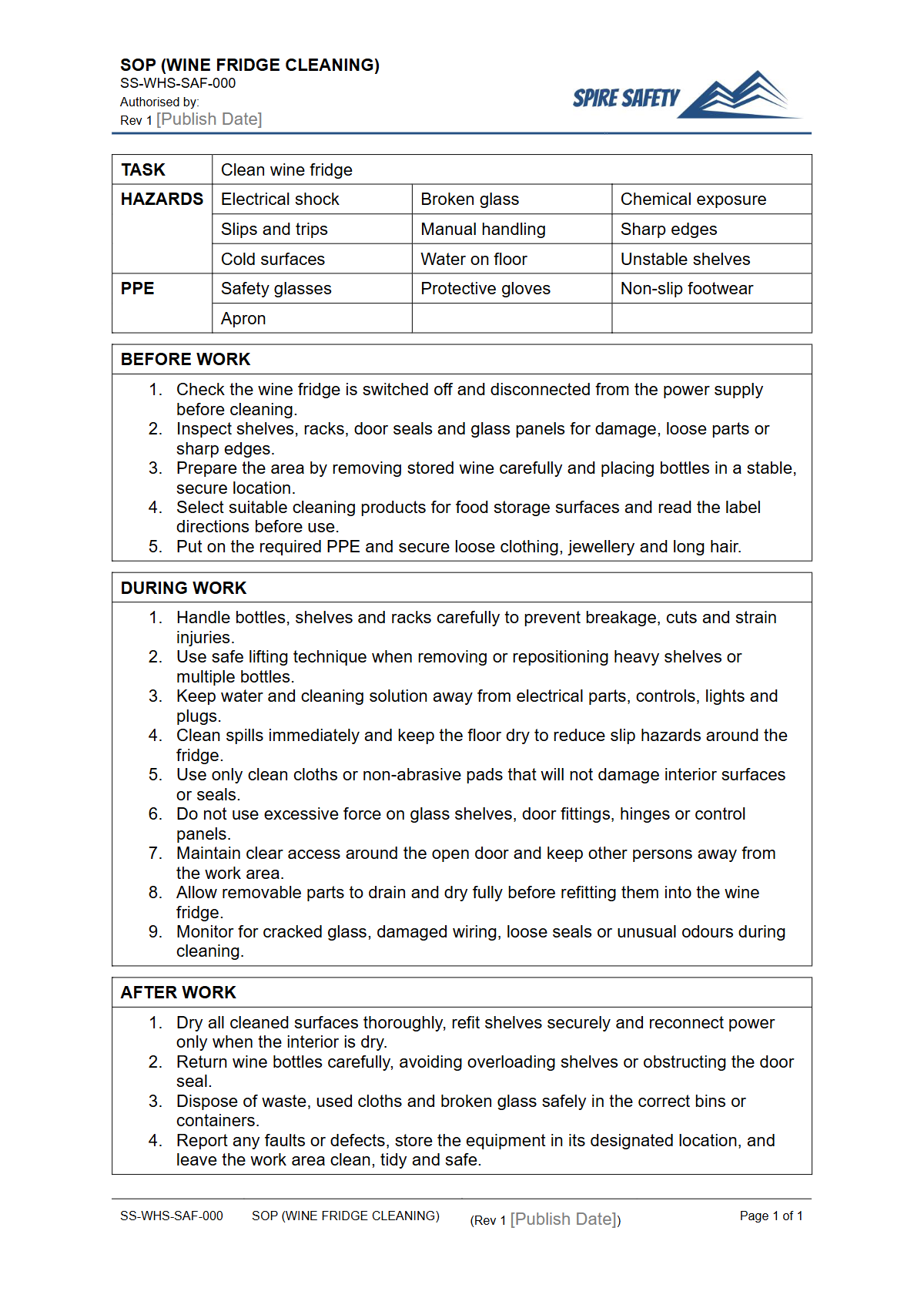
Our Free Safe Operating Procedure (Wine Fridge Cleaning) Template provides a structured framework for ensuring this task is performed safely and consistently. Using a formal SOP helps standardise the cleaning process across all staff, reducing ambiguity and the risk of errors.
It serves as a vital tool for controlling hazards associated with cleaning, including electrical risks, exposure to cleaning chemicals, and potential manual handling injuries.
A well-defined SOP is a cornerstone of effective workplace safety. It outlines the required personal protective equipment (PPE), pre-operational checks, step-by-step instructions for the task, and post-cleaning procedures.
This not only protects your workers but also ensures the longevity of expensive equipment and the quality of the product it stores. Documenting these steps is also essential for staff training and induction, providing a clear reference point for new and existing employees. For businesses in the food and beverage industry, similar structured processes are vital for other equipment, as shown in our Safe Operating Procedure for deep fryer use.
Video walkthrough
How to use the Free Safe Operating Procedure (Wine Fridge Cleaning) Template
This document is a template, not a finished procedure. To be effective, it must be adapted to the specific context of your workplace.
Download the DOCX file and customise it to reflect your unique environment, equipment, and chemicals. Start by conducting a risk assessment for the task of cleaning your wine fridges.
Identify all potential hazards, assess the level of risk, and determine the most effective control measures. Your customised SOP should reflect the outcomes of this risk assessment.
Your procedure must include specific details such as:
- The exact make and model of the wine fridges in use.
- The specific names of the approved cleaning chemicals and their safety data sheets (SDS).
- The type of PPE required (e.g., nitrile gloves, safety glasses).
- Site-specific emergency procedures, including locations of first aid kits, eyewash stations, and power isolation points.
- A clear process for reporting any faults or damage discovered during cleaning.
Important Note: This template is a starting point developed in alignment with Australian WHS principles. We have not assessed your specific workplace, equipment, or processes.
It is your responsibility to ensure the final, customised document is suitable for your business and manages all identified risks effectively. Integrating such procedures into your safety framework is a key part of developing robust comprehensive WHS management systems.
When to use it
A Safe Operating Procedure for wine fridge cleaning should be used consistently as part of your operational and maintenance schedules. It is not just for one-off deep cleans.
Use this SOP for routine weekly or monthly cleaning to maintain hygiene standards and prevent build-up of dirt and mould. It should also be referenced before any planned maintenance or servicing of the unit.
Furthermore, the SOP is a critical training document. It must be used during the induction of new hospitality or cleaning staff and for refresher training to ensure everyone follows the same safe and effective process.
This consistent application helps build a strong safety culture within your organisation.
You can find more examples of task-specific procedures for other common workplace equipment in our free WHS resources library.
Who should use it
This SOP template is designed for several key roles within a workplace. WHS Managers and Hospitality or Venue Managers should use it as the basis for developing a site-specific procedure.
They are responsible for ensuring the document is customised correctly and integrates with the overall safety management system. Supervisors and team leaders should use the finalised SOP to train their staff and to oversee the cleaning task, ensuring the documented steps are followed correctly.
Finally, the employees who perform the cleaning—such as bar staff, kitchen hands, or dedicated cleaners—are the primary end-users. For them, the SOP is a direct, step-by-step guide to performing their job safely and effectively.
Reviewing these procedures should also be a component of any part of a regular WHS compliance audit to verify their implementation and effectiveness.
Common mistakes
Common mistakes to avoid
- Forgetting to disconnect the fridge from the power source before starting.
- Using abrasive scourers or harsh chemicals that can scratch surfaces or damage seals.
- Neglecting to clean and dry the interior thoroughly, which can promote mould growth.
- Failing to document the cleaning task in a maintenance log after completion.
Legal references
Legal considerations
The following legal requirements may be relevant to this type of work.
- Work Health and Safety Act (Harmonised) — Provides the primary duties for protecting workers and other people from work health and safety risks.
- Work Health and Safety Regulations (Harmonised) — Sets out requirements supporting the management of workplace hazards and risks.
The following codes may be relevant to this type of work.
- Managing WHS Risks Code of Practice — Provides practical guidance on identifying hazards, assessing risks and applying effective controls.
- Work Health and Safety Consultation, Cooperation and Coordination Code of Practice — Provides practical guidance on consulting workers and coordinating with other duty holders.
- Managing the Work Environment and Facilities Code of Practice — Provides practical guidance on safe work environments, workplace facilities and related controls.
Did you know
Silent but Deadly
The condenser coils on a wine fridge are often located at the back or bottom. If they become clogged with dust, the fridge has to work harder, increasing energy consumption and the risk of component failure.
Chemical Compatibility
Using ammonia-based cleaners inside a wine fridge can impart odours that penetrate corks and spoil the wine. Your SOP should always specify non-toxic, odourless cleaners suitable for food and beverage environments.
FAQ
Frequently asked questions
01What hazards are involved in cleaning a commercial wine fridge?
02How often should a commercial wine fridge be cleaned using an SOP?
03Is this wine fridge cleaning SOP template enough for WHS compliance?
04What personal protective equipment (PPE) is needed for cleaning a wine fridge?
Share this resource
Free Safe Operating Procedure (Wine Fridge Cleaning) Template
Browse Categories
How To Use It
- 1Download and open in Word or PDF.
- 2Replace the placeholders with your business details.
- 3Get it reviewed by a WHS specialist before rollout.
Need it customised?
Our WHS consultants can adapt this template to your site, run a gap analysis, or audit what you already have in place.
Book a Free Consultation WHS consulting servicesor call 1300 156 382
Related templates
- Free Safe Operating Procedure (Wine Rack Handling) Template
- Free Safe Operating Procedure (Wire Bender) Template
- Free Safe Operating Procedure (Wire Drawing Machine) Template
- Free Safe Operating Procedure (Wire Rope Sling) Template
- Free Safe Operating Procedure (Wire Straightener) Template
- Free Safe Operating Procedure (Wood Chipper Operation) Template