
Free Safe Operating Procedure (Wine Rack Handling) Template
Formalise your processes for handling, moving, and storing wine racks with our structured template. Download your free Safe Operating Procedure to start now.
Free Safe Operating Procedure (Wine Rack Handling) Template
DOCX • 126 KB + PDF
Updated Oct 2026
No signup required
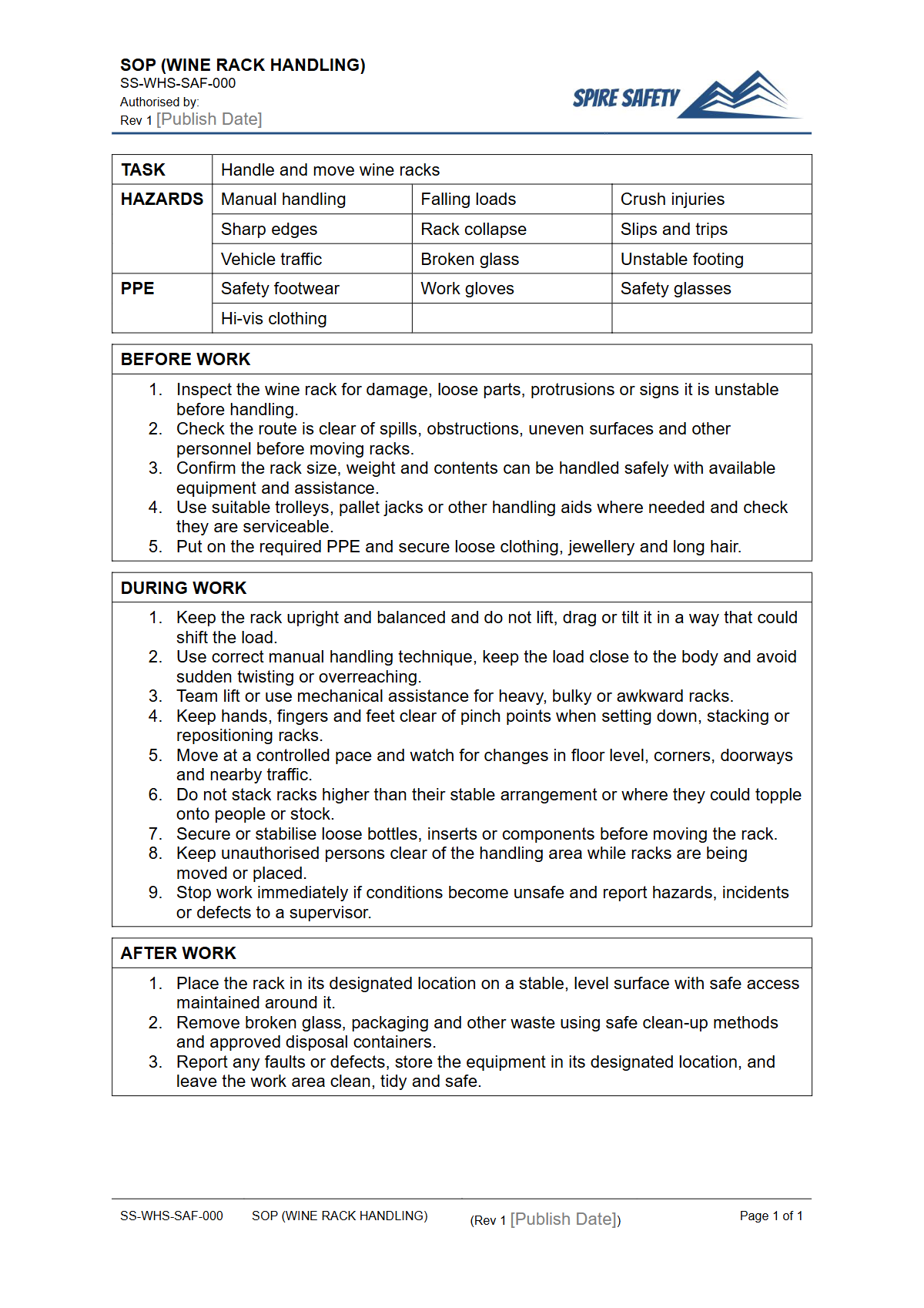
Purpose of the Free Safe Operating Procedure (Wine Rack Handling) Template
The primary purpose of this Safe Operating Procedure is to control hazards associated with moving, loading, and storing wine racks. It establishes a clear, step-by-step guide to minimise risks such as musculoskeletal injuries from lifting, crush injuries from unstable racks, and slips or trips.
By implementing a standardised process, you can ensure all workers perform the task to the same safety standard, reducing incidents and promoting a proactive safety culture. This document serves as a critical component within broader WHS management systems, providing tangible evidence of your commitment to safe work practices.
Video walkthrough
How to use the Free Safe Operating Procedure (Wine Rack Handling) Template
To get started, download the template in your preferred format (DOCX or PDF). The DOCX version is fully editable, allowing for extensive customisation to your specific work environment.
- Review and Customise: Go through each section and adapt the content to reflect your specific workplace. Consider the types of wine racks you use (modular, fixed, wall-mounted), the layout of your storage areas, and the specific tasks your workers perform.
- Consult Your Team: Involve the workers who actually handle the wine racks. Their direct experience is invaluable for identifying practical risks and effective controls.
- Finalise and Train: Once finalised, use the SOP as a training tool for new and existing employees. Ensure everyone understands the required procedures before undertaking the task.
Important: This is a template only. You must customise it to suit the unique requirements and risks of your organisation.
We are not liable for any incidents that may arise from the use of this document. It is not a substitute for professional WHS advice tailored to your business needs. For other procedures in a hospitality environment, you might also find value in a Safe Operating Procedure for a Deep Fryer.
When to use this Safe Operating Procedure
This SOP should be used as the primary reference document for all tasks involving wine racks. It is particularly relevant during:
- The initial setup and assembly of new wine racks.
- Loading and unloading cases of wine onto racks.
- Relocating or moving loaded or unloaded racks.
- Routine stocking and retrieval of individual bottles.
- Training and induction for new staff members.
- Refresher training sessions for existing employees.
Regularly reviewing its application during safety observations or WHS compliance auditing helps ensure the procedures are being followed correctly and remain effective.
Who should use it
This procedure is designed for any person whose work involves interacting with wine racks. This includes, but is not limited to:
- Cellar hands and winery workers.
- Warehouse and distribution centre staff.
- Hospitality staff in restaurants, bars, and hotels.
- Retail employees in bottle shops and liquor stores.
- Supervisors and managers responsible for overseeing these areas.
In larger operations where bulk stock is moved on pallets, the task may also involve powered mobile plant. For such scenarios, you may need to cross-reference this procedure with equipment-specific documents, like a Telehandler SOP template.
Key Hazard Controls for Wine Rack Handling
Your customised SOP should focus on implementing effective controls for identified hazards. Key controls to consider include using mechanical aids like trolleys or pallet jacks to minimise manual lifting.
For larger bottling or distribution facilities, integrating a Conveyer System SOP can streamline movement and reduce handling risks. It is also crucial to ensure racks are not overloaded, are placed on level, stable ground, and are assembled according to manufacturer specifications.
Promoting team lifts for heavy or awkward items is another fundamental control measure.
Training and Supervision
Simply having a written procedure is not enough; workers must be thoroughly trained in its contents. Training should be practical and cover topics like correct lifting techniques, how to assess rack stability, and emergency procedures if a rack becomes unstable.
Competency should be verified before a worker is permitted to perform the task unsupervised. If you need assistance developing a comprehensive safety strategy, our WHS consulting services can provide expert guidance.
You can also explore our full free WHS resources library for other templates and guides.
Common mistakes
Common mistakes to avoid
- Failing to assess the stability and levelness of the floor surface before placing a loaded rack.
- Overloading racks beyond their specified weight capacity or design.
- Using incorrect manual handling techniques, such as twisting the back while lifting cases of wine.
- Neglecting to train staff on the specific procedures for the types of racks used in the workplace.
Legal references
Legal considerations
The following legal requirements may be relevant to this type of work.
- Work Health and Safety Act (Harmonised) — Provides the primary duties for protecting workers and other people from work health and safety risks.
- Work Health and Safety Regulations (Harmonised) — Sets out requirements supporting the management of workplace hazards and risks.
The following codes may be relevant to this type of work.
- Managing WHS Risks Code of Practice — Provides practical guidance on identifying hazards, assessing risks and applying effective controls.
- Work Health and Safety Consultation, Cooperation and Coordination Code of Practice — Provides practical guidance on consulting workers and coordinating with other duty holders.
- Managing the Work Environment and Facilities Code of Practice — Provides practical guidance on safe work environments, workplace facilities and related controls.
Did you know
Manual Handling Risk
Musculoskeletal disorders from hazardous manual tasks are a leading cause of serious workers' compensation claims in Australia. Properly stacked and handled wine racks significantly reduce this risk.
Stability is Key
A standard 750ml bottle of wine weighs about 1.3 kg. A fully stocked commercial wine rack can weigh several hundred kilograms, making stability and correct assembly critical to preventing collapse.
FAQ
Frequently asked questions
01What hazards are associated with handling wine racks?
02Is a Safe Operating Procedure a legal requirement in Australia for wine rack handling?
03How often should an SOP for wine racks be reviewed?
04Can this template be used for commercial wine cellars and retail stores?
Share this resource
Free Safe Operating Procedure (Wine Rack Handling) Template
Browse Categories
How To Use It
- 1Download and open in Word or PDF.
- 2Replace the placeholders with your business details.
- 3Get it reviewed by a WHS specialist before rollout.
Need it customised?
Our WHS consultants can adapt this template to your site, run a gap analysis, or audit what you already have in place.
Book a Free Consultation WHS consulting servicesor call 1300 156 382
Related templates
- Free Safe Operating Procedure (Wire Bender) Template
- Free Safe Operating Procedure (Wire Drawing Machine) Template
- Free Safe Operating Procedure (Wire Rope Sling) Template
- Free Safe Operating Procedure (Wire Straightener) Template
- Free Safe Operating Procedure (Wood Chipper Operation) Template
- Free Safe Operating Procedure (Wood Floor Cleaning) Template