
Free Safe Operating Procedure (Wire Rope Sling) Template
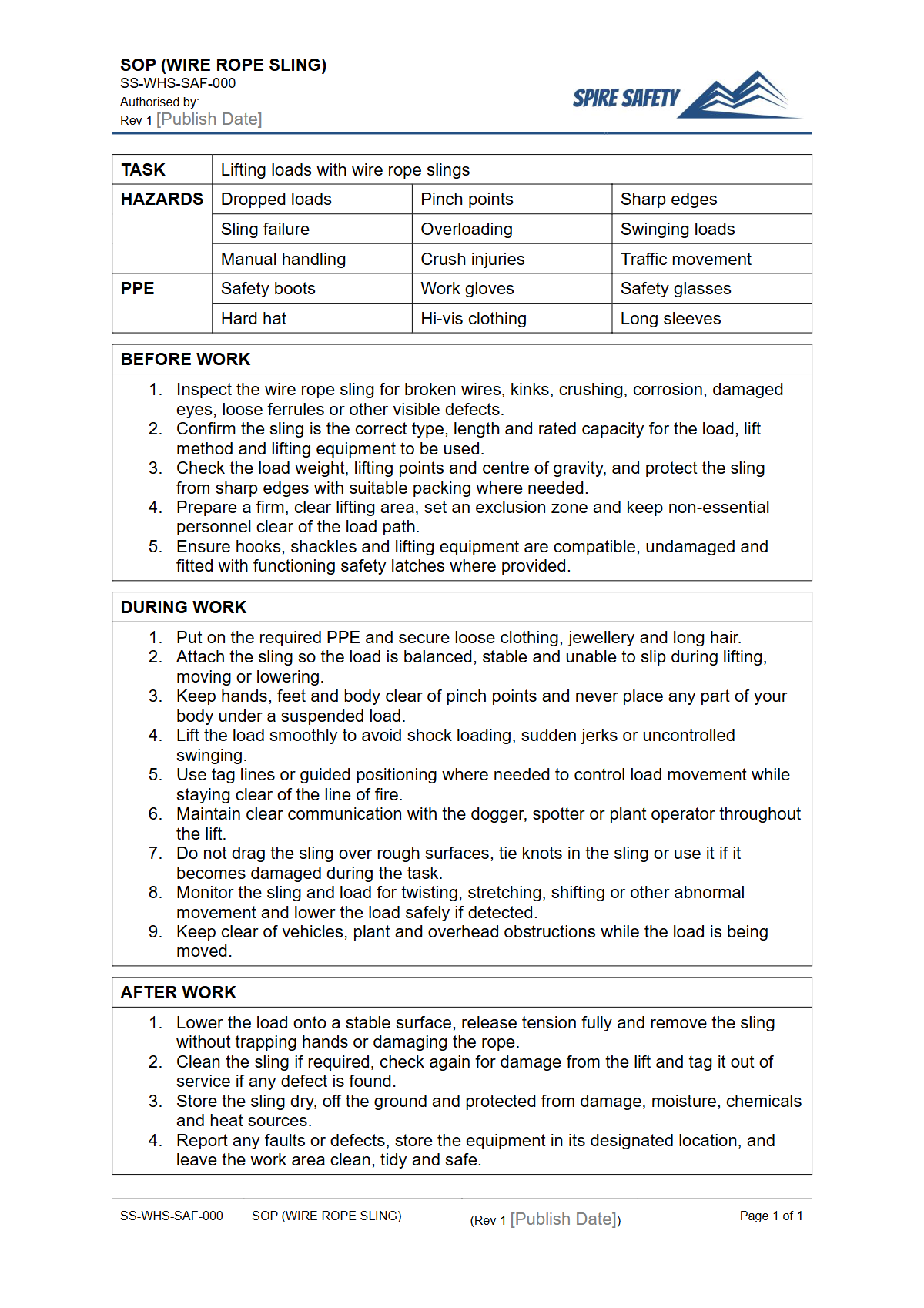
Ensure safe lifting operations with our professional template. Download this free Safe Operating Procedure for wire rope slings to standardise your processes.
Free Safe Operating Procedure (Wire Rope Sling) Template
DOCX • 126 KB + PDF
Updated Oct 2026
No signup required
Purpose of the Free Safe Operating Procedure (Wire Rope Sling) Template
This Safe Operating Procedure (SOP) template for wire rope slings provides a structured framework for documenting the safe use, handling, inspection, and storage of this critical lifting equipment. Its primary purpose is to minimise the risk of incidents such as dropped loads, equipment damage, and serious injury to personnel.
By establishing a clear, step-by-step process, organisations can ensure that all lifting operations involving wire rope slings are conducted consistently and safely, regardless of the operator or supervisor on duty. A well-defined SOP is a critical tool for worker training, competency assessment, and demonstrating due diligence in managing workplace hazards.
Implementing documented procedures like this is a cornerstone of effective safety management. This template helps formalise your operational standards, ensuring they align with Australian WHS principles.
Integrating such documents is a key step in developing robust WHS management systems that protect your workers and your business. It serves as a practical resource for supervisors to enforce correct procedures and for workers to have a reliable reference on hand.
Video walkthrough
How to use the Free Safe Operating Procedure (Wire Rope Sling) Template
To get started, download the template in your preferred format (DOCX for easy editing or PDF for straightforward printing). The document is structured with sections covering pre-operational checks, operational steps, post-operational tasks, and emergency procedures.
You should systematically review each section and modify the content to align with the specific types of wire rope slings, lifting equipment, and loads found in your workplace. This includes adding details like the specific inspection criteria for your slings, the environmental conditions they are used in (e.g., exposure to chemicals or extreme temperatures), and company-specific reporting protocols.
It is crucial to note: we provide this document as a starting point. You must customise it to reflect the specific hazards, risks, and control measures relevant to your workplace.
This SOP should be used in conjunction with procedures for associated machinery; for example, if the slings are used with a telehandler, you should ensure it cross-references your free Telehandler SOP template. Once customised, the SOP should be formally approved, communicated to all relevant personnel, and made easily accessible at the point of work.
When to use a Wire Rope Sling Safe Operating Procedure
A Safe Operating Procedure for wire rope slings should be a living document integrated into your daily operations. It is not a set-and-forget tool.
Its primary use is as a direct reference before and during any lifting task involving slings to ensure every step is followed correctly. It forms an essential part of worker induction and ongoing training programs, providing a basis for demonstrating correct and safe work methods.
Supervisors should use it for conducting toolbox talks on lifting safety, reinforcing key messages about inspection and load limits.
Furthermore, the SOP is an invaluable document during safety reviews and audits. It provides clear evidence of your organisation's prescribed methods for safe work.
In the unfortunate event of a lifting incident or near miss, the SOP serves as a benchmark against which actual work practices can be assessed during an investigation. Regular reviews, prompted by WHS compliance auditing or changes in equipment or processes, ensure the document remains current and effective.
Who should use this Safe Operating Procedure
This SOP is intended for a broad range of personnel involved in lifting operations. The primary users are the operators themselves—the riggers, doggers, and crane operators who physically handle and use the slings.
For them, it is a practical guide to performing their job safely. Site supervisors and team leaders must also be thoroughly familiar with the SOP to effectively oversee work, correct unsafe behaviour, and ensure procedures are being followed on the ground.
WHS managers and safety officers will use this template as a foundational document within the broader safety system. They are typically responsible for its development, review, and implementation, ensuring it aligns with legal requirements and industry best practice.
Documenting procedures for all high-risk plant is essential for consistency; this SOP can work alongside other key documents like a Conveyer System SOP to build a comprehensive library of procedures. Maintenance personnel who inspect and certify lifting gear should also use the SOP to understand operational context and reinforce inspection criteria.
A systematic approach to safety documentation ensures that no piece of equipment is overlooked. Whether your team is using lifting gear or other machinery, having clear instructions is paramount. For example, the principles of pre-use checks and safe operation outlined here are just as relevant when documenting procedures for other equipment, as seen in our free Trencher SOP.
This wire rope sling SOP template is just one of many resources designed to help your business manage risk effectively. We encourage you to explore our complete free WHS resources library for more templates, checklists, and guides to support your safety management efforts.
Common mistakes
Common mistakes to avoid
- Using slings with unknown or exceeded Safe Working Loads (SWLs).
- Failing to protect slings from sharp corners on the load, causing cuts or abrasion.
- Incorrectly storing slings, such as leaving them on the ground or in damp conditions.
- Continuing to use slings with visible damage like broken wires, kinks, corrosion, or crushing.
Legal references
Legal considerations
The following legal requirements may be relevant to this type of work.
- Work Health and Safety Act (Harmonised) — Provides the primary duties for protecting workers and other people from work health and safety risks.
- Work Health and Safety Regulations (Harmonised) — Sets out requirements supporting the management of workplace hazards and risks.
The following codes may be relevant to this type of work.
- Managing WHS Risks Code of Practice — Provides practical guidance on identifying hazards, assessing risks and applying effective controls.
- Work Health and Safety Consultation, Cooperation and Coordination Code of Practice — Provides practical guidance on consulting workers and coordinating with other duty holders.
- Managing the Work Environment and Facilities Code of Practice — Provides practical guidance on safe work environments, workplace facilities and related controls.
Did you know
Angle Matters
The angle of a sling significantly impacts its lifting capacity. A sling used at a 60-degree angle has only 86% of its vertical capacity, and at 30 degrees, this drops to just 50%.
Hidden Damage
A single broken wire in an outer strand can indicate more severe internal damage. This is why thorough inspection is critical, as the rope's core provides a significant portion of its strength.
FAQ
Frequently asked questions
01What should be included in a Wire Rope Sling SOP?
02Is a Safe Operating Procedure a legal requirement in Australia?
03How often should wire rope slings be inspected?
04What is the difference between a SWMS and an SOP?
Share this resource
Free Safe Operating Procedure (Wire Rope Sling) Template
Browse Categories
How To Use It
- 1Download and open in Word or PDF.
- 2Replace the placeholders with your business details.
- 3Get it reviewed by a WHS specialist before rollout.
Need it customised?
Our WHS consultants can adapt this template to your site, run a gap analysis, or audit what you already have in place.
Book a Free Consultation WHS consulting servicesor call 1300 156 382
Related templates
- Free Safe Operating Procedure (Wire Straightener) Template
- Free Safe Operating Procedure (Wood Chipper Operation) Template
- Free Safe Operating Procedure (Wood Floor Cleaning) Template
- Free Safe Operating Procedure (Wood Jointer) Template
- Free Safe Operating Procedure (Wood Lathe) Template
- Free Safe Operating Procedure (Woodchip Path Care) Template