
Free Safe Operating Procedure (Wood Chipper Operation) Template
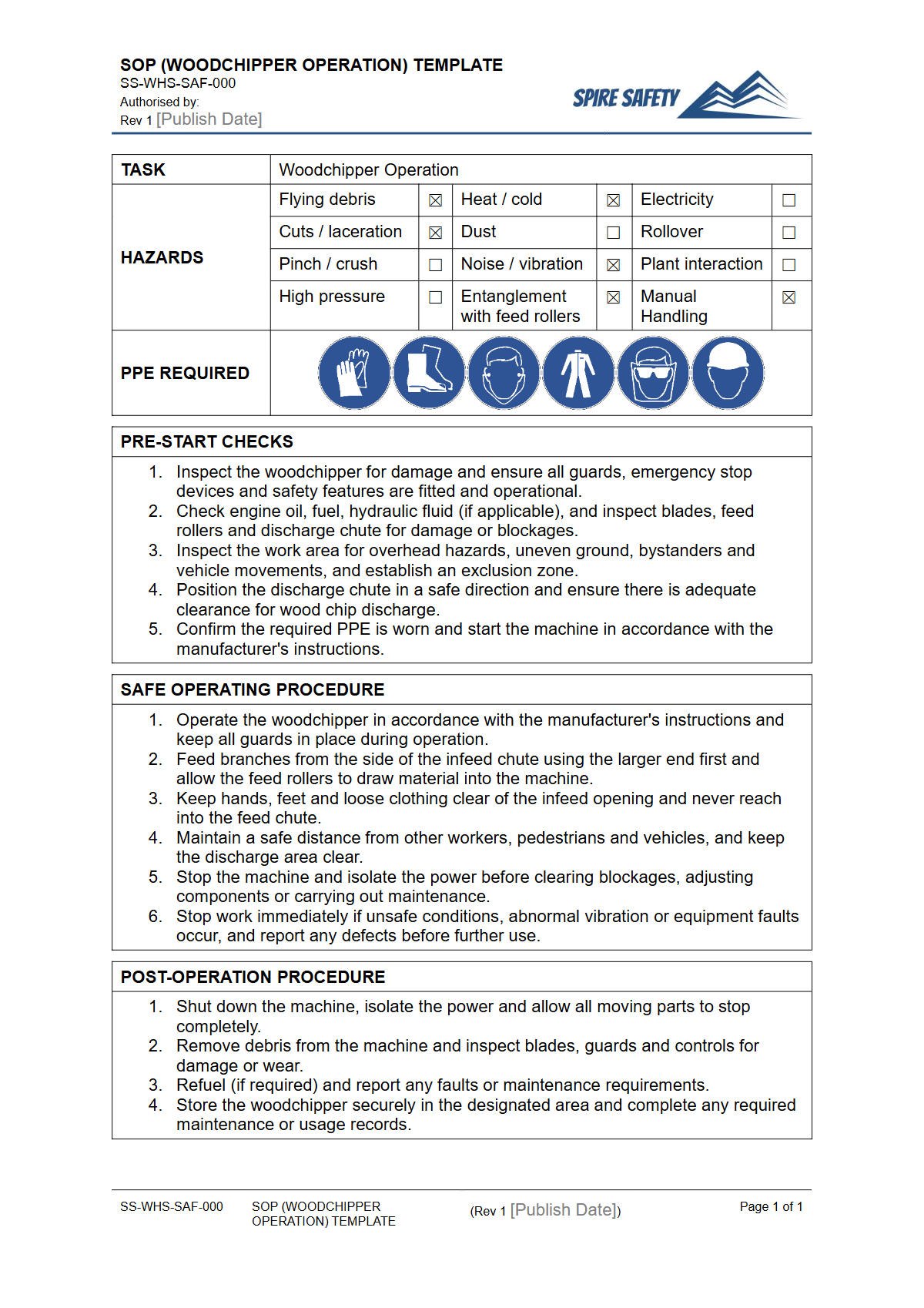
Formalise your safety process for wood chipper use. Our template offers a structured starting point for your Safe Operating Procedure.
Free Safe Operating Procedure (Wood Chipper Operation) Template
DOCX • 175 KB + PDF
Updated Oct 2026
No signup required
Purpose of the Free Safe Operating Procedure (Wood Chipper Operation) Template
Operating a wood chipper presents significant risks, including entanglement, amputation, and being struck by projectiles. This high-risk plant requires a formalised, documented process to ensure worker safety.
Our Free Safe Operating Procedure (Wood Chipper Operation) Template provides a structured starting point for your business to establish and communicate safe work methods. Its primary purpose is to help you fulfil your duty of care by outlining a step-by-step guide for operators, minimising the risk of incidents and injuries.
A well-developed SOP is a critical control measure for managing hazards associated with wood chippers. These hazards include mechanical risks from the feed mechanism and cutting blades, noise exposure, manual handling strains, and airborne dust or debris.
This template assists in documenting the specific controls for your workplace, such as pre-operational checks, correct feeding techniques, and emergency procedures. Formalising these steps is a key element in developing robust WHS management systems that protect your workers and demonstrate due diligence.
Video walkthrough
How to use the Free Safe Operating Procedure (Wood Chipper Operation) Template
This document is designed to be adapted to your unique operational context. Once you download the DOCX file, you should methodically work through each section to align it with your specific equipment and environment.
The process should involve consultation with the workers who actually operate the machinery, as their direct experience is invaluable for creating a practical and effective procedure.
IMPORTANT NOTE: This is a template only. We have developed it to serve as a strong starting point, but you MUST customise it to reflect the specific wood chipper models, work environment, personnel, and risks unique to your organisation.
Always reference the manufacturer's operating manual for machine-specific information and ensure your SOP is based on a thorough, site-specific risk assessment.
Key steps for implementation include:
- Customise: Fill in the details for your specific machine, including make, model, and location. Detail the required Personal Protective Equipment (PPE), pre-start checks, shutdown sequence, and emergency stop locations.
- Consult: Discuss the draft procedure with operators and supervisors to ensure it is clear, accurate, and practical for day-to-day use.
- Train: Use the finalised SOP as a central document for training new operators and for refresher training with experienced staff. Competency should be verified against the steps outlined in the procedure.
- Review: Schedule regular reviews of the SOP to ensure it remains current and effective.
The principles outlined in this template can be applied to other types of high-risk equipment used in similar industries. For instance, if your operations also involve earthmoving or agricultural tasks, our Free Tractor SOP Template provides a similar framework for different machinery.
When to use a Safe Operating Procedure
A Safe Operating Procedure for wood chipper use should be a living document, integrated into your daily operations. It is not a file-and-forget exercise.
It should be actively used during worker inductions and for specific competency training before an employee is authorised to use the equipment. It serves as a practical on-the-job reference and a consistent benchmark for safe behaviour.
The SOP should also be a focal point for regular toolbox talks to reinforce key safety messages, such as maintaining exclusion zones and correct feeding techniques. Furthermore, it is an essential document for review following any incident or near miss involving the wood chipper.
This allows your team to identify procedural gaps and make necessary improvements to prevent recurrence. This review process can be part of a broader program of WHS compliance auditing to ensure your safety systems remain effective.
Who should use this document
This template is designed for use by Persons Conducting a Business or Undertaking (PCBUs), WHS managers, and supervisors responsible for workplace safety. It provides them with a tool to systematically document and implement controls for high-risk plant.
By completing and implementing this SOP, they can take a significant step towards meeting their legal obligations to provide a safe system of work.
Supervisors and team leaders in sectors like arboriculture, landscaping, and local government will find it invaluable for managing their teams safely. They can use it to standardise training and ensure every operator follows the same approved, safe process.
For workers, the SOP is a clear guide to performing their tasks safely, empowering them with the knowledge to protect themselves and their colleagues. It can be used alongside procedures for other common equipment, such as our Front End Loader SOP template when conducting broad land-clearing tasks.
This document can be complemented by SOPs for related activities, like using our free Circular Saw SOP template to prepare timber before chipping. For a wider range of safety documentation, explore our library of free WHS resources to build a comprehensive safety management toolkit for your organisation.
Common mistakes
Common mistakes to avoid
- Using a generic SOP without customising it for the specific machine and site.
- Failing to train workers on the procedure or verify their competency.
- Neglecting pre-start checks, such as verifying safety guards and emergency stops are functional.
- Wearing loose clothing, gloves, or jewellery that can become an entanglement hazard.
Legal references
Legal considerations
The following legal requirements may be relevant to this type of work.
- Work Health and Safety Act (Harmonised) — Provides the primary duties for protecting workers and other people from work health and safety risks.
- Work Health and Safety Regulations (Harmonised) — Sets out requirements supporting the management of workplace hazards and risks.
The following codes may be relevant to this type of work.
- Managing WHS Risks Code of Practice — Provides practical guidance on identifying hazards, assessing risks and applying effective controls.
- Work Health and Safety Consultation, Cooperation and Coordination Code of Practice — Provides practical guidance on consulting workers and coordinating with other duty holders.
- Managing the Work Environment and Facilities Code of Practice — Provides practical guidance on safe work environments, workplace facilities and related controls.
Did you know
In-feed and Ejection Zones
The highest-risk areas of a wood chipper are the in-feed chute and the ejection chute. Most serious injuries occur from entanglement in the feed mechanism or being struck by ejected material.
Noise Hazard
Wood chippers can operate at noise levels well above 85 decibels (dB), the exposure standard for noise. Hearing protection is non-negotiable for operators and anyone in the immediate vicinity.
FAQ
Frequently asked questions
01What should be included in a wood chipper safe operating procedure?
02Is a Safe Operating Procedure a legal requirement for wood chippers in Australia?
03How often should a wood chipper SOP be reviewed?
04Can this template be used for any brand of wood chipper?
Share this resource
Free Safe Operating Procedure (Wood Chipper Operation) Template
Browse Categories
How To Use It
- 1Download and open in Word or PDF.
- 2Replace the placeholders with your business details.
- 3Get it reviewed by a WHS specialist before rollout.
Need it customised?
Our WHS consultants can adapt this template to your site, run a gap analysis, or audit what you already have in place.
Book a Free Consultation WHS consulting servicesor call 1300 156 382
Related templates
- Free Safe Operating Procedure (Wood Floor Cleaning) Template
- Free Safe Operating Procedure (Wood Jointer) Template
- Free Safe Operating Procedure (Wood Lathe) Template
- Free Safe Operating Procedure (Woodchip Path Care) Template
- Free Safe Operating Procedure (Wool Bale Handling) Template
- Free Safe Operating Procedure (Wool Press) Template