
Free Safe Operating Procedure (Wool Press) Template
Download our free Safe Operating Procedure (Wool Press) template to formalise safe work methods. This customisable document helps manage WHS risks.
Free Safe Operating Procedure (Wool Press) Template
DOCX • 126 KB + PDF
Updated Oct 2026
No signup required
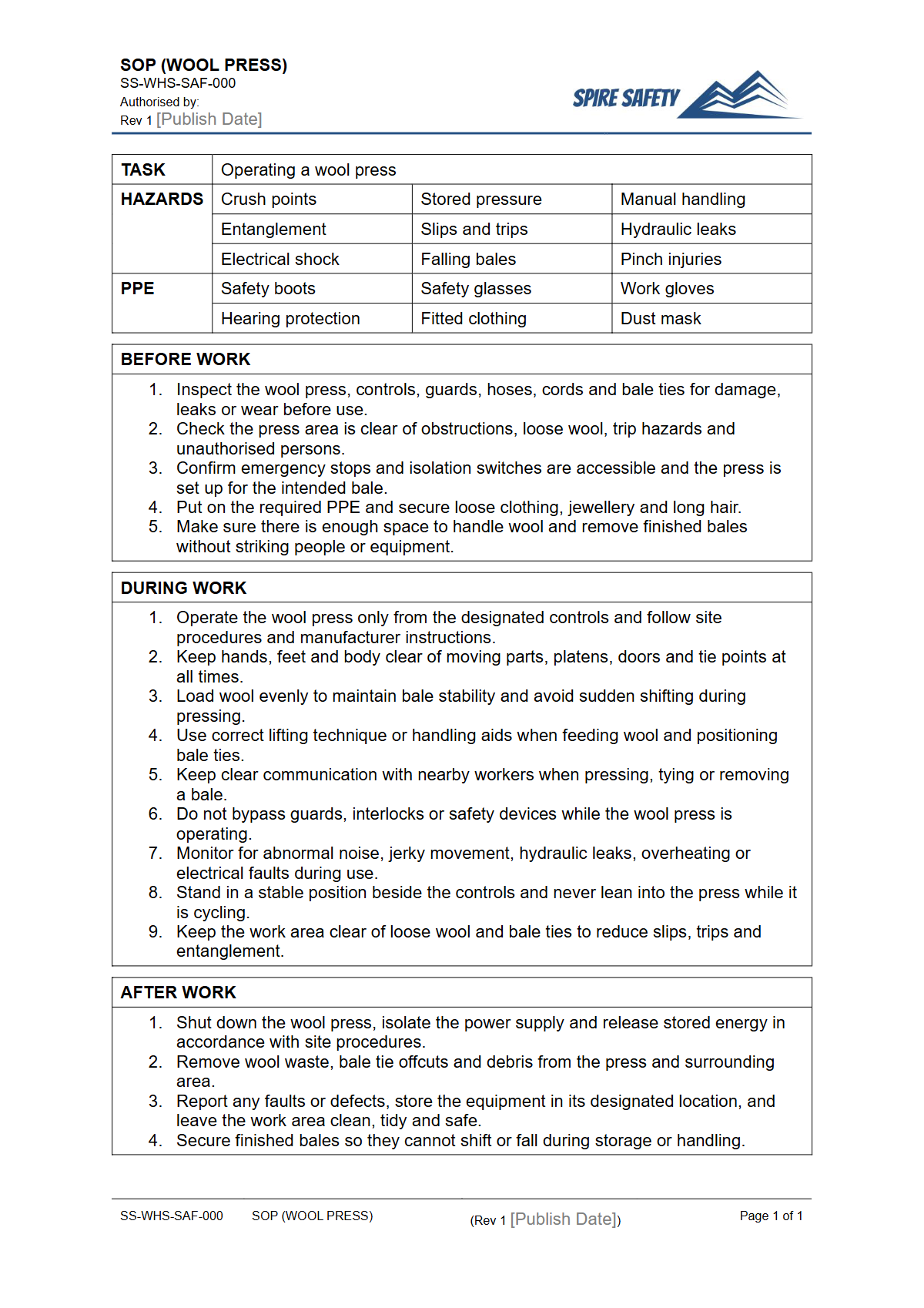
Purpose of the Free Safe Operating Procedure (Wool Press) Template
Operating a wool press involves significant risks, including crushing, entanglement, and manual handling injuries. This free Safe Operating Procedure (Wool Press) template provides a structured framework for documenting the safest way to perform this task.
By clearly outlining step-by-step instructions, hazard controls, and emergency procedures, a well-defined SOP helps Persons Conducting a Business or Undertaking (PCBUs) meet their primary duty of care. It serves as a vital tool for worker induction, training, and ongoing competency management, ensuring all operators understand the approved, safe methods for using the machinery.
Formalising procedures for high-risk agricultural machinery is a fundamental aspect of workplace safety. Just as you would for other common farm equipment, having a documented process is essential.
You can find similar structured guidance in our FREE Telehandler SOP Template to manage risks across your operations.
Video walkthrough
How to use the Free Safe Operating Procedure (Wool Press) Template
This template is provided in both DOCX and PDF formats for your convenience. The DOCX file is fully editable, allowing you to tailor the content to the specific make and model of the wool press used at your workplace.
It is designed as a starting point, aligned with Australian WHS principles, but it requires site-specific information to be effective and relevant.
Note: You must customise this template. We have provided a comprehensive foundation, but it is your responsibility to ensure the final document reflects the unique hazards, environment, and control measures of your workplace. Consult the manufacturer's instructions, conduct a site-specific risk assessment, and involve operators in the drafting process.
A competent person should review and approve the finalised SOP before it is implemented.
A robust SOP is a cornerstone of a functional safety framework. Integrating documents like this into a comprehensive system ensures consistency and demonstrates due diligence. For guidance on building a broader framework, explore our services for developing WHS management systems.
When to use a Safe Operating Procedure
A Safe Operating Procedure for a wool press should be used consistently as a core operational document. It is essential during the induction and training of new or inexperienced workers, including seasonal or casual staff, to ensure they learn the correct procedure from the start.
It should also be readily available at the point of use as a quick reference guide for all operators. Furthermore, the SOP serves as a benchmark during competency assessments and should be reviewed and updated regularly, especially after an incident, when new equipment is introduced, or when work processes change.
Establishing clear procedures for all specialised rural equipment helps standardise safety practices on your property. This approach can be extended to other activities by using resources like our free Grain Drill SOP template to ensure consistency.
Who should use this document
This SOP is intended for a range of personnel within an agricultural or shearing business. Farm owners, station managers, and shed overseers should use it to establish and enforce safe work standards.
WHS advisors or officers can use it as part of the site's overall safety management system. Critically, the operators of the wool press—including shearers, rouseabouts, and wool classers—are the primary end-users who must follow the procedure to ensure their own safety and the safety of those around them.
Developing and implementing these documents requires expertise. If your organisation lacks the internal resources to confidently adapt and roll out safety procedures, our WHS consulting services can provide expert support.
You can also explore our complete free WHS resources library for more templates and guides to support your safety management efforts.
Common mistakes
Common mistakes to avoid
- Using a generic SOP without customising it for the specific press model and site conditions.
- Failing to isolate and de-energise the wool press before performing cleaning, maintenance, or clearing a jam.
- Allowing untrained or inexperienced workers to operate the press without direct supervision.
- Overriding or disabling safety features like guards, interlock switches, or two-handed controls to speed up the process.
Legal references
Legal considerations
The following legal requirements may be relevant to this type of work.
- Work Health and Safety Act (Harmonised) — Provides the primary duties for protecting workers and other people from work health and safety risks.
- Work Health and Safety Regulations (Harmonised) — Sets out requirements supporting the management of workplace hazards and risks.
The following codes may be relevant to this type of work.
- Managing WHS Risks Code of Practice — Provides practical guidance on identifying hazards, assessing risks and applying effective controls.
- Work Health and Safety Consultation, Cooperation and Coordination Code of Practice — Provides practical guidance on consulting workers and coordinating with other duty holders.
- Managing the Work Environment and Facilities Code of Practice — Provides practical guidance on safe work environments, workplace facilities and related controls.
Did you know
Bale Weight
A standard wool bale can weigh between 110 and 204 kilograms. The immense force required by a press to compact wool to this density is why safety guards and interlocks are critical.
Agricultural Injury Statistics
The agriculture, forestry, and fishing industry consistently ranks among the most dangerous for workers in Australia, with machinery-related incidents being a leading cause of serious injuries and fatalities.
FAQ
Frequently asked questions
01What are the main hazards of operating a wool press?
02Is a Safe Operating Procedure legally required for a wool press in Australia?
03How often should a wool press SOP be reviewed?
04What training should an operator have before using a wool press?
Share this resource
Free Safe Operating Procedure (Wool Press) Template
Browse Categories
How To Use It
- 1Download and open in Word or PDF.
- 2Replace the placeholders with your business details.
- 3Get it reviewed by a WHS specialist before rollout.
Need it customised?
Our WHS consultants can adapt this template to your site, run a gap analysis, or audit what you already have in place.
Book a Free Consultation WHS consulting servicesor call 1300 156 382
Related templates
- Free Safe Operating Procedure (Work Bench) Template
- Free Safe Operating Procedure (Workboat Operation) Template
- Free Safe Operating Procedure (Workshop Press) Template
- Free Safe Operating Procedure (X-Ray Baggage Scanner) Template
- Free Safe Operating Procedure (X-Ray Inspection Unit) Template
- Free Safe Operating Procedure (Yard Pedestrian Control) Template