
Free Safe Operating Procedure (Workshop Press) Template
Effectively manage workshop press hazards with our free Safe Operating Procedure template. Download the customisable DOCX to formalise safe work practices.
Free Safe Operating Procedure (Workshop Press) Template
DOCX • 126 KB + PDF
Updated Oct 2026
No signup required
Purpose of the Free Safe Operating Procedure (Workshop Press) Template
A workshop press is a powerful and essential piece of equipment found in many mechanical, manufacturing, and maintenance environments. However, the high forces it generates introduce significant risks, including severe crushing, pinching, and impact injuries.
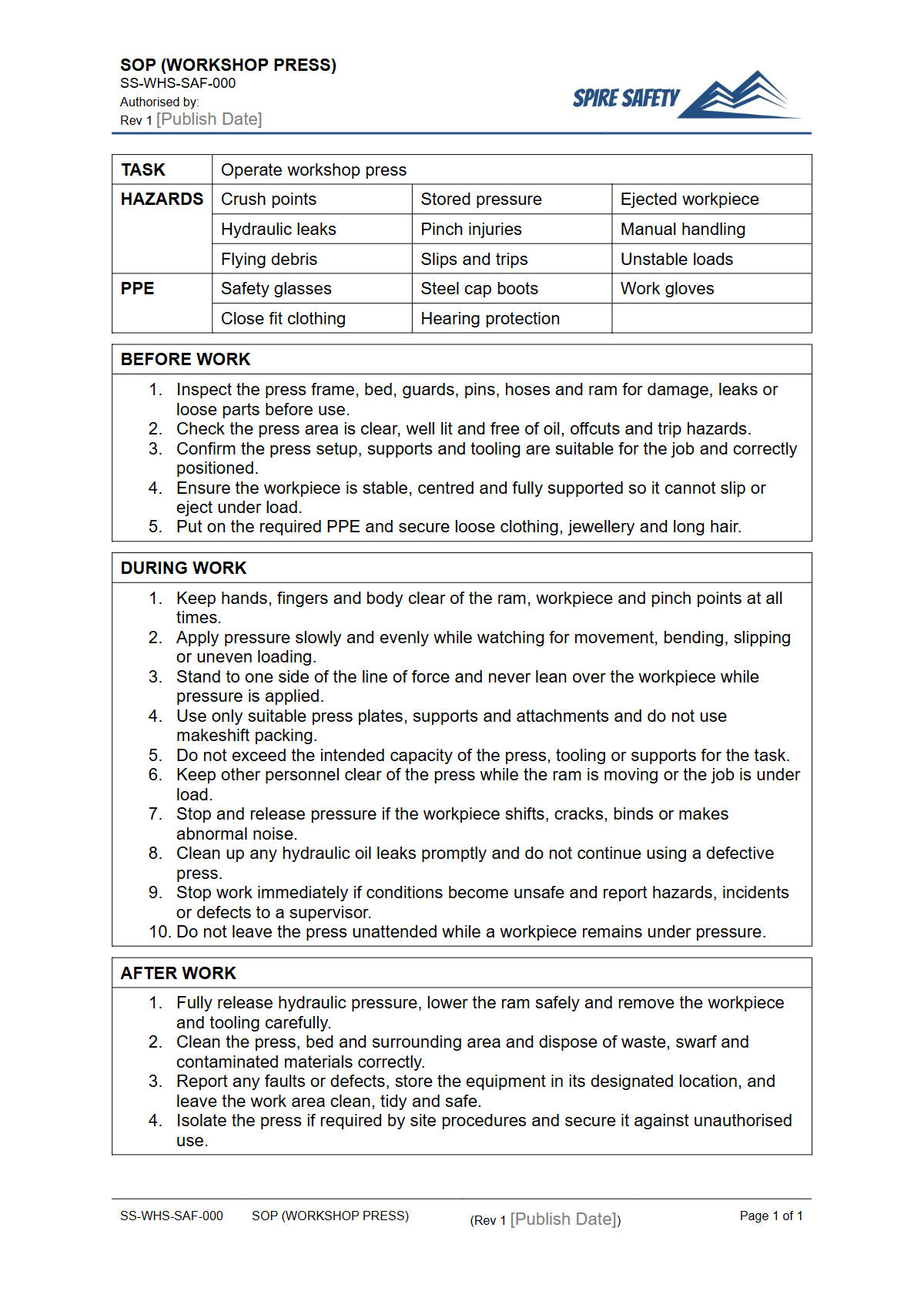
This free Safe Operating Procedure (Workshop Press) Template provides a structured framework for documenting the safe use of hydraulic and mechanical presses in your workplace. Its primary purpose is to establish a clear, step-by-step guide that helps control hazards and standardise safe work methods, ensuring all operators understand the required precautions.
By systematically outlining pre-operational checks, safe operational steps, and shutdown procedures, the SOP serves as a critical administrative control. It forms a key component of your overall safety management system, demonstrating a commitment to providing a safe working environment and fulfilling your duty of care.
Properly developed and implemented, this document helps prevent incidents, reduce equipment damage, and supports effective worker training and supervision. Integrating such procedures is a fundamental part of building robust WHS management systems that protect your people and your organisation.
Video walkthrough
How to use the Free Safe Operating Procedure (Workshop Press) Template
This downloadable document is a comprehensive starting point, not a finished product. You must adapt it to the specific make, model, and configuration of the workshop press used in your facility, as well as the unique tasks it performs.
Effective customisation involves a collaborative approach to ensure the procedure is practical, accurate, and relevant to your operational context.
IMPORTANT: This is a template only. We are not your workplace, and you are responsible for customising this document to reflect your specific equipment, processes, risk controls, and environment.
A generic procedure is not sufficient; it must be site-specific.
Key Customisation Steps:
- Consult with Workers: Engage the operators who use the workshop press daily. Their hands-on experience is invaluable for identifying practical steps, potential shortcuts that introduce risk, and effective control measures.
- Conduct a Risk Assessment: Formally identify all foreseeable hazards associated with your press and its use. This includes mechanical hazards (crushing, shearing), fluid injection, noise, and ergonomic risks. Use the findings to inform the required controls within the SOP.
- Detail Specific Procedures: Replace the placeholder text with your specific pre-start checks (e.g., inspecting hydraulic lines for leaks, checking guard integrity), step-by-step operating instructions (e.g., correctly positioning workpieces, using appropriate dies), and shutdown processes.
- Specify PPE: List the mandatory Personal Protective Equipment (PPE) required, such as safety glasses, steel-capped boots, and specific types of gloves if necessary.
- Train and Assess: Once finalised, use the SOP as a basis for training all operators. Ensure they understand every step and verify their competency before authorising them to use the equipment independently. Many workshops use our Free Air Compressor SOP template alongside this one to standardise safety for common equipment.
When to use a Workshop Press Safe Operating Procedure
A Safe Operating Procedure for a workshop press should be a living document that is integrated into your daily operations. It is not a 'set and forget' piece of paperwork.
It should be actively used during key activities, including worker training and induction, to ensure a baseline understanding of safe operation before an individual ever touches the machine. Supervisors should refer to the SOP when conducting routine observations or performance reviews to ensure correct procedures are being followed.
Furthermore, the SOP is an essential reference tool following any incident, near miss, or breakdown involving the press. It provides a benchmark against which actual practice can be compared, helping to identify procedural gaps or behavioural issues during an investigation.
Regular reviews, recommended annually or whenever changes occur, also depend on the existing SOP as a starting point. For complex procedure rollouts, expert guidance from WHS consulting services can help ensure effective implementation.
Who should use this Safe Operating Procedure
This SOP is designed for use by multiple roles within an organisation. The primary users are the plant operators and workers who physically use the workshop press.
For them, it is a direct, step-by-step guide for performing their tasks safely. It helps eliminate guesswork and ensures consistency, especially for tasks that are not performed every day.
Supervisors and line managers use the SOP as a tool for training their teams, conducting competency assessments, and monitoring work practices to supports your compliance efforts with established safety standards.
Work Health and Safety (WHS) personnel and management use these procedures to establish and maintain a compliant and safe system of work. They provide documented evidence of the organisation's risk management efforts.
This documentation is also crucial during safety audits and for demonstrating due diligence. Standardising procedures for all high-risk equipment, including tools covered in our FREE Oxy Acetylene SOP, creates a consistent and predictable safety culture across the entire workshop.
You can explore our complete collection of procedural templates in our free WHS resources library to support your safety program.
Common mistakes
Common mistakes to avoid
- Using incorrect or damaged dies, blocks, or tooling not designed for the press.
- Bypassing or disabling safety features like interlocked guards or two-hand controls.
- Failing to conduct and document pre-start inspections to identify faults like hydraulic leaks or cracked frames.
- Exceeding the press's rated tonnage capacity, leading to catastrophic failure of the machine or workpiece.
Legal references
Legal considerations
The following legal requirements may be relevant to this type of work.
- Work Health and Safety Act (Harmonised) — Provides the primary duties for protecting workers and other people from work health and safety risks.
- Work Health and Safety Regulations (Harmonised) — Sets out requirements supporting the management of workplace hazards and risks.
The following codes may be relevant to this type of work.
- Managing WHS Risks Code of Practice — Provides practical guidance on identifying hazards, assessing risks and applying effective controls.
- Work Health and Safety Consultation, Cooperation and Coordination Code of Practice — Provides practical guidance on consulting workers and coordinating with other duty holders.
- Managing the Work Environment and Facilities Code of Practice — Provides practical guidance on safe work environments, workplace facilities and related controls.
Did you know
Immense Force
Even a small, bench-mounted workshop press can exert several tonnes of force. Larger industrial presses can generate thousands of tonnes, capable of crushing steel with ease, highlighting the critical need for robust safety procedures.
Hydraulic Injection Injury
A pinhole leak in a high-pressure hydraulic hose can release a fine jet of fluid powerful enough to penetrate skin and cause a severe injection injury, which is a medical emergency requiring immediate specialist treatment.
FAQ
Frequently asked questions
01What are the main hazards of a workshop press?
02Is a Safe Operating Procedure a legal requirement for a workshop press in Australia?
03How often should a workshop press SOP be reviewed?
04Who is responsible for writing and implementing a workshop press SOP?
Share this resource
Free Safe Operating Procedure (Workshop Press) Template
Browse Categories
How To Use It
- 1Download and open in Word or PDF.
- 2Replace the placeholders with your business details.
- 3Get it reviewed by a WHS specialist before rollout.
Need it customised?
Our WHS consultants can adapt this template to your site, run a gap analysis, or audit what you already have in place.
Book a Free Consultation WHS consulting servicesor call 1300 156 382
Related templates
- Free Safe Operating Procedure (X-Ray Baggage Scanner) Template
- Free Safe Operating Procedure (X-Ray Inspection Unit) Template
- Free Safe Operating Procedure (Yard Pedestrian Control) Template
- Free Safe Operating Procedure (Yard Traffic Control) Template
- Free Safe Operating Procedure (Yard Waste Collection) Template
- Free Safe Operating Procedure Template