
Free Safe Operating Procedure (Yard Waste Collection) Template
Download our free Safe Operating Procedure for yard waste collection. This customisable template helps you outline step-by-step safety controls for this task.
Free Safe Operating Procedure (Yard Waste Collection) Template
DOCX • 126 KB + PDF
Updated Oct 2026
No signup required
Purpose of the Free Safe Operating Procedure (Yard Waste Collection) Template
Managing yard waste collection involves numerous hazards, from manual handling and biological risks to interactions with vehicles and machinery. A formalised safety process is essential.
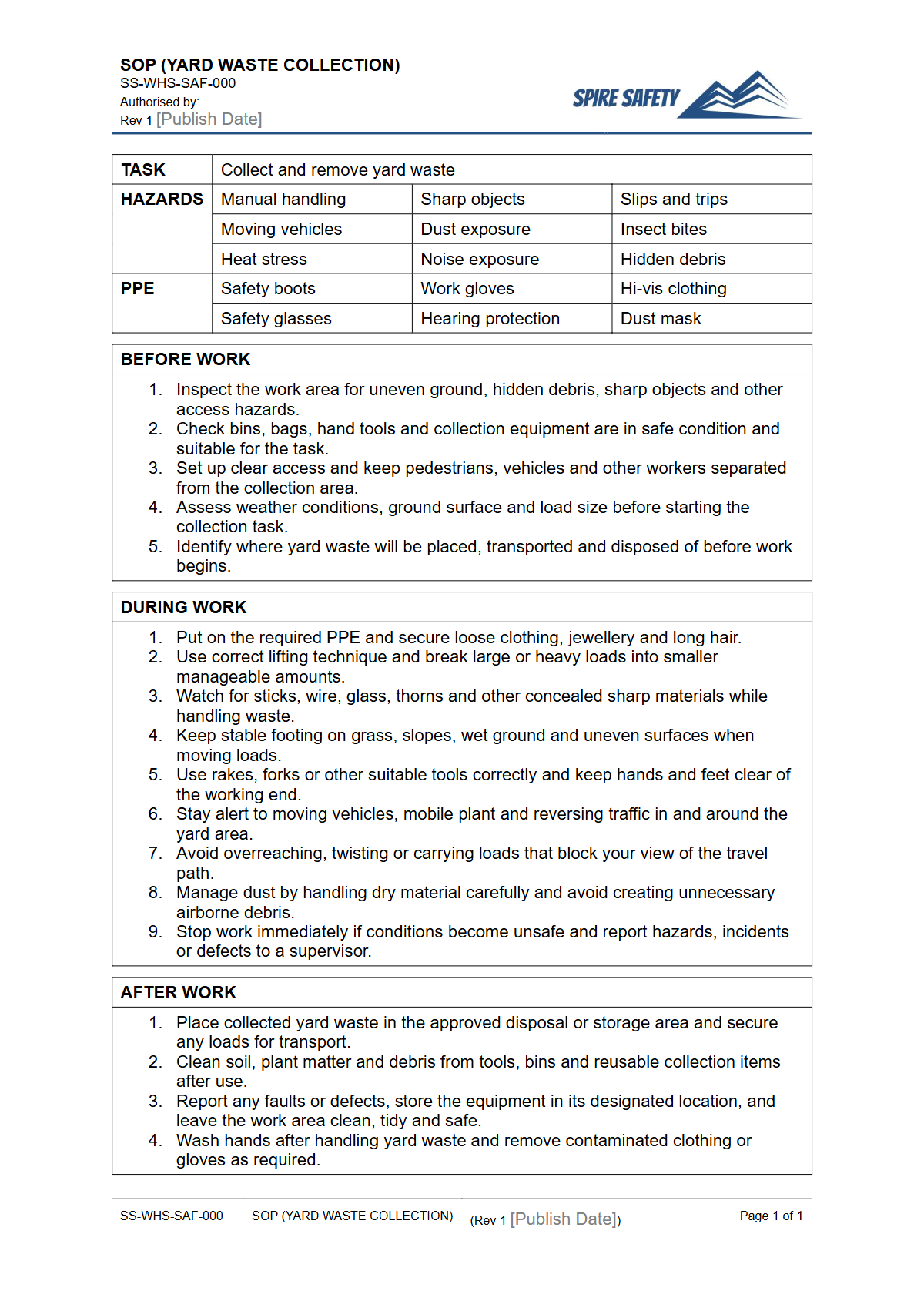
This Free Safe Operating Procedure (Yard Waste Collection) Template provides a structured starting point for documenting the step-by-step process for safely collecting, handling, and disposing of green waste. Using a clear SOP helps to standardise your approach, ensuring all workers follow the same safety protocols every time.
The primary purpose of this document is to help you identify potential hazards and establish robust control measures. By outlining pre-operational checks, safe work sequences, and post-task clean-up, you create a clear and auditable record of your safety commitments.
This not only aids in worker training and induction but also forms a critical part of your broader WHS management systems, demonstrating due diligence in managing workplace risks.
Key Objectives of This Safe Operating Procedure:
- To define the accepted, safe method for performing yard waste collection tasks.
- To identify hazards such as ergonomic strain, sharps, biological contaminants, noise, and dust.
- To specify the Personal Protective Equipment (PPE) required for the job.
- To serve as a tool for training new employees and for refresher training for existing staff.
- To provide a basis for incident investigation and process improvement.
Video walkthrough
How to use the Free Safe Operating Procedure (Yard Waste Collection) Template
This template is available for download as a DOCX file for easy editing or as a PDF for straightforward printing and distribution. To use it effectively, a competent person (such as a supervisor or WHS manager) should lead a review process involving the workers who actually perform the task.
Their direct input is invaluable for ensuring the procedure is practical and reflects the realities of the job.
Important: This is a template, not a finished document. You must customise it to suit the specific requirements of your workplace.
We recommend a competent person reviews and adapts the content to address your unique equipment, environment, work processes, and control measures. For particularly complex or high-risk operations, engaging external expertise through WHS consulting can provide additional assurance and help refine your safety documentation.
Fill in the blank sections with details relevant to your site. This includes the specific types of waste handled, the equipment used (e.g., wheelbarrows, ride-on mowers, chippers), the location of the work, and your organisation’s emergency procedures.
Once finalised, ensure the SOP is readily accessible to all relevant personnel.
When to use it
A Safe Operating Procedure for yard waste collection is a dynamic document that should be used throughout the work lifecycle, not just filed away. It is most effective when integrated into daily operations and safety management activities. For tasks involving heavy machinery like lifting bulk bags of waste, you must also develop equipment-specific procedures, such as those outlined in our FREE Telehandler SOP (Safe Operating Procedure) Template.
Key moments to use the SOP include:
- Worker Inductions: Use the SOP to train new workers on the established safe method for collecting yard waste.
- Pre-start Meetings or Toolbox Talks: Briefly review the SOP to refresh workers’ memories on key hazards and controls before the task begins.
- Risk Assessments: The SOP serves as a reference for existing controls when conducting a formal risk assessment for the task.
- After an Incident: Use the document as a baseline to investigate what went wrong and determine if the procedure needs to be updated. Regular reviews are also essential for continuous improvement, which can be verified through processes like WHS compliance auditing.
- Refresher Training: Schedule periodic reviews of the SOP with your team to ensure safety standards do not slip over time.
Who should use it
This SOP is designed for any person or organisation involved in the collection and management of yard or green waste. It provides a valuable framework for formalising safety protocols across various industries.
This includes a wide range of roles, from frontline workers to those responsible for overseeing safety.
Primary users include:
- Waste Management Workers: The operators performing the collection tasks.
- Landscaping and Gardening Businesses: Teams who generate and handle green waste as part of their services.
- Local Councils and Municipalities: Staff responsible for kerbside green waste collection and park maintenance.
- Property and Facility Managers: Individuals overseeing grounds maintenance at commercial or residential complexes.
- WHS Managers and Supervisors: Those responsible for drafting, implementing, and reviewing safety procedures.
Whether your operations involve simple manual collection or the use of specialised machinery, having a documented safe system of work is crucial. For related agricultural or landscaping tasks, you might also find our FREE Spreader SOP (Safe Operating Procedure) Template useful.
You can explore our complete free WHS resources library for more templates to support your safety management system.
Common mistakes
Common mistakes to avoid
- Using a generic template without customising it for site-specific equipment and hazards.
- Failing to train workers on the finalised SOP and confirm their understanding before they start work.
- Not reviewing and updating the SOP after an incident, near-miss, or change in process.
- Neglecting to clearly specify the correct type of Personal Protective Equipment (PPE) required for the task.
Legal references
Legal considerations
The following legal requirements may be relevant to this type of work.
- Work Health and Safety Act (Harmonised) — Provides the primary duties for protecting workers and other people from work health and safety risks.
- Work Health and Safety Regulations (Harmonised) — Sets out requirements supporting the management of workplace hazards and risks.
The following codes may be relevant to this type of work.
- Managing WHS Risks Code of Practice — Provides practical guidance on identifying hazards, assessing risks and applying effective controls.
- Work Health and Safety Consultation, Cooperation and Coordination Code of Practice — Provides practical guidance on consulting workers and coordinating with other duty holders.
- Managing the Work Environment and Facilities Code of Practice — Provides practical guidance on safe work environments, workplace facilities and related controls.
Did you know
Spontaneous Combustion
Large, damp piles of green waste can self-combust. As microorganisms break down the organic material, they generate significant heat that, if not able to escape, can build up and ignite the pile.
Industry Injury Rates
According to Safe Work Australia data, the waste collection industry has one of the highest rates of serious workers' compensation claims, with muscular stress from manual handling being a leading cause of injury.
FAQ
Frequently asked questions
01What are the main hazards involved in yard waste collection?
02Is a Safe Operating Procedure legally required for yard waste collection in Australia?
03How often should an SOP for yard waste collection be reviewed?
04Can this template be used for large-scale commercial green waste collection?
Share this resource
Free Safe Operating Procedure (Yard Waste Collection) Template
Browse Categories
How To Use It
- 1Download and open in Word or PDF.
- 2Replace the placeholders with your business details.
- 3Get it reviewed by a WHS specialist before rollout.
Need it customised?
Our WHS consultants can adapt this template to your site, run a gap analysis, or audit what you already have in place.
Book a Free Consultation WHS consulting servicesor call 1300 156 382
Related templates
- Free Safe Operating Procedure Template
- FREE Sand Blasting SOP (Safe Operating Procedure) Template
- FREE Scissor Lift SOP (Safe Operating Procedure) Template
- FREE Scraper SOP (Safe Operating Procedure) Template
- FREE Seed Drill SOP (Safe Operating Procedure) Template
- FREE Seeder SOP (Safe Operating Procedure) Template