
Free Safe Operating Procedure Template
Download our free Safe Operating Procedure template to create clear, step-by-step instructions for tasks. Aligned with Australian WHS standards. Download now.
Free Safe Operating Procedure Template
DOCX • 162 KB + PDF
Updated Oct 2026
No signup required
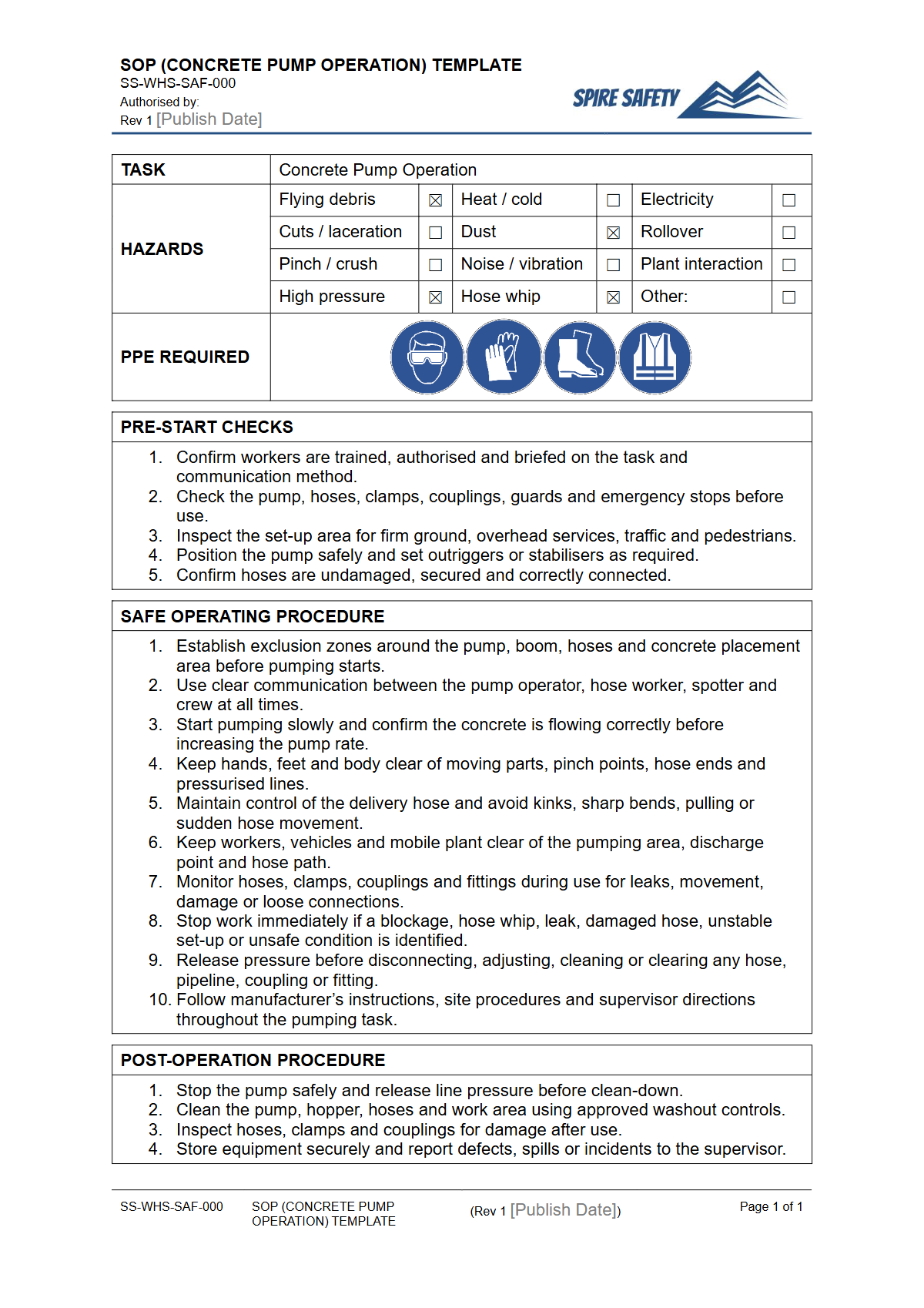
Developing clear and effective safe systems of work is a cornerstone of workplace safety. This free Safe Operating Procedure template provides a structured starting point for documenting task-specific instructions, helping to control risks and guide workers.
A Safe Operating Procedure (SOP), sometimes called a Safe Work Procedure (SWP), outlines the logical sequence of steps for a task to be performed safely, ensuring consistency and minimising the chance of incidents.
Video walkthrough
Purpose of the Free Safe Operating Procedure Template
A Safe Operating Procedure is more than just a document; it's a critical administrative control measure. Its primary purpose is to provide clear, step-by-step instructions that standardise a task to ensure it is always performed in the safest known way.
By formalising a process, an SOP helps your organisation fulfil its primary duty of care under WHS law. It serves as a key training resource for new and existing workers, a benchmark for supervision, and evidence of your commitment to providing a safe work environment.
These procedures form an integral part of broader WHS management systems, linking risk assessments to on-the-ground daily operations.
How to use the Free Safe Operating Procedure Template
This downloadable document is a framework. To make it effective, it must be populated with specific details from your workplace.
The process involves more than just filling in blanks; it requires consultation, risk assessment, and clear communication.
- Consultation: Engage directly with the workers who perform the task. Their experience is invaluable for identifying practical steps, hidden hazards, and effective controls.
- Risk Assessment: Before writing the SOP, ensure a thorough risk assessment for the task has been completed. The controls identified in the risk assessment will inform the steps in the SOP.
- Customisation: Adapt the template to your specific needs. Add your company branding, and detail the exact equipment, location, and potential hazards relevant to the task. For example, the procedure for a workshop machine will differ greatly from a field-based task.
- Review and Approval: Once drafted, the SOP should be reviewed by a supervisor and a health and safety representative before being formally approved for use.
IMPORTANT: This is a template only. We provide it as a starting point.
You must customise it to reflect the specific hazards, risks, and control measures relevant to your workplace, equipment, and environment. A generic, uncustomised procedure is not effective and will not meet your legal obligations.
What to Include in Your Safe Operating Procedure
A comprehensive SOP should cover all phases of the task. Our template prompts you to include:
- Required PPE: List all personal protective equipment required to perform the task safely.
- Pre-operational Checks: Detail the safety checks that must be conducted on equipment and the work area before starting.
- Step-by-step Instructions: A logical, sequential list of actions to perform the task. For each step, identify associated hazards and the control measures to manage them.
- Emergency Procedures: Outline the immediate actions to take in case of an emergency, such as equipment failure, injury, or spill.
- Post-operational Tasks: Include instructions for shutting down equipment, cleaning the work area, and storing tools correctly. As an example, our circular saw SOP template includes specific steps for blade inspection and storage after use.
When to use a Safe Operating Procedure
SOPs are essential for any task where there is a moderate to high risk of injury or illness if the task is performed incorrectly. They are particularly important for:
- Tasks involving hazardous chemicals or substances.
- Operation of powered mobile plant or machinery, such as that covered in our front end loader SOP.
- Complex or non-routine tasks that have multiple steps.
- Work requiring specific permits or isolation procedures (e.g., confined space entry, lockout-tagout).
- Any critical task where deviation from a standard method could lead to significant consequences.
These documents are also foundational for worker training and competency assessments. They provide a clear standard against which a worker’s performance can be measured.
Who should use it
This template is designed for use by anyone responsible for workplace safety and operational management. This includes:
- Work Health and Safety (WHS) Managers and Advisors
- Supervisors and Team Leaders
- Business Owners and Persons Conducting a Business or Undertaking (PCBUs)
- Operations Managers
While these individuals typically lead the development of an SOP, the end-users are the workers themselves. The document must be written in plain, simple English, be easily accessible, and used actively in day-to-day work, training, and supervision.
If you require expert assistance in developing a suite of SOPs tailored to your business, consider engaging professional WHS consulting services.
Furthermore, well-developed SOPs are a key piece of evidence examined during safety audits. An auditor will not just check if you have an SOP, but whether it is fit-for-purpose, up-to-date, and if workers are following it.
Regular WHS compliance auditing helps verify the effectiveness of your documented procedures.
Whether for agriculture, manufacturing, or construction, the principles of documenting safe work are universal. This template can be adapted for a huge range of tasks, from using simple hand tools to operating complex machinery like the equipment detailed in our free Tractor SOP template. To see other specific examples, browse our complete free WHS resources library.
Common mistakes
Common mistakes to avoid
- Creating the SOP in isolation without consulting the workers who perform the task.
- Making the procedure too long, complex, or full of jargon, making it difficult to follow.
- Failing to review and update the SOP after an incident or a change in process.
- Treating the SOP as a 'set and forget' document instead of a living tool for training and supervision.
Legal references
Legal considerations
The following legal requirements may be relevant to this type of work.
- Work Health and Safety Act (Harmonised) — Provides the primary duties for protecting workers and other people from work health and safety risks.
- Work Health and Safety Regulations (Harmonised) — Sets out requirements supporting the management of workplace hazards and risks.
The following codes may be relevant to this type of work.
- Managing WHS Risks Code of Practice — Provides practical guidance on identifying hazards, assessing risks and applying effective controls.
- Work Health and Safety Consultation, Cooperation and Coordination Code of Practice — Provides practical guidance on consulting workers and coordinating with other duty holders.
- Managing the Work Environment and Facilities Code of Practice — Provides practical guidance on safe work environments, workplace facilities and related controls.
Did you know
Training Tool
Well-written SOPs are not just compliance documents; they are excellent tools for inducting new employees and providing refresher training for existing staff.
Consultation is Key
Under Australian WHS law, consulting with workers on safety matters is a mandatory duty. Involving them in creating SOPs improves safety outcomes and worker buy-in.
FAQ
Frequently asked questions
01What is the difference between an SOP and a SWMS?
02How often should Safe Operating Procedures be reviewed?
03Who is responsible for writing a Safe Operating Procedure?
04Is a Safe Operating Procedure a legal requirement in Australia?
Share this resource
Free Safe Operating Procedure Template
Browse Categories
How To Use It
- 1Download and open in Word or PDF.
- 2Replace the placeholders with your business details.
- 3Get it reviewed by a WHS specialist before rollout.
Need it customised?
Our WHS consultants can adapt this template to your site, run a gap analysis, or audit what you already have in place.
Book a Free Consultation WHS consulting servicesor call 1300 156 382
Related templates
- FREE Sand Blasting SOP (Safe Operating Procedure) Template
- FREE Scissor Lift SOP (Safe Operating Procedure) Template
- FREE Scraper SOP (Safe Operating Procedure) Template
- FREE Seed Drill SOP (Safe Operating Procedure) Template
- FREE Seeder SOP (Safe Operating Procedure) Template
- FREE Skidsteer SOP (Safe Operating Procedure) Template