
Free Safe Operating Procedure (Yard Traffic Control) Template
Manage vehicle and pedestrian movement safely with our free Yard Traffic Control SOP template. Download this customisable DOCX to formalise your procedures.
Free Safe Operating Procedure (Yard Traffic Control) Template
DOCX • 126 KB + PDF
Updated Oct 2026
No signup required
Purpose of the Free Safe Operating Procedure (Yard Traffic Control) Template
Effectively managing the movement of vehicles, mobile plant, and people in a work yard is critical for preventing serious incidents. A documented procedure provides clarity and consistency for everyone on site.
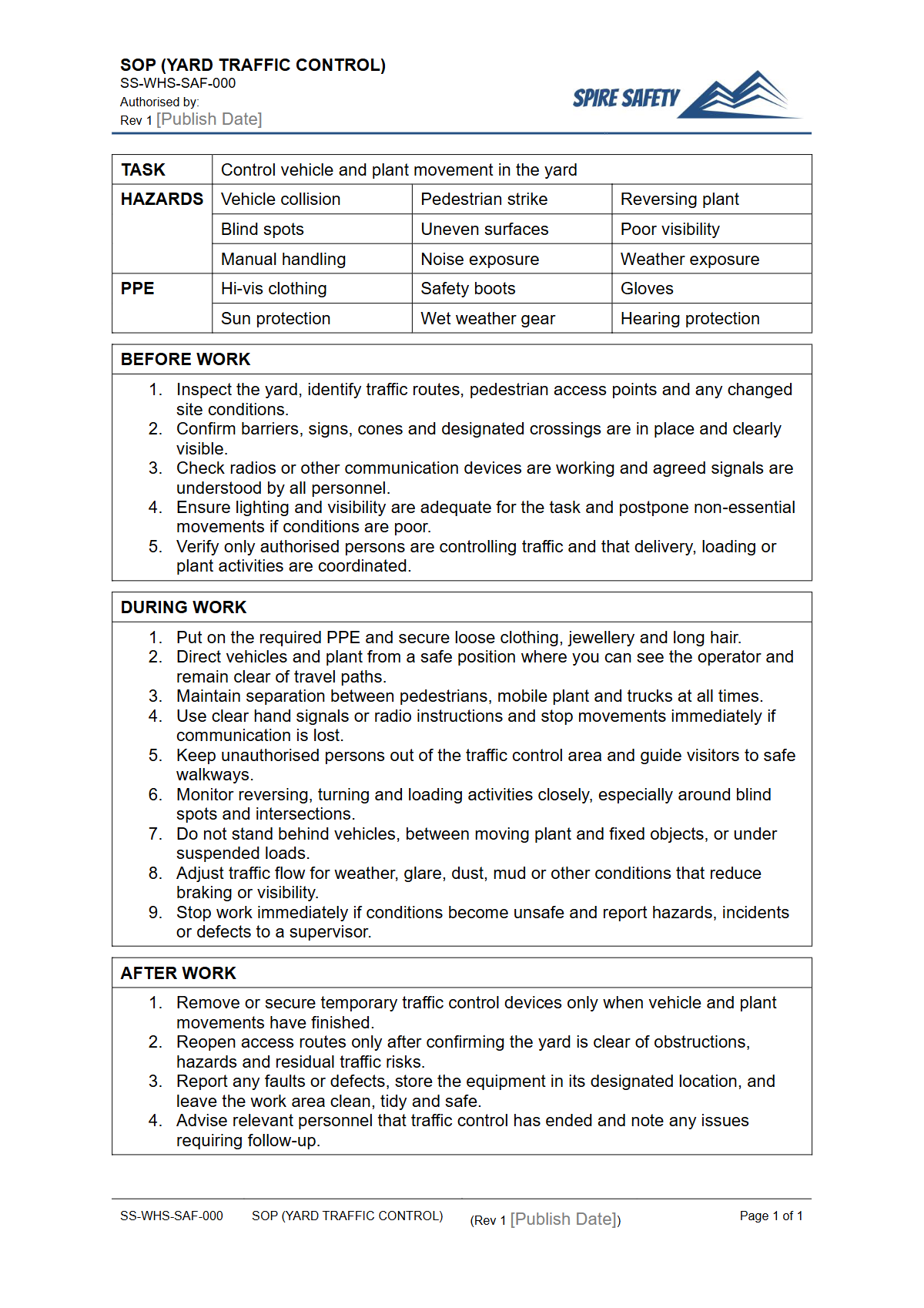
This Free Safe Operating Procedure (Yard Traffic Control) Template provides a structured starting point for creating a formal process tailored to your specific workplace environment. It helps organisations document the hazards and control measures associated with managing traffic flow in yards, loading bays, and other operational areas.
The primary purpose of this Safe Operating Procedure is to minimise the risk of collisions between vehicles, mobile plant, and pedestrians. By establishing clear rules for traffic flow, speed limits, parking, loading zones, and communication, you can create a safer, more organised work environment.
Formalising these procedures helps ensure all workers and visitors understand their responsibilities. This SOP forms a crucial component of your broader WHS management systems, demonstrating a systematic approach to hazard management.
Video walkthrough
How to use the Free Safe Operating Procedure (Yard Traffic Control) Template
This template is provided in both DOCX and PDF formats for your convenience. The DOCX file is fully editable, allowing you to adapt it to the unique layout and operational needs of your site. To implement it effectively:
- Download the DOCX template.
- Conduct a risk assessment of your yard, identifying traffic routes, interaction points, and specific hazards.
- Consult with your workers, including operators, drivers, and ground staff, to ensure the procedure is practical and reflects actual work practices.
- Customise the document with site-specific details, such as a site map, designated pedestrian walkways, vehicle exclusion zones, speed limits, and rules for specific equipment. Our FREE Telehandler SOP Template can be used alongside this document for managing specific high-risk plant.
- Communicate the finalised Safe Operating Procedure to all relevant personnel through toolbox talks, inductions, and site signage.
Important: This is a template only. We are not WHS consultants, and this document must be customised by a competent person to suit the specific hazards, equipment, and conditions of your workplace and to ensure it aligns with your legal obligations.
When to use it
This Safe Operating Procedure should be developed and implemented in any workplace where vehicles and pedestrians interact in a shared space. This includes transport depots, manufacturing sites, construction sites, warehouses, and agricultural properties.
It is a fundamental document for establishing a traffic management plan. Using a formal SOP is particularly important before introducing new types of vehicles, changing the site layout, or after any traffic-related incident or near miss.
Regular reviews of your procedures can be verified through a systematic WHS compliance auditing process to ensure ongoing effectiveness.
Who should use it
The responsibility for developing, implementing, and reviewing this Safe Operating Procedure typically falls to the Person Conducting a Business or Undertaking (PCBU). In practice, this task is often delegated to:
- WHS Managers or Safety Advisors
- Site or Operations Managers
- Logistics and Warehouse Supervisors
- Team Leaders
However, the procedure itself must be understood and followed by all workers, contractors, and visitors who enter the yard. This includes truck drivers, plant operators, and any pedestrians who need to access the area.
When complex traffic interactions are present, engaging external expertise through WHS consulting can provide valuable insight and ensure all risks are adequately addressed. Many yards also incorporate fixed machinery.
For example, if your traffic plan involves vehicles interacting with loading or unloading equipment, you may also need a FREE Conveyer System SOP (Safe Operating Procedure) Template to manage associated risks. Ensuring all procedures are integrated is key to a holistic safety approach. You can find more templates and checklists in our free WHS resources library.
Common mistakes
Common mistakes to avoid
- Failing to physically separate pedestrian routes from vehicle roadways.
- Using inadequate, worn, or unclear signage and line marking.
- Assuming drivers and workers understand the rules without formal induction and training.
- Not reviewing or updating the traffic management plan after a near miss or a change in site conditions.
Legal references
Legal considerations
The following legal requirements may be relevant to this type of work.
- Work Health and Safety Act (Harmonised) — Provides the primary duties for protecting workers and other people from work health and safety risks.
- Work Health and Safety Regulations (Harmonised) — Sets out requirements supporting the management of workplace hazards and risks.
The following codes may be relevant to this type of work.
- Managing WHS Risks Code of Practice — Provides practical guidance on identifying hazards, assessing risks and applying effective controls.
- Work Health and Safety Consultation, Cooperation and Coordination Code of Practice — Provides practical guidance on consulting workers and coordinating with other duty holders.
- Managing the Work Environment and Facilities Code of Practice — Provides practical guidance on safe work environments, workplace facilities and related controls.
Did you know
A Leading Cause of Fatality
Being hit by a moving vehicle is one of the leading causes of workplace fatalities in Australia. Between 2017 and 2021, 98 workers were killed in a vehicle collision incident at their place of work (Safe Work Australia).
FAQ
Frequently asked questions
01What's the difference between a Traffic Management Plan and a Safe Operating Procedure?
02Who is responsible for traffic management in an Australian workplace?
03Does this yard traffic control template cover specific vehicle types?
04How often should our yard traffic control SOP be reviewed?
Share this resource
Free Safe Operating Procedure (Yard Traffic Control) Template
Browse Categories
How To Use It
- 1Download and open in Word or PDF.
- 2Replace the placeholders with your business details.
- 3Get it reviewed by a WHS specialist before rollout.
Need it customised?
Our WHS consultants can adapt this template to your site, run a gap analysis, or audit what you already have in place.
Book a Free Consultation WHS consulting servicesor call 1300 156 382
Related templates
- Free Safe Operating Procedure (Yard Waste Collection) Template
- Free Safe Operating Procedure Template
- FREE Sand Blasting SOP (Safe Operating Procedure) Template
- FREE Scissor Lift SOP (Safe Operating Procedure) Template
- FREE Scraper SOP (Safe Operating Procedure) Template
- FREE Seed Drill SOP (Safe Operating Procedure) Template