
Free Safe Operating Procedure (Yard Pedestrian Control) Template
Effectively manage the risks of moving vehicles and pedestrians in your yard with our structured template.
Free Safe Operating Procedure (Yard Pedestrian Control) Template
DOCX • 126 KB + PDF
Updated Oct 2026
No signup required
Purpose of the Free Safe Operating Procedure (Yard Pedestrian Control) Template
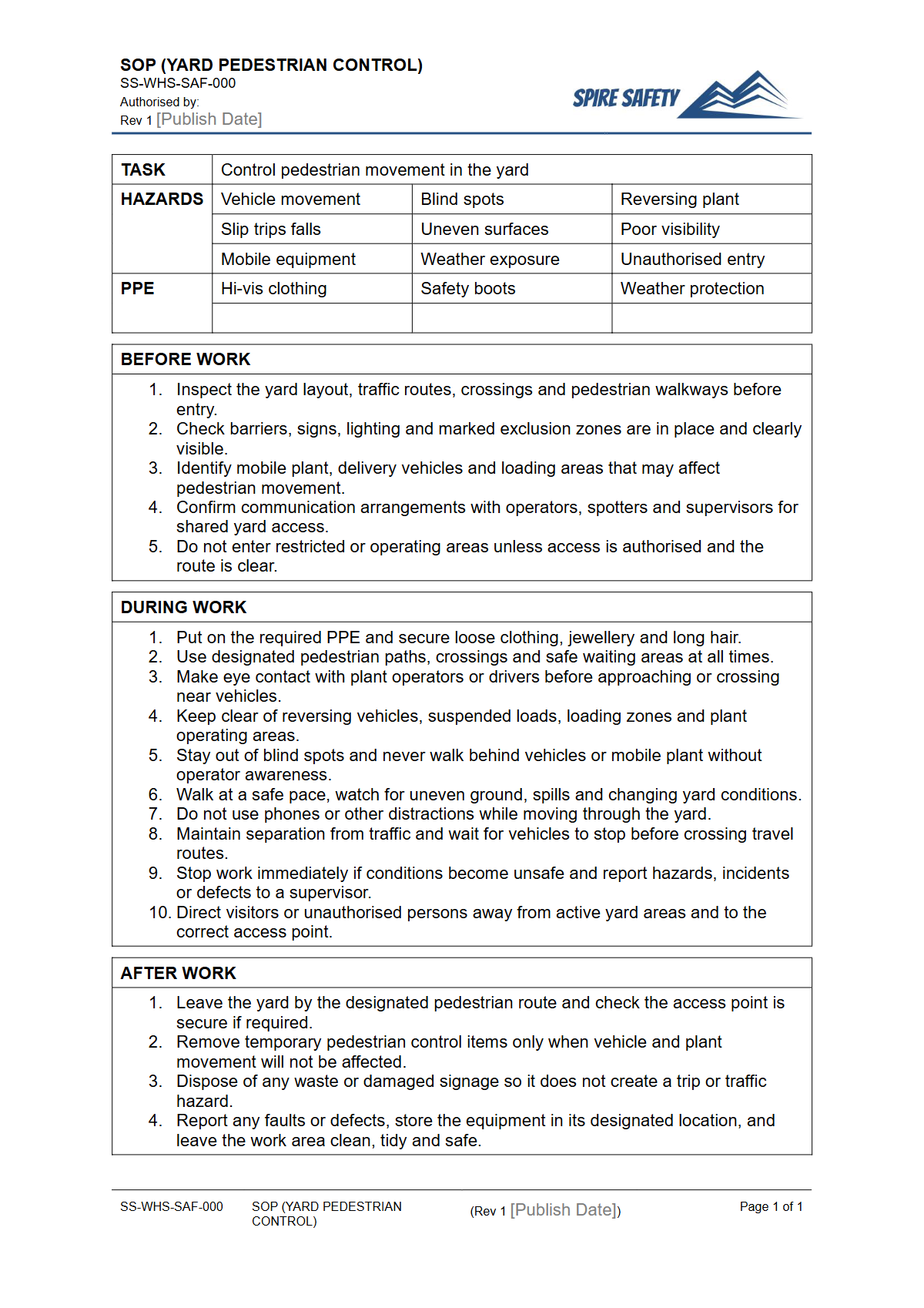
Managing the interaction between pedestrians and vehicles is a critical safety challenge in many Australian workplaces. This Free Safe Operating Procedure (Yard Pedestrian Control) Template provides a structured starting point for organisations to formalise their rules and procedures.
It is designed to help you systematically control risks associated with mobile plant and vehicle movement in operational yards, warehouses, and loading docks. The primary goal is to prevent serious injuries or fatalities resulting from collisions by establishing clear, documented instructions for everyone on site.
A documented SOP helps define safe work practices, communication protocols, and the physical layout required to separate people from moving machinery. It forms a key part of your overall safety management system, demonstrating a commitment to proactive risk management.
Implementing robust controls is essential for creating a safer work environment for employees, contractors, and visitors alike. This is especially true for sites that use specific heavy equipment, which should have its own dedicated procedures, such as those outlined in our FREE Telehandler SOP (Safe Operating Procedure) Template.
Video walkthrough
How to use the Free Safe Operating Procedure (Yard Pedestrian Control) Template
This Safe Operating Procedure is available as a fully editable DOCX file and a print-ready PDF. To use it, simply download your preferred format and begin customising it to reflect the specific conditions of your workplace.
It's crucial to detail your site's traffic management plan, including designated pedestrian walkways, vehicle speed limits, exclusion zones, and the types of mobile plant in operation.
Important: This document is a template, not a finished procedure. We must stress that it needs to be customised for your specific workplace.
You must conduct a site-specific risk assessment, consult with your workers and health and safety representatives, and integrate your own operational details. A generic procedure is not sufficient to meet your WHS obligations; it must be adapted to your unique environment and reviewed regularly as part of your broader WHS management systems.
Key Elements of Yard Pedestrian Control
An effective yard control SOP should address several key areas to be comprehensive. The template provides sections for you to detail these elements, which typically include:
- Physical Segregation: The most effective control is keeping people and vehicles apart. This involves clearly marked and protected pedestrian walkways, physical barriers, and designated crossing points.
- Traffic Flow: Designing a one-way traffic system where possible can eliminate the dangers associated with reversing vehicles.
- Signage and Markings: All traffic routes, walkways, speed limits, and hazards must be clearly identified with compliant signage and durable line marking.
- Visibility: Procedures should address worksite lighting, requirements for high-visibility clothing, and measures to eliminate blind spots for vehicle operators.
- Communication: Establish clear communication protocols, such as using a spotter for reversing vehicles or requiring positive acknowledgement between drivers and pedestrians before movement occurs.
For yards with specific automated hazards, additional procedures are necessary. For instance, areas around fixed machinery should have their own SOPs, similar to the framework provided in our FREE Conveyer System SOP (Safe Operating Procedure) Template.
When to use this Safe Operating Procedure
This SOP should be a core document used in multiple business processes. It is essential for the induction and training of all new employees, contractors, and visitors who will access yard areas.
It serves as a vital tool for regular refresher training, ensuring that safety awareness remains high. Supervisors should use the procedure as a benchmark for monitoring behaviour and enforcing site rules.
Furthermore, the SOP must be reviewed and updated following any incident or near miss, or whenever there are changes to the yard layout, traffic flow, or types of vehicles used. Regular reviews can also be triggered as part of a scheduled WHS compliance auditing program.
Who should use this SOP
This procedure is intended for a broad audience within an organisation. Primarily, it is for any person required to move through the yard on foot.
This includes operational staff, maintenance crews, delivery drivers (when out of their vehicles), and office personnel. It is also a critical document for all mobile plant operators, as it outlines their responsibilities towards pedestrians.
Supervisors and managers must be thoroughly familiar with the SOP to effectively oversee its implementation and supports your compliance efforts. This ensures all parties understand their role in maintaining a safe environment, whether they are operating heavy machinery or simply transiting through the area. Similar principles apply to operators of specific equipment, whose training should be supplemented with machine-specific documents like a FREE Scraper SOP (Safe Operating Procedure) Template.
By customising and implementing a thorough yard pedestrian control procedure, your organisation takes a significant step towards preventing workplace incidents. This template provides a solid foundation for that process. For more templates and safety guides, explore our complete free WHS resources library.
Common mistakes
Common mistakes to avoid
- Assuming drivers and pedestrians can see each other, especially around large vehicles with significant blind spots.
- Failing to install or maintain clear, durable line markings for walkways and exclusion zones.
- Neglecting to enforce site speed limits, allowing vehicle operators to travel too fast for the conditions.
- Providing inadequate lighting for night or low-light operations, obscuring hazards and reducing visibility.
Legal references
Legal considerations
The following legal requirements may be relevant to this type of work.
- Work Health and Safety Act (Harmonised) — Provides the primary duties for protecting workers and other people from work health and safety risks.
- Work Health and Safety Regulations (Harmonised) — Sets out requirements supporting the management of workplace hazards and risks.
The following codes may be relevant to this type of work.
- Managing WHS Risks Code of Practice — Provides practical guidance on identifying hazards, assessing risks and applying effective controls.
- Work Health and Safety Consultation, Cooperation and Coordination Code of Practice — Provides practical guidance on consulting workers and coordinating with other duty holders.
- Managing the Work Environment and Facilities Code of Practice — Provides practical guidance on safe work environments, workplace facilities and related controls.
Did you know
Vehicle Incidents
According to Safe Work Australia, from 2018 to 2022, 97 workers were killed in vehicle collisions in the workplace. The majority of these fatalities involved trucks, highlighting the critical need for robust traffic management plans.
FAQ
Frequently asked questions
01What is a traffic management plan for a workplace yard?
02How do you separate pedestrians from vehicles in a yard?
03Who is responsible for implementing pedestrian control measures in a yard?
04Why are near misses important to report in yard safety?
Share this resource
Free Safe Operating Procedure (Yard Pedestrian Control) Template
Browse Categories
How To Use It
- 1Download and open in Word or PDF.
- 2Replace the placeholders with your business details.
- 3Get it reviewed by a WHS specialist before rollout.
Need it customised?
Our WHS consultants can adapt this template to your site, run a gap analysis, or audit what you already have in place.
Book a Free Consultation WHS consulting servicesor call 1300 156 382
Related templates
- Free Safe Operating Procedure (Yard Traffic Control) Template
- Free Safe Operating Procedure (Yard Waste Collection) Template
- Free Safe Operating Procedure Template
- FREE Sand Blasting SOP (Safe Operating Procedure) Template
- FREE Scissor Lift SOP (Safe Operating Procedure) Template
- FREE Scraper SOP (Safe Operating Procedure) Template