
Free Safe Operating Procedure (X-Ray Baggage Scanner) Template
Ensure safe operation of security screening equipment with our structured SOP template. Download your free X-Ray Baggage Scanner procedure to get started now.
Free Safe Operating Procedure (X-Ray Baggage Scanner) Template
DOCX • 126 KB + PDF
Updated Oct 2026
No signup required
Purpose of the Free Safe Operating Procedure (X-Ray Baggage Scanner) Template
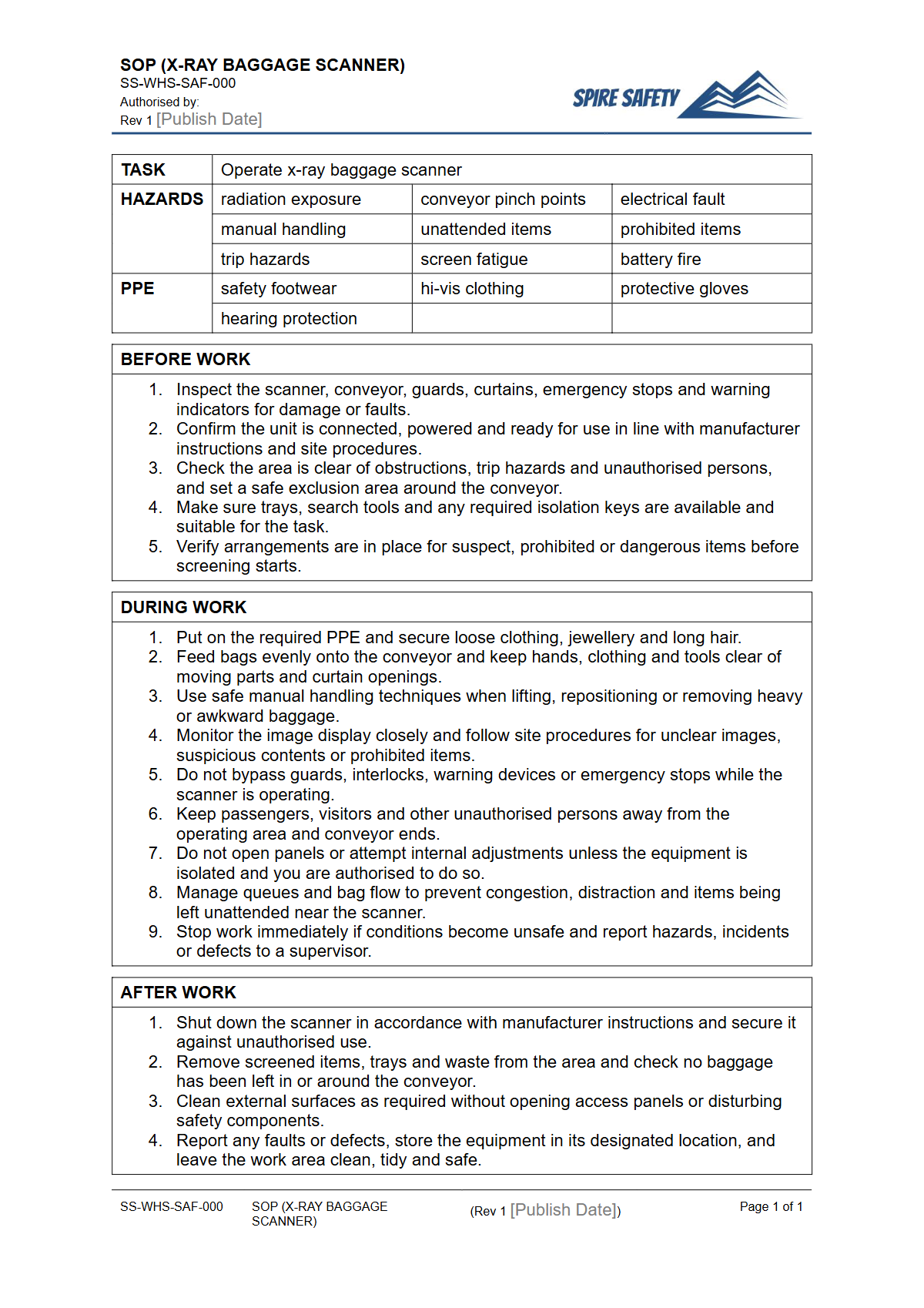
This Free Safe Operating Procedure (X-Ray Baggage Scanner) Template provides a comprehensive framework for documenting the safety steps required to operate security screening equipment. Developing a clear SOP is a critical administrative control for managing risks and ensuring consistent, safe work practices.
X-ray baggage scanners, while essential for security, present several workplace hazards that must be managed. These include exposure to ionising radiation, electrical hazards, ergonomic strains from manual handling, and mechanical risks from moving parts like conveyor belts.
Using a structured template helps your organisation create a formal, repeatable process that guides operators through pre-start checks, normal operation, shutdown procedures, and emergency responses. It forms a key part of your safety documentation, serving as a vital resource for training, competency assessments, and incident investigations.
A well-drafted SOP demonstrates a commitment to health and safety by proactively identifying hazards and outlining clear control measures.
Video walkthrough
How to use the Free Safe Operating Procedure (X-Ray Baggage Scanner) Template
Our template is available as a fully editable DOCX file, allowing for easy customisation to suit your specific workplace. Simply download the document and begin populating it with information relevant to your equipment and operational context.
Effective implementation of this SOP is a crucial step in building robust WHS management systems that protect your workers and ensure operational integrity.
IMPORTANT: This is a template only. We have provided a solid foundation, but you must customise this document to reflect the specific equipment, processes, and risks present in your workplace.
This involves conducting a thorough risk assessment, consulting with your workers who operate the equipment, and incorporating manufacturer specifications.
Key Customisation Areas
When adapting the template, pay close attention to the following sections:
- Equipment Specifics: Detail the make, model, and unique features of your X-ray scanner.
- PPE Requirements: List any personal protective equipment required, although it is often minimal for routine operation of modern, well-maintained scanners.
- Radiation Safety: Include details on radiation monitoring, exclusion zones, and signage as required by your state or territory's radiation safety authority.
- Emergency Procedures: Outline clear steps for responding to power failure, equipment malfunction, fire, and medical emergencies.
- Clearing Blockages: Provide a specific, safe procedure for clearing jammed baggage or items from the conveyor and tunnel, including lock-out tag-out (LOTO) steps where necessary. For more detailed guidance on the mechanical aspects, you can adapt controls from our FREE Conveyer System SOP.
If you are unsure how to conduct the necessary risk assessments or tailor the procedure for your specific environment, engaging professional WHS consulting can provide clarity and expert guidance to ensure your documentation is robust and effective.
When to use an X-Ray Scanner SOP
A Safe Operating Procedure for an X-ray baggage scanner should be used as a primary reference document in several key situations. It is essential for inducting and training new security personnel or any worker required to use the equipment.
It should also be used for conducting refresher training to ensure ongoing competency. Operators should refer to the SOP for carrying out daily pre-operational checks to verify that safety features are functioning correctly.
The document becomes indispensable during and after maintenance activities to ensure the equipment is returned to service safely. Furthermore, it serves as a critical benchmark for investigating any incidents or near misses involving the scanner.
Who should use this Safe Operating Procedure
This SOP is designed for a range of personnel within an organisation. The primary users are the operators themselves, including security screening officers, aviation protection officers, and building security staff.
Supervisors and team leaders must also be intimately familiar with the SOP to effectively oversee operations, enforce safe behaviour, and conduct competency checks. Maintenance technicians should consult the SOP before and after servicing the equipment.
Finally, WHS managers and safety representatives will use the document for auditing purposes, risk assessments, and continuous improvement of safety protocols. Regular reviews of the SOP's effectiveness can be supported by periodic WHS compliance auditing to verify its ongoing implementation.
By standardising the operating process, this procedure helps ensure that every person interacting with the X-ray scanner does so with the highest regard for safety. If you need other templates for different types of equipment or tasks, you can browse our complete free WHS resources library for more downloadable documents.
Common mistakes
Common mistakes to avoid
- Failing to customise the template for the specific machine model and workplace.
- Neglecting to train all operators on the finalised, site-specific SOP.
- Forgetting to include procedures for clearing jams or dealing with system errors safely.
- Storing the SOP in an office instead of making it readily accessible to operators at their workstation.
Legal references
Legal considerations
The following legal requirements may be relevant to this type of work.
- Work Health and Safety Act (Harmonised) — Provides the primary duties for protecting workers and other people from work health and safety risks.
- Work Health and Safety Regulations (Harmonised) — Sets out requirements supporting the management of workplace hazards and risks.
The following codes may be relevant to this type of work.
- Managing WHS Risks Code of Practice — Provides practical guidance on identifying hazards, assessing risks and applying effective controls.
- Work Health and Safety Consultation, Cooperation and Coordination Code of Practice — Provides practical guidance on consulting workers and coordinating with other duty holders.
- Managing the Work Environment and Facilities Code of Practice — Provides practical guidance on safe work environments, workplace facilities and related controls.
Did you know
Dual-Energy Technology
Modern X-ray scanners use two different X-ray energy levels simultaneously. By analysing the differential absorption of these energies, the system can distinguish between organic (e.g., food, explosives), inorganic (e.g., metals), and mixed materials, often assigning them different colours on the screen to aid operator analysis.
Minimal Radiation Dose
The radiation dose to a scanned object is extremely low. The dose to an operator standing nearby a properly maintained machine is typically negligible and far below regulatory limits, often less than the background radiation received during a short commercial flight.
FAQ
Frequently asked questions
01What are the main radiation hazards with X-ray baggage scanners?
02How often should an SOP for an X-ray scanner be reviewed?
03Is special training required to operate an X-ray baggage scanner?
04Can this template be used for all types of X-ray screening equipment?
Share this resource
Free Safe Operating Procedure (X-Ray Baggage Scanner) Template
Browse Categories
How To Use It
- 1Download and open in Word or PDF.
- 2Replace the placeholders with your business details.
- 3Get it reviewed by a WHS specialist before rollout.
Need it customised?
Our WHS consultants can adapt this template to your site, run a gap analysis, or audit what you already have in place.
Book a Free Consultation WHS consulting servicesor call 1300 156 382
Related templates
- Free Safe Operating Procedure (X-Ray Inspection Unit) Template
- Free Safe Operating Procedure (Yard Pedestrian Control) Template
- Free Safe Operating Procedure (Yard Traffic Control) Template
- Free Safe Operating Procedure (Yard Waste Collection) Template
- Free Safe Operating Procedure Template
- FREE Sand Blasting SOP (Safe Operating Procedure) Template