
Free Safe Operating Procedure (X-Ray Inspection Unit) Template
Manage radiation safety and operational risks with our structured Safe Operating Procedure for X-Ray Inspection Units.
Free Safe Operating Procedure (X-Ray Inspection Unit) Template
DOCX • 126 KB + PDF
Updated Oct 2026
No signup required
Purpose of the Free Safe Operating Procedure (X-Ray Inspection Unit) Template
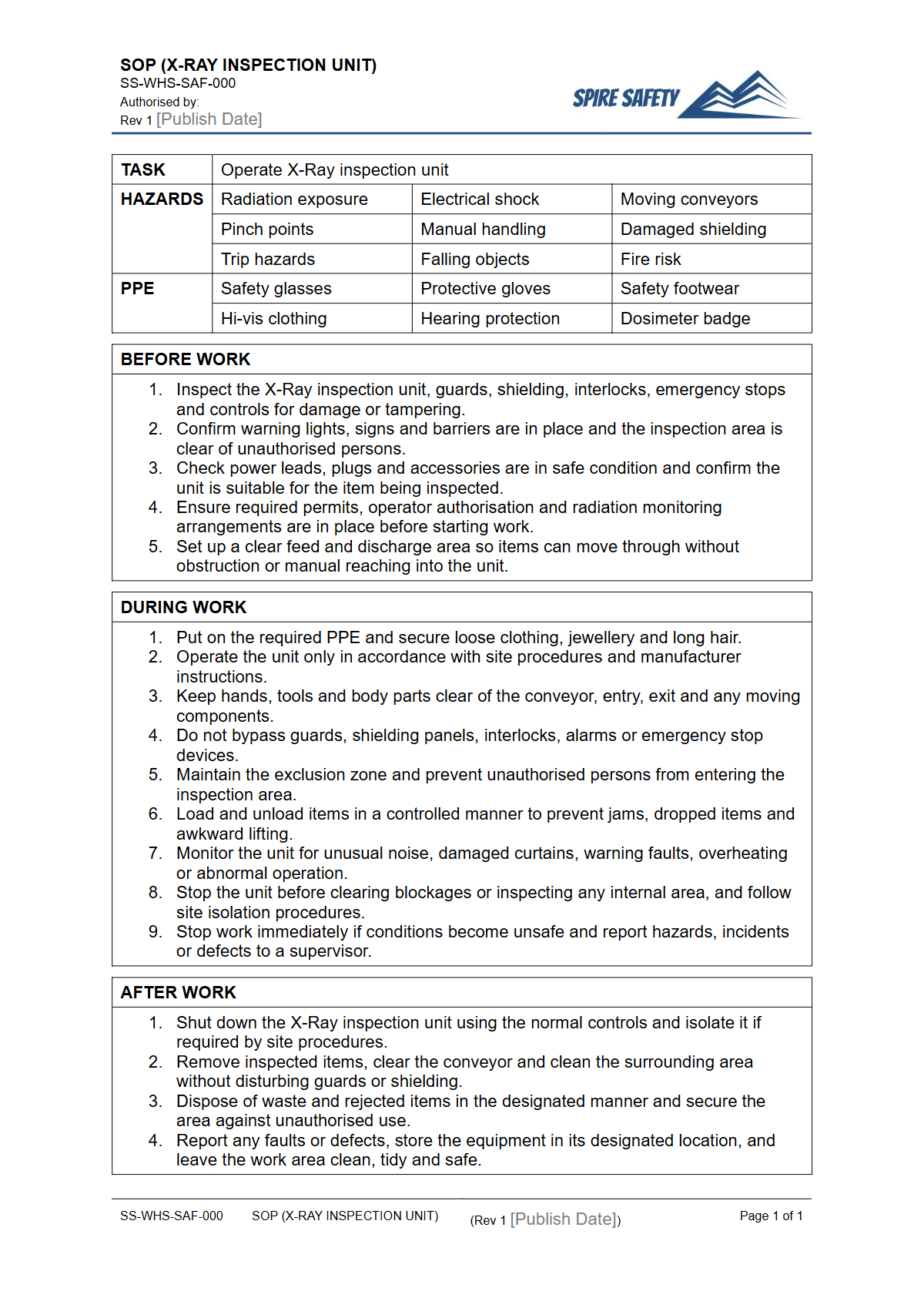
Operating an X-ray inspection unit involves significant hazards, primarily ionising radiation, but also electrical and mechanical risks. This Free Safe Operating Procedure (X-Ray Inspection Unit) Template provides a structured framework for documenting the essential health and safety controls required to manage these risks.
It guides your organisation in outlining step-by-step instructions for pre-operational checks, safe operation, cleaning, and shutdown processes, forming a critical part of your overall safety management system.
Using a documented SOP helps ensure that all personnel follow a consistent, safe method of work, reducing the likelihood of accidents and exposure to radiation. This is particularly important for equipment that is part of a larger production line, where interactions with other machinery must be managed.
For associated equipment, you may also need a FREE Conveyer System SOP (Safe Operating Procedure) Template to ensure seamless and safe integration.
What's Included in the SOP Template
This template is a comprehensive starting point designed to be adapted to your specific workplace. It includes sections for:
- Designated responsibilities and required training/licensing.
- Potential hazards and associated risk controls (PPE, engineering controls, administrative controls).
- Pre-operational safety checks (e.g., checking lead curtains, emergency stops, warning lights).
- Step-by-step operating procedures.
- Procedures for clearing blockages or jams.
- Shutdown and cleaning processes.
- Emergency procedures.
Video walkthrough
How to use the Free Safe Operating Procedure (X-Ray Inspection Unit) Template
This downloadable document is provided in DOCX and PDF formats for easy customisation. It is essential that you adapt this template to reflect the specific make and model of your X-ray unit, your workplace environment, and the tasks your workers perform.
Generic procedures are not sufficient for managing high-risk plant.
Important: You must customise this template. To create a compliant and effective SOP, you need to conduct a site-specific risk assessment for your X-ray unit and consult with the operators and maintenance staff who use the equipment.
We cannot provide a document that is compliant out-of-the-box, as this depends entirely on your specific circumstances. If you require assistance with risk assessments or developing tailored safety documents, consider our WHS consulting services.
When to use it
A Safe Operating Procedure for an X-ray inspection unit should be used as a primary reference document in several key situations. It should be the basis for all operator training and competency assessments.
It must be readily available to workers in the operating area for easy reference. The SOP is also a critical tool during safety audits, incident investigations, and regular procedural reviews.
Integrating this SOP into your broader safety framework ensures it doesn't exist in isolation. Well-developed WHS management systems use SOPs as foundational documents for training, monitoring, and continuous improvement.
The procedure should be formally reviewed at least annually, or whenever there is a change to the equipment, process, or relevant legislation.
Who should use it
This SOP is intended for several groups within an organisation. Primarily, it is for the trained and authorised operators of the X-ray inspection unit.
Supervisors must also be thoroughly familiar with the SOP to effectively oversee work and ensure procedures are followed correctly. Maintenance personnel should use the relevant sections of the SOP, in conjunction with manufacturer's manuals, when performing servicing or repairs.
Workplace Health and Safety (WHS) managers and officers will use the SOP as a key document for risk management, training development, and compliance verification. Regular checks and audits are essential to ensure the documented procedures remain effective and reflect actual work practices.
Spire Safety can assist with WHS compliance auditing to verify the effectiveness of your implemented procedures.
This template is just one of many industry-specific documents available. You can explore our complete free WHS resources library for other templates and guides to support your safety management efforts. For example, many industrial facilities also require procedures for other common equipment, which may be covered by our Free Air Compressor SOP (Safe Operating Procedure) Template.
Common mistakes
Common mistakes to avoid
- Using the template without customising it for the specific machine model and workplace.
- Failing to incorporate state-specific radiation use licensing requirements for operators.
- Neglecting to include detailed procedures for safely clearing product jams inside the tunnel.
- Not providing practical, hands-on training to workers based on the finalised SOP.
Legal references
Legal considerations
The following legal requirements may be relevant to this type of work.
- Work Health and Safety Act (Harmonised) — Provides the primary duties for protecting workers and other people from work health and safety risks.
- Work Health and Safety Regulations (Harmonised) — Sets out requirements supporting the management of workplace hazards and risks.
The following codes may be relevant to this type of work.
- Managing WHS Risks Code of Practice — Provides practical guidance on identifying hazards, assessing risks and applying effective controls.
- Work Health and Safety Consultation, Cooperation and Coordination Code of Practice — Provides practical guidance on consulting workers and coordinating with other duty holders.
- Managing the Work Environment and Facilities Code of Practice — Provides practical guidance on safe work environments, workplace facilities and related controls.
Did you know
State-Based Regulation
Unlike medical X-ray equipment, industrial X-ray units are typically regulated by state or territory environmental protection agencies or radiation health departments, not the Therapeutic Goods Administration (TGA).
Lead Curtains are Critical
The flexible lead-impregnated curtains at the entrance and exit of an X-ray unit's tunnel are a critical engineering control. Even small gaps, damage, or missing strips can significantly increase radiation scatter in the work area.
FAQ
Frequently asked questions
01What are the main hazards of an X-ray inspection unit?
02Is a Safe Operating Procedure a legal requirement for X-ray equipment in Australia?
03Who is qualified to operate an X-ray inspection unit?
04How often should an SOP for an X-ray unit be reviewed?
Share this resource
Free Safe Operating Procedure (X-Ray Inspection Unit) Template
Browse Categories
How To Use It
- 1Download and open in Word or PDF.
- 2Replace the placeholders with your business details.
- 3Get it reviewed by a WHS specialist before rollout.
Need it customised?
Our WHS consultants can adapt this template to your site, run a gap analysis, or audit what you already have in place.
Book a Free Consultation WHS consulting servicesor call 1300 156 382
Related templates
- Free Safe Operating Procedure (Yard Pedestrian Control) Template
- Free Safe Operating Procedure (Yard Traffic Control) Template
- Free Safe Operating Procedure (Yard Waste Collection) Template
- Free Safe Operating Procedure Template
- FREE Sand Blasting SOP (Safe Operating Procedure) Template
- FREE Scissor Lift SOP (Safe Operating Procedure) Template