
Free Safe Operating Procedure (Work Bench) Template
Establish clear, safe work practices for using work benches in your workshop. Download our free Safe Operating Procedure (Work Bench) Template today.
Free Safe Operating Procedure (Work Bench) Template
DOCX • 126 KB + PDF
Updated Oct 2026
No signup required
Purpose of the Free Safe Operating Procedure (Work Bench) Template
A work bench is a fundamental piece of equipment in almost any workshop, factory, or maintenance facility. While it may seem simple, the tasks performed on it often involve hazards that can lead to injury if not properly managed.
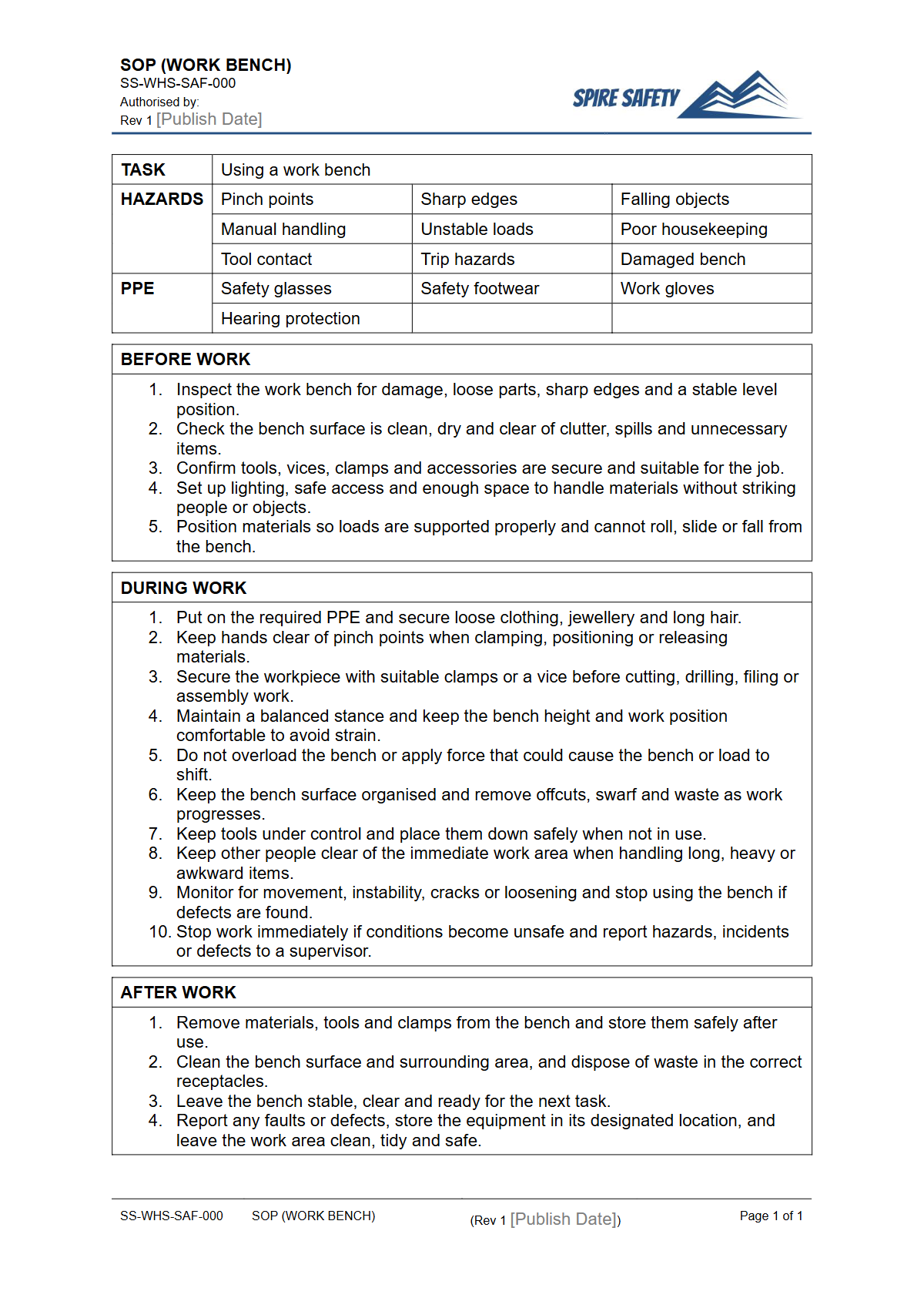
This Free Safe Operating Procedure (Work Bench) Template provides a structured starting point for documenting the safe use of work benches in your organisation. Using a standardised SOP helps to minimise risks such as cuts, strains, trips, and exposure to hazardous materials.
It formalises step-by-step instructions, ensuring tasks are performed consistently and safely by all personnel.
Implementing a clear SOP for work benches demonstrates a commitment to workplace safety and is a key component of a proactive risk management strategy. It serves as a vital training tool for new employees and a reference for experienced workers, helping to embed a strong safety culture.
A documented procedure also plays a crucial role in your overall WHS management systems, providing clear evidence of the control measures you have in place to protect your team.
Video walkthrough
How to use the Free Safe Operating Procedure (Work Bench) Template
This template is available as a fully editable DOCX file, with a PDF version also provided for easy printing and distribution. To get the most out of this resource, you should integrate it into your existing safety documentation.
The process involves identifying all tasks performed at the work bench, consulting with the workers who use it, and conducting a thorough risk assessment to identify all potential hazards. The template includes sections for pre-operational checks, step-by-step procedures, and clean-up, which you must populate with details specific to your site.
For example, your procedure should detail the specific hand tools, power tools, or chemicals used, and outline the correct handling and storage for each. If workers frequently use specific equipment at the bench, such as a grinder or saw, you may want to reference your specific circular saw SOP template within this document.
This creates a more comprehensive and interconnected safety system for your workshop.
IMPORTANT: This is a template, not a finished document. It is a starting point that you must customise to reflect the specific work benches, tools, tasks, materials, and hazards present in your unique workplace.
Spire Safety is not responsible for your WHS outcomes; compliance depends entirely on the accuracy and implementation of the final document you create.
When to use a Work Bench SOP
A Safe Operating Procedure for a work bench should be developed before any work commences. It should be used as a primary training document during the induction and onboarding of new employees or contractors who will be working in the workshop.
The SOP is also a critical reference tool for regular refresher training to prevent complacency and reinforce safe work habits. It should be readily available at or near the work area for quick reference.
The document should also be reviewed and updated periodically. A review is necessary whenever a new task, tool, or chemical is introduced; after any incident or near miss occurs; or if legislative requirements change.
Regular reviews, which can be part of your scheduled WHS compliance auditing program, ensure the SOP remains relevant and effective in controlling risks. This continuous improvement process is fundamental to maintaining a safe work environment.
Who should use this SOP
This Safe Operating Procedure should be used by anyone who interacts with the work bench. This includes workshop employees, maintenance staff, apprentices, trainees, and supervisors.
Supervisors are responsible for ensuring that workers are trained on the SOP and follow its instructions. WHS managers and officers will use the SOP as part of their risk assessments, safety audits, and incident investigations.
Essentially, the SOP acts as a clear communication tool between management and workers, outlining expectations for safe behaviour. By involving workers in the development and review of the SOP, you foster a sense of ownership and increase the likelihood of adherence.
For organisations looking to build a more robust safety framework beyond individual documents, engaging external experts can be beneficial. Professional WHS consulting can help integrate procedures like this into a comprehensive, site-wide safety system.
Procedures for other common workshop equipment, like our air compressor SOP, can also be developed to complement this document and cover more of your operational risks.
This document is just one of many templates we offer to support Australian businesses in managing their WHS obligations. You can explore our complete free WHS resources library for more templates, checklists, and guides covering a wide range of tasks and equipment.
Common mistakes
Common mistakes to avoid
- Using a generic template without customising it for specific tools, tasks, and materials.
- Failing to specify the correct Personal Protective Equipment (PPE) for tasks performed at the bench.
- Neglecting to include clear procedures for housekeeping and waste disposal.
- Storing the SOP in an office instead of making it easily accessible to workers in the work area.
Legal references
Legal considerations
The following legal requirements may be relevant to this type of work.
- Work Health and Safety Act (Harmonised) — Provides the primary duties for protecting workers and other people from work health and safety risks.
- Work Health and Safety Regulations (Harmonised) — Sets out requirements supporting the management of workplace hazards and risks.
The following codes may be relevant to this type of work.
- Managing WHS Risks Code of Practice — Provides practical guidance on identifying hazards, assessing risks and applying effective controls.
- Work Health and Safety Consultation, Cooperation and Coordination Code of Practice — Provides practical guidance on consulting workers and coordinating with other duty holders.
- Managing the Work Environment and Facilities Code of Practice — Provides practical guidance on safe work environments, workplace facilities and related controls.
Did you know
Ergonomic Impact
Incorrect work bench height is a leading cause of musculoskeletal disorders in workshops. An adjustable-height bench can significantly reduce the risk of back and neck strain for workers of different statures.
The 5S System
A cluttered work bench is a hazardous one. Implementing the '5S' methodology (Sort, Set in Order, Shine, Standardise, Sustain) can dramatically improve safety and efficiency by creating an organised workspace.
FAQ
Frequently asked questions
01What should be included in a work bench SOP?
02How often should a Safe Operating Procedure for a work bench be reviewed?
03Is an SOP legally required for a simple work bench?
04What is the difference between an SOP and a SWMS for a work bench?
Share this resource
Free Safe Operating Procedure (Work Bench) Template
Browse Categories
How To Use It
- 1Download and open in Word or PDF.
- 2Replace the placeholders with your business details.
- 3Get it reviewed by a WHS specialist before rollout.
Need it customised?
Our WHS consultants can adapt this template to your site, run a gap analysis, or audit what you already have in place.
Book a Free Consultation WHS consulting servicesor call 1300 156 382
Related templates
- Free Safe Operating Procedure (Workboat Operation) Template
- Free Safe Operating Procedure (Workshop Press) Template
- Free Safe Operating Procedure (X-Ray Baggage Scanner) Template
- Free Safe Operating Procedure (X-Ray Inspection Unit) Template
- Free Safe Operating Procedure (Yard Pedestrian Control) Template
- Free Safe Operating Procedure (Yard Traffic Control) Template