
Free Safe Operating Procedure (Workboat Operation) Template
Formalise your safety protocols for marine tasks with our workboat operation template. Download this free Safe Operating Procedure to get started.
Free Safe Operating Procedure (Workboat Operation) Template
DOCX • 126 KB + PDF
Updated Oct 2026
No signup required
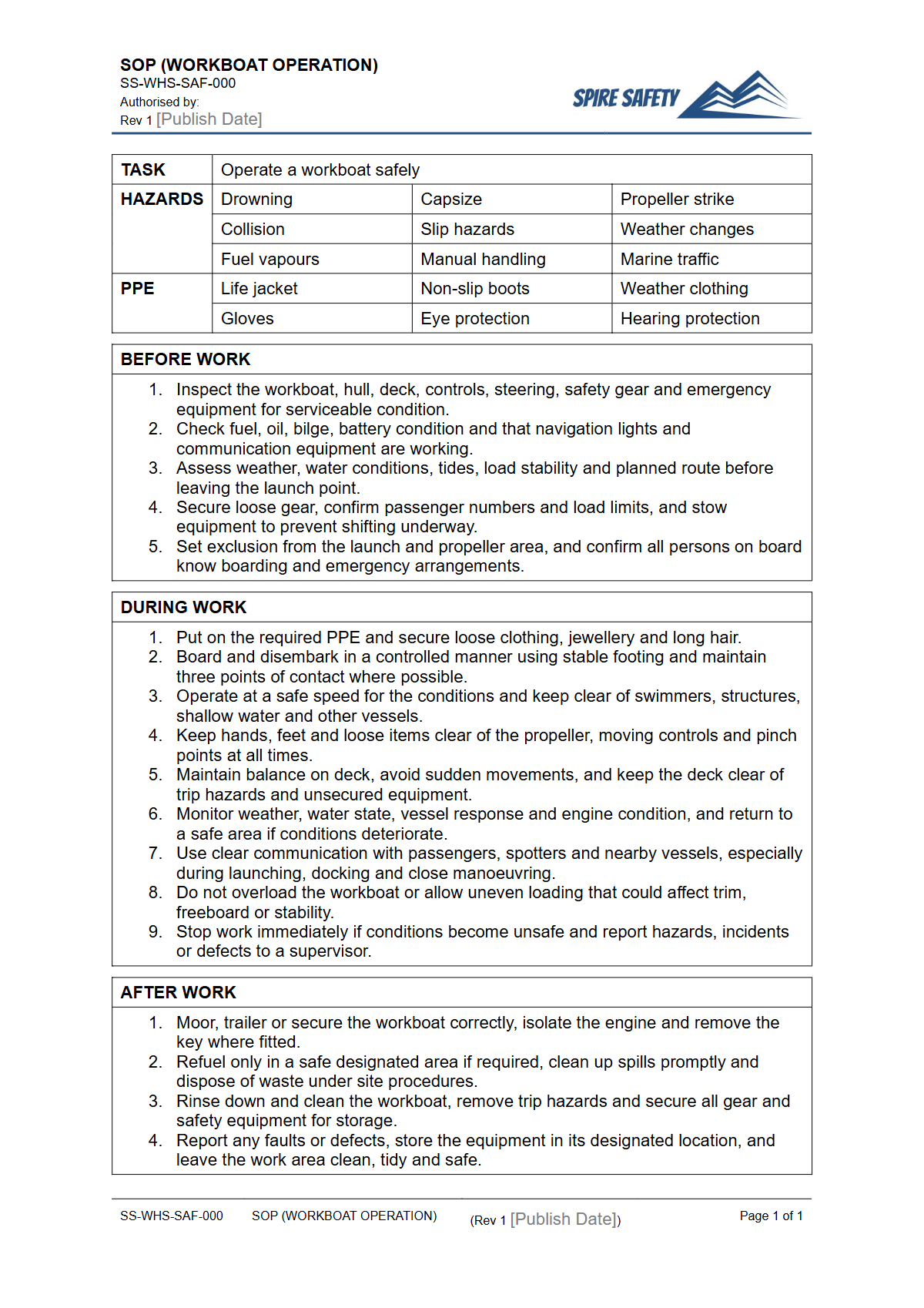
Purpose of the Free Safe Operating Procedure (Workboat Operation) Template
Operating a workboat, whether on coastal waters, rivers, or dams, involves significant risks, from drowning and collision to mechanical failure and exposure to the elements. This free Safe Operating Procedure (Workboat Operation) template provides a structured framework for documenting the safe and compliant use of workboats in your organisation.
It is designed to help you clearly define pre-operational checks, step-by-step task instructions, and emergency responses, forming a critical component of your overall safety management system.
A well-developed SOP serves as a vital tool for training, risk management, and demonstrating due diligence. By standardising procedures, you reduce the likelihood of incidents caused by human error, equipment misuse, or a lack of situational awareness.
Integrating this procedure into your broader WHS management systems ensures that marine operations are managed with the same level of safety and scrutiny as land-based activities, helping to protect your workers and meet your legal obligations.
Video walkthrough
How to use the Free Safe Operating Procedure (Workboat Operation) Template
This document is provided in both DOCX and PDF formats for your convenience. The DOCX file is fully editable, allowing for complete customisation.
To effectively implement this SOP, you should download the template and methodically work through each section, adapting the content to match your specific operational context. This includes detailing the types of workboats used, the exact tasks they are used for, the local marine environment, and the competencies required of your operators.
It is critical to remember that this is a template, not a finished document. We have provided a comprehensive starting point, but you must adapt it to reflect your specific workboats, tasks, environment, and personnel.
Consultation with your workers is a mandatory part of this process; they have firsthand knowledge of the risks and practicalities of the job. For organisations that use a variety of high-risk plant, you might also review our FREE Telehandler SOP (Safe Operating Procedure) Template to see how procedures for different equipment can be structured.
Key Elements of a Workboat SOP
A robust Workboat Operation SOP should be comprehensive and easy to understand. This template prompts you to detail several critical areas to create a complete and effective safety document.
Pre-Operational Checks
Before any voyage, a series of checks is essential. The SOP guides you to list all required inspections, including checks on the vessel's hull integrity, engine and fuel systems, steering, and communication equipment.
It also covers safety gear inventories, ensuring that personal flotation devices (PFDs), first aid kits, fire extinguishers, and signalling devices are present, in-date, and in good working order.
Safe Operation Steps
This section forms the core of the SOP, outlining the step-by-step process for normal operations. It should cover everything from launching and retrieval to navigating channels, mooring, and performing specific work tasks from the vessel.
If hazardous work like welding is performed on or from the vessel, you may need to cross-reference other procedures, similar to how a workshop would use an FREE Oxy Acetylene SOP (Safe Operating Procedure) Template for hot works.
Emergency Procedures
Things can go wrong quickly on the water. This section is dedicated to defining clear, actionable emergency plans.
Key scenarios to cover include man overboard recovery, engine failure, vessel grounding, fire onboard, medical emergencies, and procedures for abandoning the vessel if necessary. Clearly defined steps ensure a calm and coordinated response in a high-stress situation.
When to use a Workboat Operation SOP
A Safe Operating Procedure for workboats should be a living document, used consistently throughout your operations. It is essential during the induction and training of new operators to establish a baseline of safe behaviour.
It should also be readily available at the point of use as a reference for pre-start checks and complex manoeuvres. Furthermore, the SOP is a key document for review during safety meetings, after any near-miss or incident, and as part of periodic WHS compliance auditing to verify that documented procedures are being followed in practice.
Who should use this Safe Operating Procedure
This SOP should be used by multiple people within an organisation. Vessel operators and crew are the primary users who must understand and follow the procedures daily.
Supervisors and managers are responsible for implementing the SOP, providing training, and ensuring compliance. A Person Conducting a Business or Undertaking (PCBU) holds the ultimate responsibility for ensuring such safe systems of work are developed and maintained.
For businesses needing expert assistance in drafting and implementing robust safety procedures, engaging external WHS consulting services can provide valuable guidance and help ensure all legal duties are met.
This template is one of many tools designed to help Australian businesses manage workplace risks. For more templates, checklists, and guides, explore our complete free WHS resources library.
Common mistakes
Common mistakes to avoid
- Using the generic template without customising it for specific vessels and tasks.
- Failing to conduct practical, hands-on training for all operators based on the finalised SOP.
- Overlooking or rushing pre-start inspections and essential safety equipment checks.
- Not having clear 'no-go' criteria for adverse weather or sea conditions.
Legal references
Legal considerations
The following legal requirements may be relevant to this type of work.
- Work Health and Safety Act (Harmonised) — Provides the primary duties for protecting workers and other people from work health and safety risks.
- Work Health and Safety Regulations (Harmonised) — Sets out requirements supporting the management of workplace hazards and risks.
The following codes may be relevant to this type of work.
- Managing WHS Risks Code of Practice — Provides practical guidance on identifying hazards, assessing risks and applying effective controls.
- Work Health and Safety Consultation, Cooperation and Coordination Code of Practice — Provides practical guidance on consulting workers and coordinating with other duty holders.
- Managing the Work Environment and Facilities Code of Practice — Provides practical guidance on safe work environments, workplace facilities and related controls.
Did you know
Unpredictable Waters
Drowning is a leading cause of workplace fatalities in Australia's maritime sector. Many incidents could have been prevented by wearing a personal flotation device (PFD) and following established safety procedures.
Beyond the SOP
A Safe Operating Procedure is an 'administrative control' in the hierarchy of controls. It must be supported by higher-level controls like vessel maintenance (engineering) and eliminating unnecessary risks.
FAQ
Frequently asked questions
01What is a Safe Operating Procedure (SOP) for a workboat?
02Who is responsible for developing a workboat SOP in Australia?
03Does this template cover all types of workboats and marine conditions?
04How often should a Workboat Operation SOP be reviewed?
Share this resource
Free Safe Operating Procedure (Workboat Operation) Template
Browse Categories
How To Use It
- 1Download and open in Word or PDF.
- 2Replace the placeholders with your business details.
- 3Get it reviewed by a WHS specialist before rollout.
Need it customised?
Our WHS consultants can adapt this template to your site, run a gap analysis, or audit what you already have in place.
Book a Free Consultation WHS consulting servicesor call 1300 156 382
Related templates
- Free Safe Operating Procedure (Workshop Press) Template
- Free Safe Operating Procedure (X-Ray Baggage Scanner) Template
- Free Safe Operating Procedure (X-Ray Inspection Unit) Template
- Free Safe Operating Procedure (Yard Pedestrian Control) Template
- Free Safe Operating Procedure (Yard Traffic Control) Template
- Free Safe Operating Procedure (Yard Waste Collection) Template