
Free Safe Operating Procedure (Wood Lathe) Template
Control the risks associated with wood lathe operation with our free template. Download this customisable Safe Operating Procedure to document your processes.
Free Safe Operating Procedure (Wood Lathe) Template
DOCX • 126 KB + PDF
Updated Oct 2026
No signup required
Purpose of the Free Safe Operating Procedure (Wood Lathe) Template
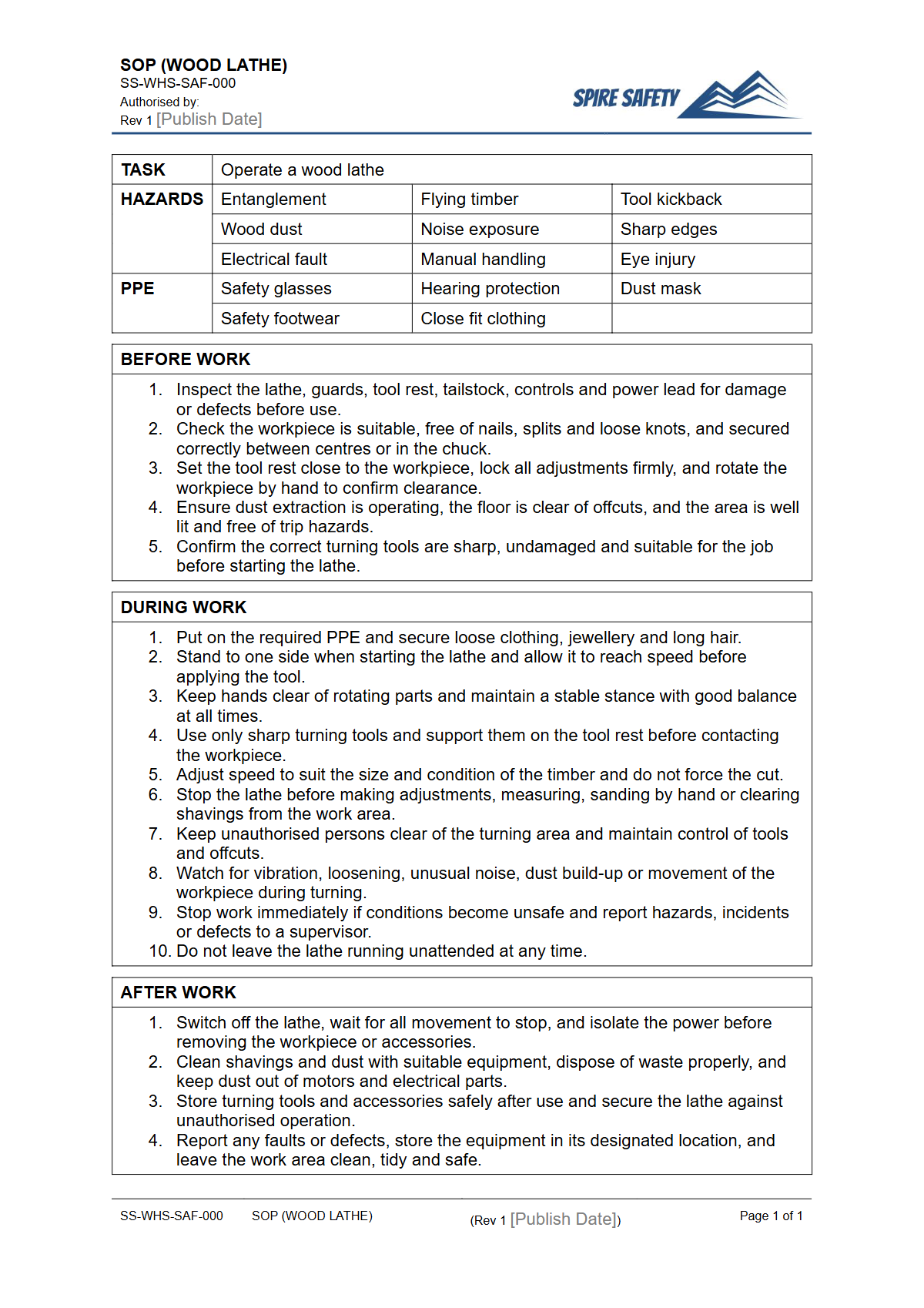
Operating a wood lathe presents significant health and safety risks, including entanglement, impact from the workpiece, and dust inhalation. This Free Safe Operating Procedure (Wood Lathe) Template provides a structured starting point for your business to document the required steps for operating this equipment safely.
A well-drafted SOP is a critical tool for worker training, risk management, and demonstrating a commitment to a safe work environment. It formalises your processes, helps ensure consistency in operation, and acts as a key component of your overall safety management framework.
The template is designed to be clear and user-friendly, guiding you through the essential components of a robust procedure. It covers key areas such as pre-operational checks, personal protective equipment (PPE) requirements, step-by-step operating instructions, and shutdown procedures.
By implementing a detailed SOP, you help meet your duty of care obligations under Australian WHS legislation.
Video walkthrough
How to use the Free Safe Operating Procedure (Wood Lathe) Template
This resource is available for download as a DOCX file for easy editing or as a PDF for quick reference. The first step is to download the template and thoroughly review its contents.
It is designed based on the model WHS framework and common industry practices but must be adapted to your specific context.
It is crucial to note that this template is a starting point. We strongly recommend you customise it to reflect the specific make and model of your lathe, your unique workplace environment, the types of materials used, and any state-specific regulations.
You should consult with the operators of the equipment to ensure the documented steps are practical and reflect how the work is actually done safely. Once customised, the SOP should be approved by a manager or supervisor before being implemented.
When to use it
A Safe Operating Procedure for a wood lathe should be a living document used consistently within your workplace. Its primary use is during worker induction and training, ensuring every operator understands the approved safe method before they use the equipment.
It should also be readily accessible in the work area as a day-to-day reference for pre-start checks and operational steps.
Furthermore, the SOP is a vital tool for refresher training and for verifying competency. It should be reviewed and referenced after any incident or near-miss, or when changes are made to the equipment or process.
Integrating SOPs like this one is a fundamental part of developing comprehensive WHS management systems that proactively manage risk.
What's included in the template?
Our template provides a clear structure to build upon, including sections for:
- Required Personal Protective Equipment (PPE)
- Potential hazards and risk controls
- Pre-operational safety checks
- Step-by-step instructions for safe operation
- Post-operation shutdown and cleaning procedures
- Emergency response actions
For complex workshops, you may need multiple SOPs for different types of equipment. For instance, you could complement this document with our free Circular Saw SOP to cover other key woodworking machinery.
Who should use it
Responsibility for workplace safety is shared. This SOP template is intended for use by several key roles within an organisation:
- Persons Conducting a Business or Undertaking (PCBUs): To meet their primary duty of care by providing a safe system of work.
- Managers and Supervisors: To train workers, enforce procedures, and supports your compliance efforts in their area of responsibility. Regular reviews and checks can be supported by external WHS compliance auditing services to verify effectiveness.
- Workers: To understand and follow the safe work steps required to protect themselves and their colleagues from harm.
- WHS Professionals: As a tool to standardise procedures and integrate them into the broader safety system.
A collaborative approach involving consultation with operators is the most effective way to develop and implement a practical SOP. In a typical workshop, you may also require procedures for ancillary equipment, which can be developed using our Air Compressor SOP template.
While this SOP covers lathes, other high-risk tasks like welding require their own specific procedures, such as our free Oxy Acetylene SOP template. Ensuring you have documented procedures for all high-risk plant and equipment is essential. You can explore our entire free WHS resources library for more templates to support your safety goals.
Common mistakes
Common mistakes to avoid
- Using the template without customising it for the specific lathe model and workplace.
- Failing to adequately train workers on the SOP's contents before they operate the lathe.
- Not wearing appropriate PPE, especially mandatory eye and face protection.
- Neglecting to review and update the SOP after an incident, process change, or on a scheduled basis.
Legal references
Legal considerations
The following legal requirements may be relevant to this type of work.
- Work Health and Safety Act (Harmonised) — Provides the primary duties for protecting workers and other people from work health and safety risks.
- Work Health and Safety Regulations (Harmonised) — Sets out requirements supporting the management of workplace hazards and risks.
The following codes may be relevant to this type of work.
- Managing WHS Risks Code of Practice — Provides practical guidance on identifying hazards, assessing risks and applying effective controls.
- Work Health and Safety Consultation, Cooperation and Coordination Code of Practice — Provides practical guidance on consulting workers and coordinating with other duty holders.
- Managing the Work Environment and Facilities Code of Practice — Provides practical guidance on safe work environments, workplace facilities and related controls.
Did you know
Ancient Origins
The earliest known depiction of a lathe dates back to an ancient Egyptian tomb from around 300 BC. This early two-person lathe required one person to turn the wood with a rope while the other used a sharp tool to cut.
Entanglement Risk
Loose clothing, long hair, and jewellery are leading causes of serious injuries on lathes. They can be easily caught by the rotating workpiece or chuck, pulling the operator into the machine in a fraction of a second.
FAQ
Frequently asked questions
01What should be included in a wood lathe SOP?
02How often should a Safe Operating Procedure be reviewed?
03Is an SOP the same as a risk assessment?
04Who is responsible for writing a wood lathe SOP?
Share this resource
Free Safe Operating Procedure (Wood Lathe) Template
Browse Categories
How To Use It
- 1Download and open in Word or PDF.
- 2Replace the placeholders with your business details.
- 3Get it reviewed by a WHS specialist before rollout.
Need it customised?
Our WHS consultants can adapt this template to your site, run a gap analysis, or audit what you already have in place.
Book a Free Consultation WHS consulting servicesor call 1300 156 382
Related templates
- Free Safe Operating Procedure (Woodchip Path Care) Template
- Free Safe Operating Procedure (Wool Bale Handling) Template
- Free Safe Operating Procedure (Wool Press) Template
- Free Safe Operating Procedure (Work Bench) Template
- Free Safe Operating Procedure (Workboat Operation) Template
- Free Safe Operating Procedure (Workshop Press) Template