
Free Safe Operating Procedure (Wool Bale Handling) Template
Effectively manage manual handling risks in your agricultural workplace with our free wool bale handling SOP.
Free Safe Operating Procedure (Wool Bale Handling) Template
DOCX • 126 KB + PDF
Updated Oct 2026
No signup required
Purpose of the Free Safe Operating Procedure (Wool Bale Handling) Template
Handling wool bales presents significant manual handling risks, primarily due to their substantial weight and awkward size. This can lead to serious musculoskeletal disorders (MSDs) and other injuries.
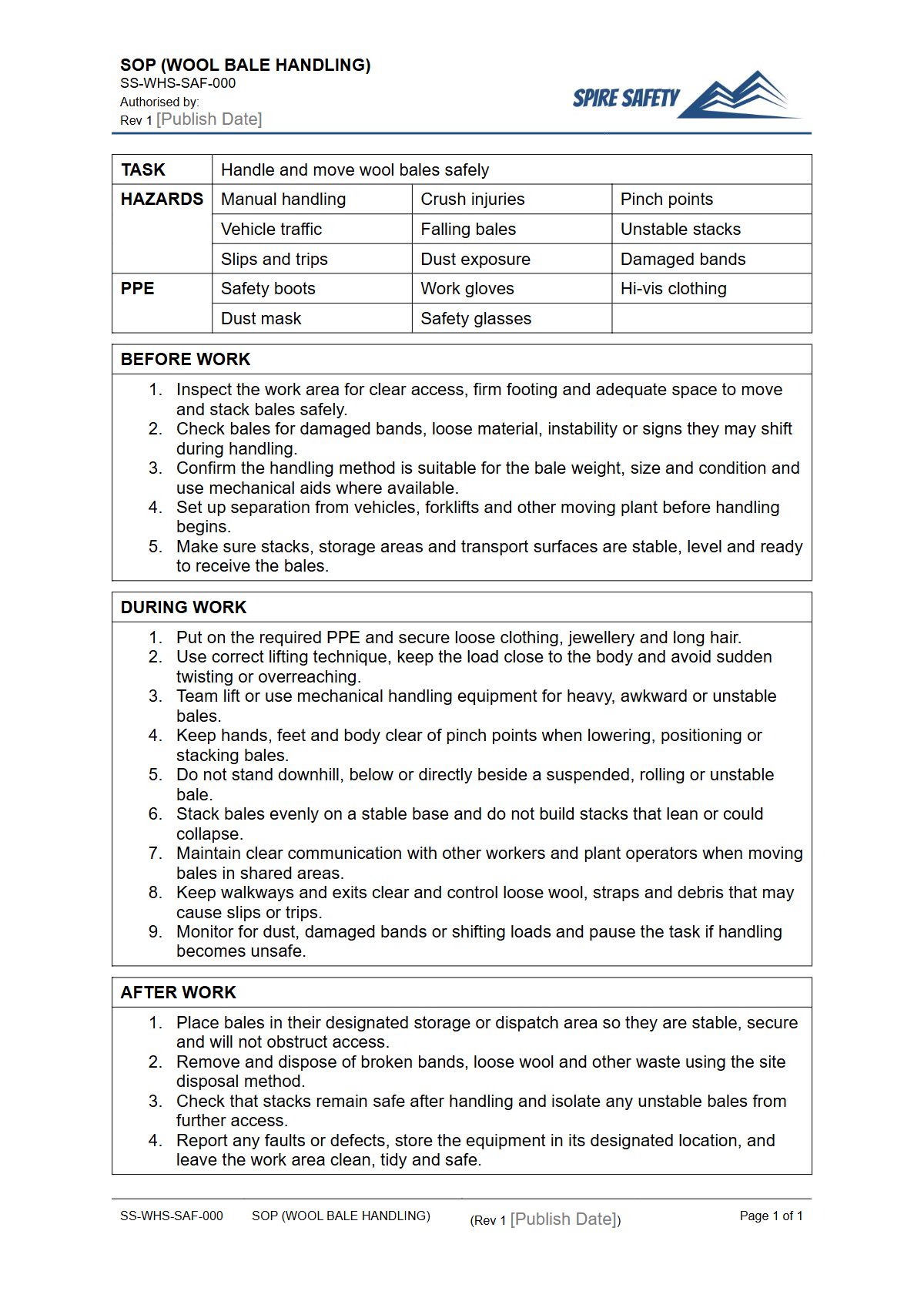
This Free Safe Operating Procedure (Wool Bale Handling) Template provides a structured framework for documenting and implementing a safe system of work for lifting, moving, stacking, and destacking wool bales. By establishing clear, step-by-step instructions, organisations can standardise their processes, reduce the risk of injury, and demonstrate a commitment to workplace health and safety.
The template is designed to help you identify hazards, assess risks, and implement effective control measures specific to your agricultural setting.
Video walkthrough
How to use the Free Safe Operating Procedure (Wool Bale Handling) Template
Our template is available for download as a fully editable DOCX file, with a PDF version also provided for easy printing and distribution. The key to its effectiveness lies in its customisation.
This document is a starting point, not a finished product.
Important: You must customise this template to reflect the specific equipment, environment, and processes used in your workplace. We recommend a collaborative approach: consult with your workers, supervisors, and health and safety representatives to ensure the final SOP is practical, comprehensive, and understood by everyone who will use it.
Fill in the designated sections with your site-specific details, including machinery used, personnel responsibilities, and emergency contacts. This process ensures the SOP becomes an integral part of your broader WHS management systems.
When to use this Safe Operating Procedure
A Safe Operating Procedure (SOP) for wool bale handling should be a core document used consistently throughout your operations. It serves multiple functions, including:
- Training and Induction: Use the SOP as a primary training tool for new and young workers to ensure they understand the approved methods and associated risks from day one.
- Pre-Task Briefings: Review the SOP during toolbox talks or before starting a high-risk bale handling task to refresh knowledge and reinforce safety protocols.
- Risk Management: The SOP is a live document that forms part of your risk assessment process. It should be reviewed and updated after any incident, near miss, or when new equipment or procedures are introduced.
- Supervision and Monitoring: Supervisors can use the SOP as a benchmark to monitor work practices and confirm that tasks are being performed safely and correctly. Regular reviews may be part of a scheduled WHS compliance auditing program.
Who should use it
This SOP is intended for use by all personnel involved in the lifecycle of wool bale handling. This includes:
- Workers: The primary users, who must understand and follow the procedure to ensure their own safety and the safety of their colleagues.
- Supervisors and Farm Managers: Responsible for implementing the SOP, providing adequate training, and ensuring it is consistently followed on the ground.
- Persons Conducting a Business or Undertaking (PCBUs): Business owners and employers who have the primary duty of care to ensure a safe working environment. A well-implemented SOP is a key way to help meet this obligation.
- WHS Officers and Consultants: Professionals who can use the template to develop and integrate formalised safety procedures into the organisation's safety framework.
Key Hazards in Wool Bale Handling
The core purpose of this SOP is to control risks associated with common hazards. These include:
- Manual Handling: Lifting, pushing, or pulling heavy bales can cause sprains, strains, and chronic back injuries.
- Struck-by Hazards: Workers can be struck by falling bales from unstable stacks or during mechanical handling.
- Crush Injuries: Getting caught between a bale and a fixed structure, or being crushed by overturning machinery like a forklift or tractor.
- Slips, Trips, and Falls: Poor housekeeping, uneven ground, and contaminants like grease or wool debris can create hazardous walking surfaces in storage and handling areas.
Controlling Risks with Mechanical Aids
The hierarchy of control prioritises eliminating manual handling where possible. Using mechanical aids is a critical engineering control.
If your operation uses specific machinery for this task, you should have a corresponding procedure in place. For instance, many farms rely on telehandlers for moving bales, which requires its own documented procedure, such as our FREE Telehandler SOP Template.
A comprehensive approach to farm safety involves documenting procedures for all high-risk plant and activities. Alongside bale handling, your safety system may need to cover other common equipment.
For example, ensuring you have a documented process like our FREE Grain Drill SOP Template helps create a more robust safety culture across all farm operations. This SOP is just one component of a complete safety system.
You can explore our entire free WHS resources library for more templates to support your organisation.
Common mistakes
Common mistakes to avoid
- Failing to properly customise the generic template for site-specific machinery and conditions.
- Neglecting to consult with workers who actually perform the task when drafting the procedure.
- Stacking bales in a way that is unstable, such as in a pure column stack rather than an interlocking pattern.
- Not providing or enforcing the use of available mechanical aids like forklifts, telehandlers, or bale grabs.
Legal references
Legal considerations
The following legal requirements may be relevant to this type of work.
- Work Health and Safety Act (Harmonised) — Provides the primary duties for protecting workers and other people from work health and safety risks.
- Work Health and Safety Regulations (Harmonised) — Sets out requirements supporting the management of workplace hazards and risks.
The following codes may be relevant to this type of work.
- Managing WHS Risks Code of Practice — Provides practical guidance on identifying hazards, assessing risks and applying effective controls.
- Work Health and Safety Consultation, Cooperation and Coordination Code of Practice — Provides practical guidance on consulting workers and coordinating with other duty holders.
- Managing the Work Environment and Facilities Code of Practice — Provides practical guidance on safe work environments, workplace facilities and related controls.
Did you know
A Heavy Burden
A single farm wool bale can weigh up to 204 kg, making it impossible and extremely dangerous for one person to lift manually. This highlights the critical need for mechanical aids and proper procedures.
Agriculture's High Risk
The agriculture, forestry, and fishing industry consistently has one of the highest rates of serious workplace injury claims in Australia, with body stressing and being hit by moving objects being major causes.
FAQ
Frequently asked questions
01What are the main hazards of handling wool bales?
02Is a Safe Operating Procedure a legal requirement for handling wool bales in Australia?
03How heavy is a standard wool bale?
04Can I use this SOP for other types of agricultural bales, like hay or silage?
Share this resource
Free Safe Operating Procedure (Wool Bale Handling) Template
Browse Categories
How To Use It
- 1Download and open in Word or PDF.
- 2Replace the placeholders with your business details.
- 3Get it reviewed by a WHS specialist before rollout.
Need it customised?
Our WHS consultants can adapt this template to your site, run a gap analysis, or audit what you already have in place.
Book a Free Consultation WHS consulting servicesor call 1300 156 382
Related templates
- Free Safe Operating Procedure (Wool Press) Template
- Free Safe Operating Procedure (Work Bench) Template
- Free Safe Operating Procedure (Workboat Operation) Template
- Free Safe Operating Procedure (Workshop Press) Template
- Free Safe Operating Procedure (X-Ray Baggage Scanner) Template
- Free Safe Operating Procedure (X-Ray Inspection Unit) Template