
Free Safe Operating Procedure (Woodchip Path Care) Template
Download our free Safe Operating Procedure (Woodchip Path Care) Template to manage hazards in landscaping and groundskeeping. Get your DOCX and PDF now.
Free Safe Operating Procedure (Woodchip Path Care) Template
DOCX • 126 KB + PDF
Updated Oct 2026
No signup required
Purpose of the Free Safe Operating Procedure (Woodchip Path Care) Template
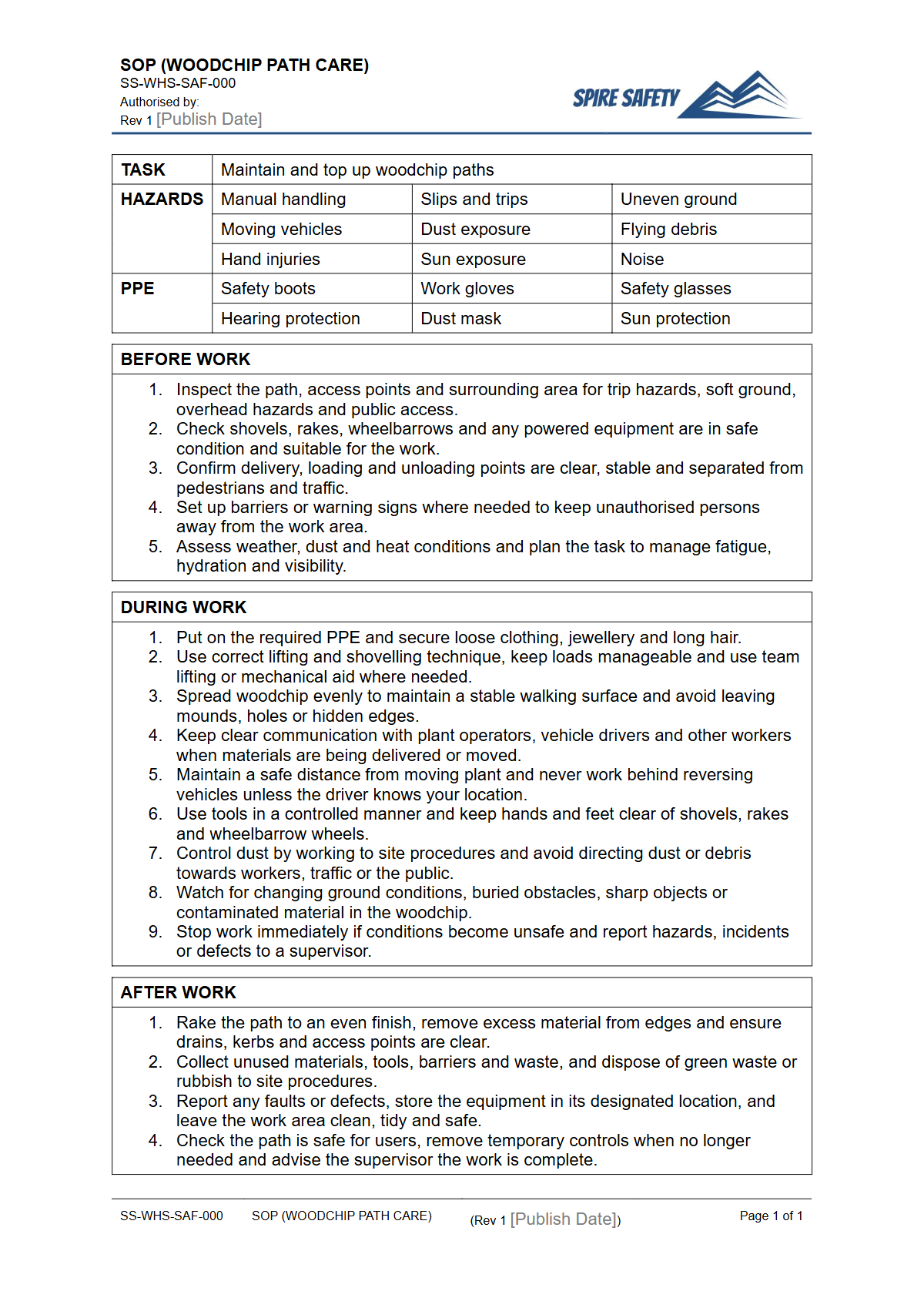
This Safe Operating Procedure (SOP) for woodchip path care provides a structured framework for managing health and safety risks associated with maintaining paths in parks, gardens, and other landscaped areas. Using a dedicated Free Safe Operating Procedure (Woodchip Path Care) Template helps ensure tasks like spreading, raking, and replenishing woodchips are performed consistently and safely.
The document prompts consideration of hazards such as manual handling, slips and trips, dust inhalation, and the use of landscaping tools.
By formally documenting the process, organisations can standardise their approach, train workers effectively, and demonstrate due diligence in providing a safe system of work. A well-defined SOP is a critical component of any functional safety management system, forming the basis for worker training, competency assessments, and incident investigations.
It helps control risks at the source, which is a fundamental principle of Australian WHS legislation.
Video walkthrough
How to use the Free Safe Operating Procedure (Woodchip Path Care) Template
Our Free Safe Operating Procedure (Woodchip Path Care) Template is available for download as a DOCX file for easy editing and a PDF for straightforward distribution. This document is a starting point, designed to be adapted to your specific workplace.
It is essential that you customise the content to reflect the unique environment, equipment, materials, and personnel at your site.
To use the template effectively, a Person Conducting a Business or Undertaking (PCBU) or their delegate should consult with workers who perform the task. Input from the ground up ensures the procedure is practical and addresses the real-world hazards they face.
After customisation, the SOP should be formally approved, and all relevant workers must be trained on its contents before commencing work. Regular reviews are crucial to keep the document current. For complex operations involving heavy machinery to move materials, you may need to integrate procedures from other documents, like a FREE Telehandler SOP Template.
When to use it
An SOP for woodchip path care should be developed and implemented before any such maintenance work begins. It is a proactive tool used to guide routine tasks, such as topping up existing paths, clearing debris, or raking the surface level.
It is also essential when installing new woodchip paths, as this often involves more intensive manual labour and potential use of machinery.
The procedure should also be referenced during worker induction and task-specific training. Furthermore, it serves as a critical document for review after any incident or near-miss related to path maintenance.
If your worksite preparation involves creating new ground for paths, you may also require documents like a FREE Trencher SOP Template to cover associated excavation risks.
Who should use it
This SOP is intended for use by a range of personnel and organisations. This includes landscapers, groundskeepers, horticulturalists, park rangers, and council workers responsible for maintaining public or private spaces.
It is also a vital resource for property managers and body corporates who oversee landscaped common areas.
WHS managers, supervisors, and team leaders should use this template to establish and enforce safe work standards within their teams. By implementing formal procedures, they can build a more robust framework for their WHS management systems. Workers themselves are the end-users, relying on the SOP for clear, step-by-step guidance on how to perform their duties safely.
For large-scale woodchip application, such as in playgrounds or extensive trail networks, specific machinery might be used. In these cases, your risk assessment may identify the need for additional procedures, such as those found in our FREE Spreader SOP (Safe Operating Procedure) Template, to manage equipment-specific hazards.
Ensuring these procedures are correctly implemented and consistently followed is key to maintaining a safe workplace. Regular reviews and checks can confirm that the documented process aligns with actual practice.
Organisations often benefit from independent WHS compliance auditing to verify the effectiveness of their safety systems.
This document is one of many available to help your organisation manage workplace risks. You can explore a wide range of similar documents in our complete free WHS resources library, covering various equipment, tasks, and hazards.
Common mistakes
Common mistakes to avoid
- Failing to customise the template with site-specific hazards and controls.
- Using poor manual handling techniques when lifting bags or spreading woodchip with a shovel.
- Neglecting to wear appropriate PPE, particularly respiratory protection (P2 mask) against dust and mould spores.
- Not inspecting tools like rakes, shovels, and wheelbarrows for defects before use.
Legal references
Legal considerations
The following legal requirements may be relevant to this type of work.
- Work Health and Safety Act (Harmonised) — Provides the primary duties for protecting workers and other people from work health and safety risks.
- Work Health and Safety Regulations (Harmonised) — Sets out requirements supporting the management of workplace hazards and risks.
The following codes may be relevant to this type of work.
- Managing WHS Risks Code of Practice — Provides practical guidance on identifying hazards, assessing risks and applying effective controls.
- Work Health and Safety Consultation, Cooperation and Coordination Code of Practice — Provides practical guidance on consulting workers and coordinating with other duty holders.
- Managing the Work Environment and Facilities Code of Practice — Provides practical guidance on safe work environments, workplace facilities and related controls.
Did you know
Hidden Heat
Thick piles of fresh woodchip can generate significant heat through decomposition. While rare, this process, known as composting, can create a spontaneous combustion risk in very hot, dry conditions if piles are not properly managed.
A Common Trip Hazard
One of the most frequent incidents associated with woodchip paths is a trip and fall. Regular raking and maintenance are not just for aesthetics; they are crucial risk controls to keep the surface level and prevent displacement.
FAQ
Frequently asked questions
01What are the main hazards involved in woodchip path care?
02Is a Safe Operating Procedure legally required for this task?
03How often should an SOP for woodchip path care be reviewed?
04Can this template be adapted for other types of garden mulch?
Share this resource
Free Safe Operating Procedure (Woodchip Path Care) Template
Browse Categories
How To Use It
- 1Download and open in Word or PDF.
- 2Replace the placeholders with your business details.
- 3Get it reviewed by a WHS specialist before rollout.
Need it customised?
Our WHS consultants can adapt this template to your site, run a gap analysis, or audit what you already have in place.
Book a Free Consultation WHS consulting servicesor call 1300 156 382
Related templates
- Free Safe Operating Procedure (Wool Bale Handling) Template
- Free Safe Operating Procedure (Wool Press) Template
- Free Safe Operating Procedure (Work Bench) Template
- Free Safe Operating Procedure (Workboat Operation) Template
- Free Safe Operating Procedure (Workshop Press) Template
- Free Safe Operating Procedure (X-Ray Baggage Scanner) Template