
Free Safe Operating Procedure (Wood Jointer) Template
Clearly define the step-by-step process for operating a wood jointer safely with our structured template. Download your free DOCX and PDF to get started.
Free Safe Operating Procedure (Wood Jointer) Template
DOCX • 126 KB + PDF
Updated Oct 2026
No signup required
Purpose of the Free Safe Operating Procedure (Wood Jointer) Template
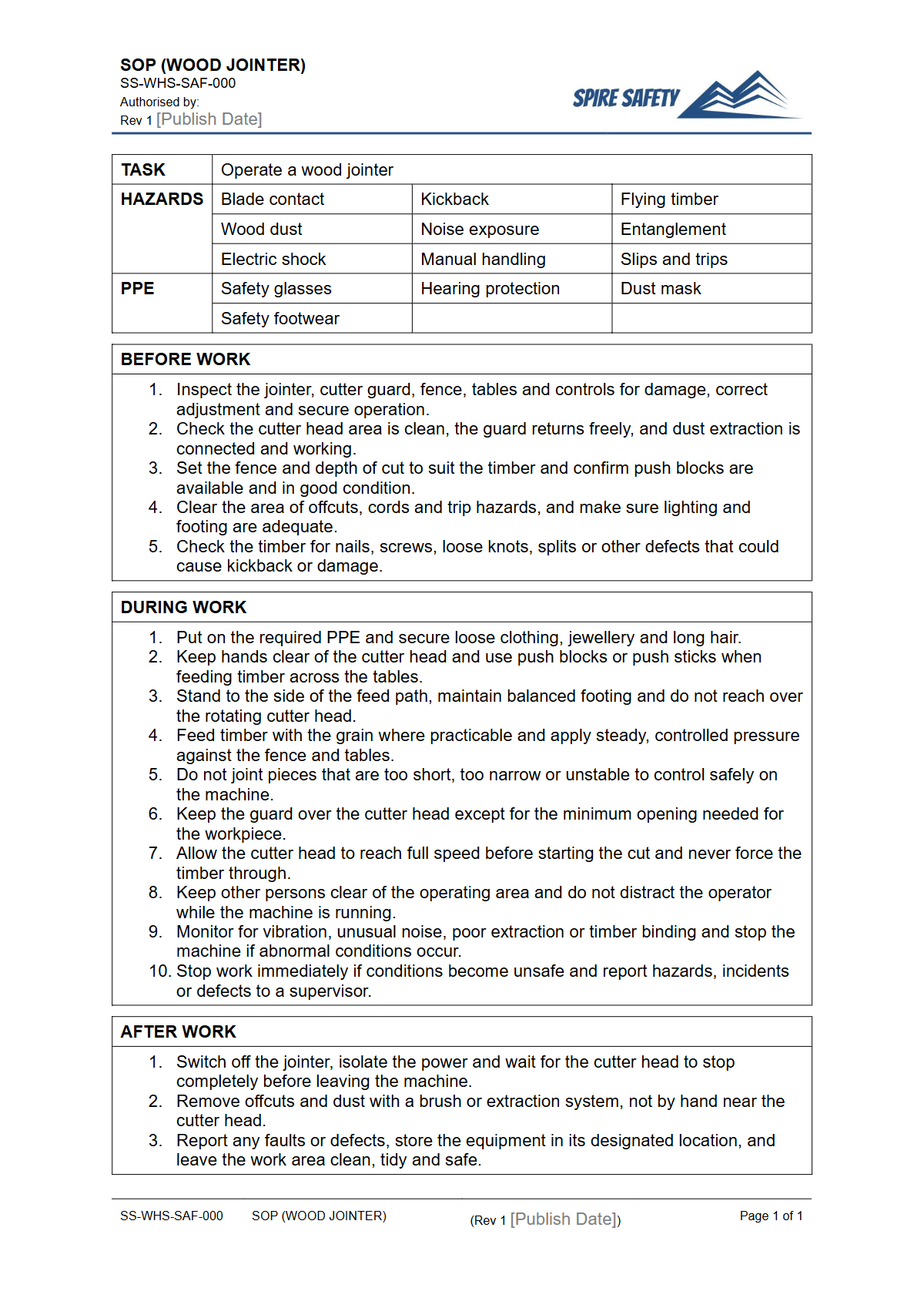
Operating a wood jointer presents significant risks, including severe cuts and amputations from the high-speed rotating cutterhead. This Free Safe Operating Procedure (Wood Jointer) Template provides a structured framework for documenting the required steps to operate this equipment safely.
A well-drafted SOP is a critical administrative control that helps standardise tasks, reduce the likelihood of incidents, and provide a clear basis for worker training and supervision. By outlining hazards like blade contact, kickback, and wood dust exposure, this template helps your organisation fulfil its primary duty of care.
It forms a key part of managing workshop risks, similar to how our circular saw SOP template addresses hazards for other common woodworking machinery.
Video walkthrough
How to use the Free Safe Operating Procedure (Wood Jointer) Template
Download the template in the format that best suits your needs: the DOCX file for easy editing and customisation, or the PDF for straightforward printing and distribution. It is essential to adapt this document to your specific operational context.
The template includes sections for Personal Protective Equipment (PPE), pre-start safety checks, step-by-step operating instructions, and post-use shutdown and cleaning procedures. You should consult with the workers who actually operate the jointer to ensure the procedure is practical, accurate, and reflects how the task is performed safely on-site.
Integrating tailored SOPs is a cornerstone of robust WHS management systems, demonstrating a systematic approach to hazard control.
Please note: This document is a template and must be customised to be effective. We have provided a structured starting point, but you must edit it to reflect the specific make and model of jointer in use, the types of timber being processed, and the unique conditions and processes of your workplace.
Its implementation and suitability are your responsibility.
When to use it
A Safe Operating Procedure for a wood jointer should be a readily accessible and frequently used document in any workshop. It is not a file to be completed once and forgotten.
Key times for its use include during the induction and training of new workers to establish a baseline of safe behaviour from day one. It should also be used for refresher training for existing staff to prevent complacency and reinforce correct methods.
The SOP serves as a vital on-the-job reference before commencing work, especially for tasks that are not performed daily. Following any incident or near-miss involving the jointer, the SOP must be reviewed and updated as part of the investigation process to prevent recurrence. It's a living document that supports other workshop safety protocols, like those detailed in our Air Compressor SOP template.
Who should use it
This SOP is intended for a range of personnel within an organisation to ensure a consistent and safe approach to machinery operation. The primary users are the workers and operators who are tasked with using the wood jointer.
Supervisors and managers must also use the document to verify that work is being conducted according to the agreed procedure and to facilitate safety observations. WHS personnel will use this template as part of the process of developing and reviewing the organisation's safety documentation.
Additionally, trainers and assessors will find it invaluable for conducting practical training sessions and verifying the competency of operators. Having clear, documented procedures is a fundamental expectation for any business; if you need assistance developing these documents, our WHS consulting services can provide expert guidance.
Key Elements of an Effective Procedure
A comprehensive SOP for a wood jointer goes beyond simple instructions. It must integrate several key safety elements to be truly effective.
The procedure should begin by clearly identifying hazards such as blade contact, kickback, noise, and dust inhalation. It must specify the mandatory PPE, such as safety glasses, hearing protection, and appropriate respiratory protection, while also explicitly forbidding items like gloves and loose clothing that pose an entanglement risk.
A critical section is the pre-operational checklist, covering the condition and position of the cutterhead guard, the sharpness of the blades, and the functionality of the dust extraction system. The step-by-step instructions should detail correct hand placement, the use of push blocks, maximum depth of cut, and the minimum safe length of timber.
Finally, it should include emergency shutdown procedures. The thoroughness of these documents is often scrutinised during WHS compliance audits. You can find more examples of structured safety documents in our free WHS resources library.
Common mistakes
Common mistakes to avoid
- Attempting to joint pieces of wood that are too short to be handled safely (generally under 300mm).
- Removing or failing to correctly adjust the spring-loaded cutterhead guard.
- Applying downward pressure with hands directly over the cutterhead instead of using push blocks.
- Setting the depth of cut too deep, which increases the risk of kickback and strains the machine.
Legal references
Legal considerations
The following legal requirements may be relevant to this type of work.
- Work Health and Safety Act (Harmonised) — Provides the primary duties for protecting workers and other people from work health and safety risks.
- Work Health and Safety Regulations (Harmonised) — Sets out requirements supporting the management of workplace hazards and risks.
The following codes may be relevant to this type of work.
- Managing WHS Risks Code of Practice — Provides practical guidance on identifying hazards, assessing risks and applying effective controls.
- Work Health and Safety Consultation, Cooperation and Coordination Code of Practice — Provides practical guidance on consulting workers and coordinating with other duty holders.
- Managing the Work Environment and Facilities Code of Practice — Provides practical guidance on safe work environments, workplace facilities and related controls.
Did you know
The Kickback Zone
Jointer kickback occurs when a piece of timber is thrown back towards the operator at high speed. This is most often caused by jointing wood with knots, irregular grain, or by attempting to surface the end grain of a board.
Hazardous Wood Dust
Dust from certain types of wood is not just an irritant; it can be a sensitiser or even a carcinogen. Effective dust extraction is not just for cleanliness but is a critical health control measure when operating woodworking machinery.
FAQ
Frequently asked questions
01What is the main difference between a jointer and a planer?
02Why are gloves not recommended when using a wood jointer?
03How often should a Safe Operating Procedure for a wood jointer be reviewed?
04Do I need a specific SOP for each different model of wood jointer in my workshop?
Share this resource
Free Safe Operating Procedure (Wood Jointer) Template
Browse Categories
How To Use It
- 1Download and open in Word or PDF.
- 2Replace the placeholders with your business details.
- 3Get it reviewed by a WHS specialist before rollout.
Need it customised?
Our WHS consultants can adapt this template to your site, run a gap analysis, or audit what you already have in place.
Book a Free Consultation WHS consulting servicesor call 1300 156 382
Related templates
- Free Safe Operating Procedure (Wood Lathe) Template
- Free Safe Operating Procedure (Woodchip Path Care) Template
- Free Safe Operating Procedure (Wool Bale Handling) Template
- Free Safe Operating Procedure (Wool Press) Template
- Free Safe Operating Procedure (Work Bench) Template
- Free Safe Operating Procedure (Workboat Operation) Template