
Free Safe Operating Procedure (Wood Floor Cleaning) Template
Download our free Safe Operating Procedure (Wood Floor Cleaning) template. This document provides a structured starting point for managing wood floor cleaning tasks. Get your DOCX file now.
Free Safe Operating Procedure (Wood Floor Cleaning) Template
DOCX • 126 KB + PDF
Updated Oct 2026
No signup required
Purpose of the Free Safe Operating Procedure (Wood Floor Cleaning) Template
Effectively managing workplace health and safety requires clear, documented processes for routine tasks. This Free Safe Operating Procedure (Wood Floor Cleaning) Template provides a structured starting point for organisations to formalise their wood floor cleaning activities.
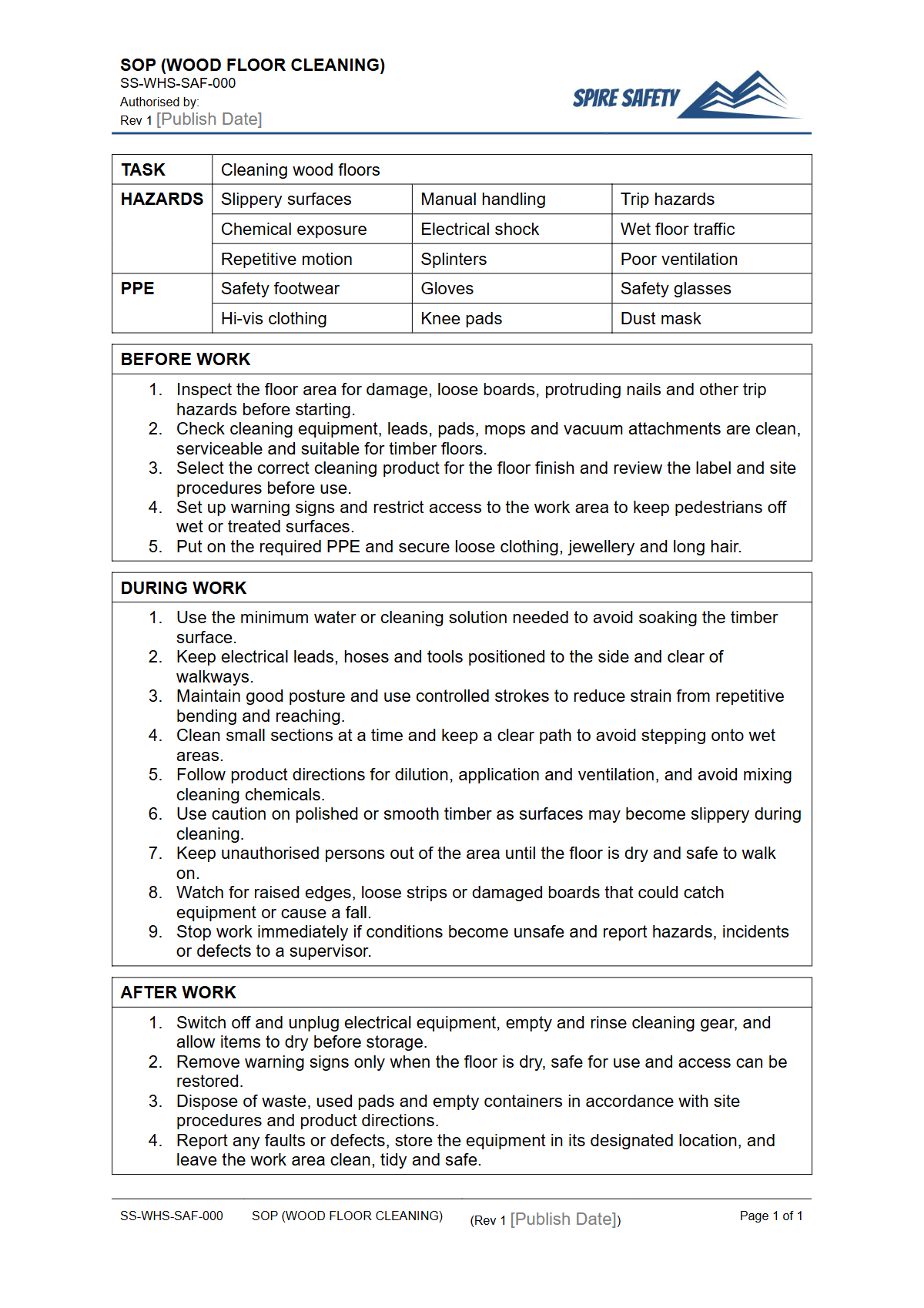
The purpose of this SOP is to outline the potential hazards and establish a step-by-step method to perform the job safely, minimising risks to workers and others in the workplace.
A well-developed SOP for wood floor cleaning helps identify risks such as slips from wet surfaces, ergonomic injuries from manual handling of equipment, and exposure to hazardous chemicals. It details the required Personal Protective Equipment (PPE) like non-slip footwear and gloves, pre-operational checks for equipment, and emergency procedures.
By standardising the task, you create a consistent benchmark for training and performance, which is a cornerstone of a proactive safety culture.
Video walkthrough
How to use the Free Safe Operating Procedure (Wood Floor Cleaning) Template
This Safe Operating Procedure for wood floor cleaning is available for download as a DOCX file, allowing for full customisation, and a PDF for easy distribution and printing. To use the template effectively, you must adapt it to the specific context of your workplace.
This involves a thorough review of the document and adding details relevant to your site, including the specific type of wood flooring, the cleaning chemicals in use, and the make and model of any machinery like buffers or polishers.
Important: This document is a template and must be customised to suit your organisation’s specific needs. We strongly advise you to consult with the workers who perform the cleaning tasks, as their direct experience is invaluable for creating a practical and effective procedure. For complex operations or if you are unsure about your obligations, consider seeking guidance from professional WHS consulting services.
Integrating this SOP into your safety framework ensures it doesn't exist in isolation. These procedures are critical components of comprehensive WHS management systems, serving as practical tools that translate risk assessments into safe work practices on the ground.
When to use a Wood Floor Cleaning SOP
A Safe Operating Procedure for wood floor cleaning should be used as a primary reference document in several situations. It is essential during the induction and training of new employees, ensuring they understand the approved, safe method for the task from day one.
It should also be readily available in the work area as a quick reference for all workers before they begin the cleaning process.
Supervisors can use the SOP to conduct pre-start toolbox talks, reinforcing key safety points and any site-specific conditions. For larger areas or mechanised cleaning, you may need additional documentation, such as our Safe Operating Procedure for Floor Scrubber Operation. Furthermore, in the unfortunate event of an incident or near-miss, the SOP serves as a benchmark for investigation, helping to identify whether the procedure was followed and if it requires revision.
Who should use this Safe Operating Procedure
This SOP is intended for a range of personnel within an organisation. Primarily, it is for the operators—the cleaners and maintenance staff who physically carry out the wood floor cleaning tasks.
They must be trained on the procedure and have easy access to it during their work.
Supervisors and managers are also key users. They are responsible for ensuring workers are trained, competent, and adhering to the documented procedure.
They use the SOP to monitor work, enforce safety standards, and lead safety discussions. WHS personnel and management will also use this document as part of the broader safety system, ensuring it is reviewed, updated, and integrated with other safety processes.
The effectiveness of any SOP relies on regular review and verification. This can be achieved through practical observation and formal reviews as part of regular WHS compliance auditing to ensure the procedure remains relevant and effective at controlling risks.
By implementing this procedure, your organisation demonstrates a commitment to meeting its duty of care under Australian WHS legislation. Explore our extensive library of free WHS resources for more templates and guides to support your safety management efforts.
Common mistakes
Common mistakes to avoid
- Using a generic procedure without customising it for specific equipment, chemicals, and floor types.
- Failing to obtain and make Safety Data Sheets (SDS) readily accessible for all cleaning agents.
- Neglecting to adequately signpost wet areas with clear, visible warnings, creating a slip hazard.
- Providing inadequate training, resulting in workers not fully understanding or following the SOP.
Legal references
Legal considerations
The following legal requirements may be relevant to this type of work.
- Work Health and Safety Act (Harmonised) — Provides the primary duties for protecting workers and other people from work health and safety risks.
- Work Health and Safety Regulations (Harmonised) — Sets out requirements supporting the management of workplace hazards and risks.
The following codes may be relevant to this type of work.
- Managing WHS Risks Code of Practice — Provides practical guidance on identifying hazards, assessing risks and applying effective controls.
- Work Health and Safety Consultation, Cooperation and Coordination Code of Practice — Provides practical guidance on consulting workers and coordinating with other duty holders.
- Managing the Work Environment and Facilities Code of Practice — Provides practical guidance on safe work environments, workplace facilities and related controls.
Did you know
Slip, Trip, and Fall Hazard
Slips, trips, and falls are a leading cause of workplace injuries in Australia. Wet and slippery floors from cleaning activities are a major, yet preventable, contributor to these statistics.
Chemical Dilution Risks
Incorrectly diluting cleaning chemicals can not only permanently damage expensive wood floors but also create significant health hazards for workers, ranging from skin irritation to serious respiratory issues.
FAQ
Frequently asked questions
01Is this SOP suitable for all types of wood floors?
02What other documents do I need besides an SOP?
03How often should a Safe Operating Procedure be reviewed?
04Do I need to consult workers when creating an SOP?
Share this resource
Free Safe Operating Procedure (Wood Floor Cleaning) Template
Browse Categories
How To Use It
- 1Download and open in Word or PDF.
- 2Replace the placeholders with your business details.
- 3Get it reviewed by a WHS specialist before rollout.
Need it customised?
Our WHS consultants can adapt this template to your site, run a gap analysis, or audit what you already have in place.
Book a Free Consultation WHS consulting servicesor call 1300 156 382
Related templates
- Free Safe Operating Procedure (Wood Jointer) Template
- Free Safe Operating Procedure (Wood Lathe) Template
- Free Safe Operating Procedure (Woodchip Path Care) Template
- Free Safe Operating Procedure (Wool Bale Handling) Template
- Free Safe Operating Procedure (Wool Press) Template
- Free Safe Operating Procedure (Work Bench) Template