
Free Safe Operating Procedure (Floor Scrubber Operation) Template
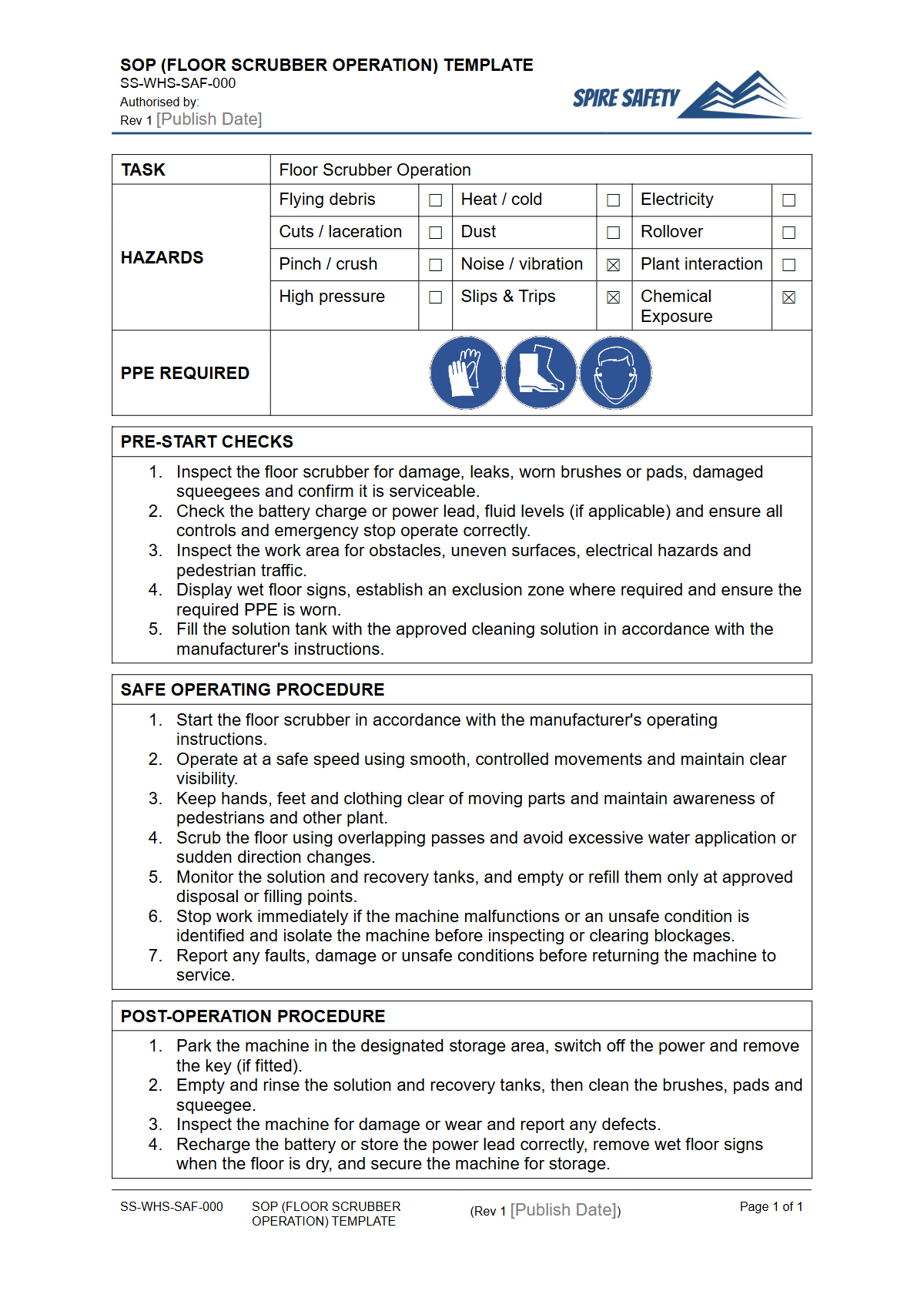
Download our Free Safe Operating Procedure (SOP) for Floor Scrubber Operation. This template provides a structured starting point for your WHS documentation.
Free Safe Operating Procedure (Floor Scrubber Operation) Template
DOCX • 156 KB + PDF
Updated Oct 2026
No signup required
Purpose of the Free Safe Operating Procedure (Floor Scrubber Operation) Template
A Safe Operating Procedure (SOP) is a foundational document that provides step-by-step instructions on how to perform a task safely. This Free Safe Operating Procedure (Floor Scrubber Operation) Template is designed to help your organisation document the required process for operating commercial floor scrubbers, a common task in many industries from retail and hospitality to manufacturing and logistics.
Using powered mobile plant like a floor scrubber introduces significant hazards, including slips, trips, and falls from wet surfaces, electrical risks from cords or faulty batteries, musculoskeletal injuries, and potential exposure to hazardous chemicals.
Developing a formal procedure helps in systematically identifying these risks and implementing effective controls. It forms a critical part of your overall WHS management systems, demonstrating a commitment to proactive risk management.
This template provides a clear framework for you to outline pre-operational checks, safe operational steps, and post-operation cleaning and storage, helping you fulfil your duty of care under Australian WHS legislation.
Video walkthrough
How to use the Free Safe Operating Procedure (Floor Scrubber Operation) Template
This document is provided in both DOCX and PDF formats. The DOCX version is fully editable, allowing you to tailor it precisely to your workplace's needs.
To use the template effectively, you should work through each section and replace the placeholder text with information specific to your environment. This includes detailing the exact make and model of the floor scrubber, the specific cleaning chemicals used (and referencing their Safety Data Sheets), and the unique layout and floor surfaces in your facility.
You will need to develop procedures for other equipment as well; for instance, a maintenance workshop might also need an Air Compressor SOP to manage risks from different types of plant. Consulting with the workers who actually operate the equipment is a mandatory part of the process.
Their hands-on experience is invaluable for creating a procedure that is both safe and practical. Once customised, the SOP should be used to train all operators.
Key Customisation Sections
Pay close attention to these sections when adapting the template:
- Risk Assessment Reference: Link the SOP to your specific risk assessment for floor scrubber operation. An SOP is an outcome of the risk assessment process, not a substitute for it.
- Personal Protective Equipment (PPE): Specify the exact PPE required, such as non-slip footwear, gloves, and eye protection, based on the machine and chemicals used.
- Pre-operational Checks: Customise the checklist to match the manufacturer's recommendations for your specific machine. This includes checking batteries, cords, pads, squeegees, and safety features.
- Emergency Procedures: Detail the steps to take in case of a chemical spill, electrical fault, or injury. This must be specific to your site's emergency plan.
This methodical approach is consistent across all our templates, including our FREE Circular Saw SOP (Safe Operating Procedure) Template, ensuring a familiar structure for various high-risk tasks in your workplace. Remember to save your customised document and make it easily accessible to all relevant personnel.
When to use a Safe Operating Procedure
A specific Safe Operating Procedure for floor scrubbers should be used in several key situations. It is an essential tool for the induction and training of new employees or existing staff who are new to the task.
It should also be readily available in the work area as a reference for operators and supervisors. The SOP serves as a benchmark for competency assessments, helping supervisors confirm that workers can perform the task as required.
Furthermore, it is a critical document during incident investigations, helping to determine if procedures were followed and where they might need improvement. Regular WHS compliance auditing can also verify that SOPs are current, relevant, and being used effectively across the organisation.
Who should use this Safe Operating Procedure
This SOP is intended for a range of personnel within an organisation.
Workers and Operators use it as a direct guide for performing their work safely and consistently.
Supervisors and Team Leaders use it to train their teams, monitor work practices, and enforce safety standards on the floor. They must ensure workers are trained on all relevant procedures, whether it's for cleaning equipment or complex machinery covered by our Free Brake Press SOP (Safe Operating Procedure) Template.
WHS Managers and Advisors use the template to develop and formalise workplace procedures as part of the broader safety management system. They are typically responsible for ensuring the document is reviewed and updated as necessary. Explore our complete free WHS resources library for more templates and guides to support your safety system.
Common mistakes
Common mistakes to avoid
- Not using 'Wet Floor' signs, or placing them ineffectively.
- Using the machine at excessive speeds, especially around corners or in congested areas.
- Failing to conduct a thorough pre-start check of batteries, cords, and squeegees.
- Using incorrect or improperly diluted cleaning chemicals, leading to surface damage or increased slip risk.
Legal references
Legal considerations
The following legal requirements may be relevant to this type of work.
- Work Health and Safety Act (Harmonised) — Provides the primary duties for protecting workers and other people from work health and safety risks.
- Work Health and Safety Regulations (Harmonised) — Sets out requirements supporting the management of workplace hazards and risks.
The following codes may be relevant to this type of work.
- Managing WHS Risks Code of Practice — Provides practical guidance on identifying hazards, assessing risks and applying effective controls.
- Work Health and Safety Consultation, Cooperation and Coordination Code of Practice — Provides practical guidance on consulting workers and coordinating with other duty holders.
- Managing the Work Environment and Facilities Code of Practice — Provides practical guidance on safe work environments, workplace facilities and related controls.
Did you know
A Leading Cause of Injury
According to Safe Work Australia, slips, trips and falls are a leading cause of non-fatal workplace injuries, making proper management of wet floors from scrubbing operations a critical safety priority.
Noise Levels
Commercial floor scrubbers can operate at noise levels between 65 and 85 dBA. A risk assessment should determine if the duration and level of noise exposure require hearing protection or other controls.
FAQ
Frequently asked questions
01What are the main hazards of using a floor scrubber?
02Does a worker need a licence to operate a floor scrubber?
03How often should an SOP for a floor scrubber be reviewed?
04Can I use one SOP for both a walk-behind and a ride-on floor scrubber?
Share this resource
Free Safe Operating Procedure (Floor Scrubber Operation) Template
Browse Categories
How To Use It
- 1Download and open in Word or PDF.
- 2Replace the placeholders with your business details.
- 3Get it reviewed by a WHS specialist before rollout.
Need it customised?
Our WHS consultants can adapt this template to your site, run a gap analysis, or audit what you already have in place.
Book a Free Consultation WHS consulting servicesor call 1300 156 382
Related templates
- Free Safe Operating Procedure (Floor Spot Cleaning) Template
- Free Safe Operating Procedure (Floor Stripping) Template
- Free Safe Operating Procedure (Floor Waxing) Template
- Free Safe Operating Procedure (Flow Meter Test) Template
- Free Safe Operating Procedure (Flow Transmitter) Template
- Free Safe Operating Procedure (Flower Bed Maintenance) Template