
Free Safe Operating Procedure (Floor Spot Cleaning) Template
Download our free Safe Operating Procedure for floor spot cleaning to formalise your safety processes. This template helps you outline hazards and controls.
Free Safe Operating Procedure (Floor Spot Cleaning) Template
DOCX • 126 KB + PDF
Updated Oct 2026
No signup required
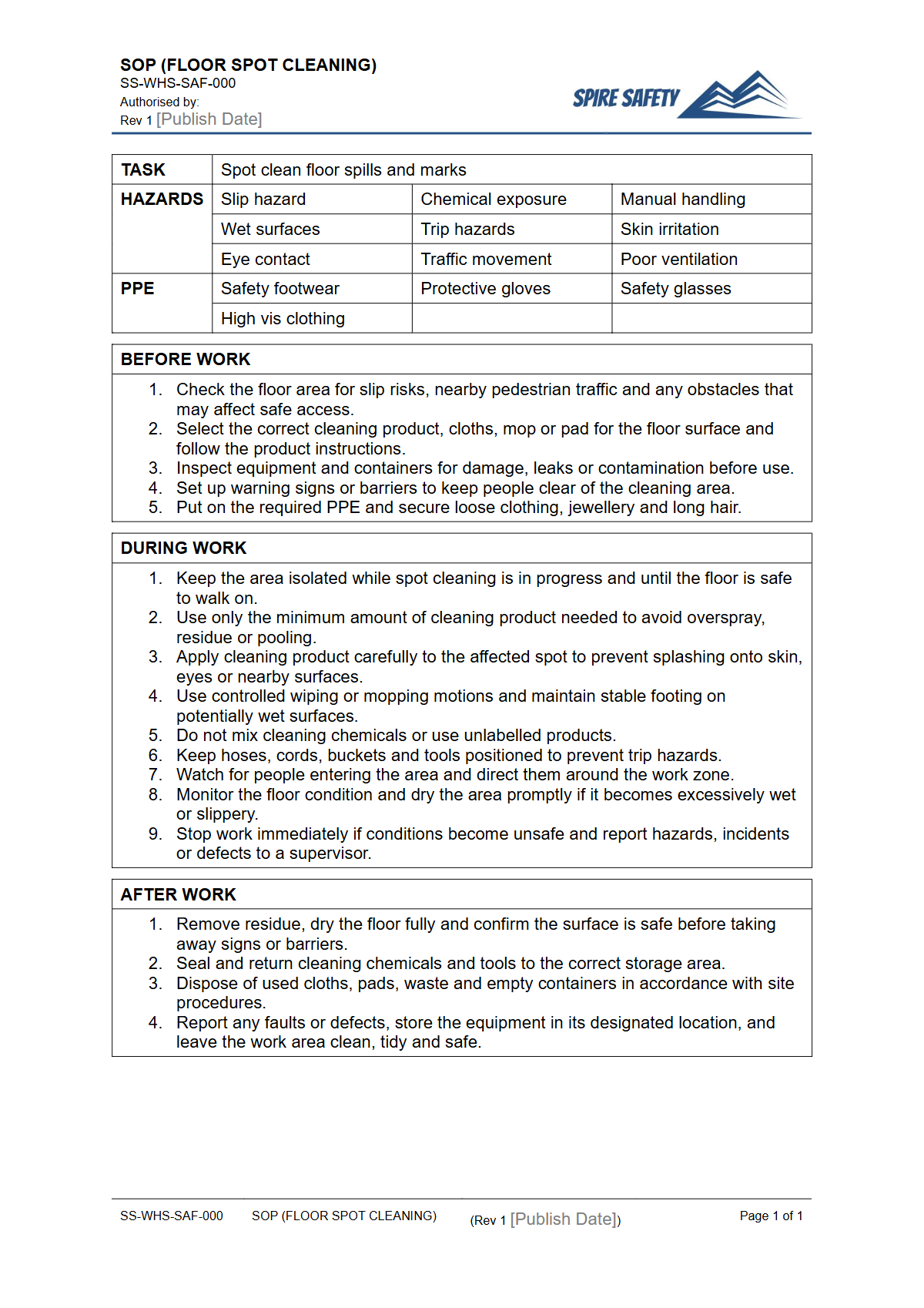
Maintaining clean floors is essential for workplace presentation and safety. Our Free Safe Operating Procedure (Floor Spot Cleaning) Template provides a structured framework to help your organisation manage the risks associated with this common but potentially hazardous task.
By formalising your process for spot cleaning spills and messes, you can significantly reduce the likelihood of slips, trips, and chemical-related incidents. This downloadable template is designed to be a practical tool, aligned with Australian WHS best practices, helping you establish a clear and safe method of work for your team.
Video walkthrough
Purpose of the Free Safe Operating Procedure (Floor Spot Cleaning) Template
The primary purpose of this Safe Operating Procedure (SOP) is to standardise the task of floor spot cleaning across your workplace. It serves as a vital administrative control to ensure every worker performs the task safely and consistently, minimising risks to themselves and others.
An effective SOP goes beyond a simple checklist; it is a foundational document for training, supervision, and demonstrating due diligence. By implementing this procedure, you are actively managing foreseeable hazards before they lead to an incident.
Key Hazards Addressed
Floor spot cleaning, while seemingly simple, introduces several workplace hazards. This template prompts you to consider and control for:
- Slips, trips, and falls: The most obvious risk, caused by wet surfaces during and after cleaning, or by spills themselves.
- Hazardous chemicals: Exposure to cleaning agents through inhalation, skin contact, or splashes, potentially causing irritation, allergic reactions, or burns.
- Manual tasks: Risks associated with bending, lifting buckets, and using mops or other equipment, which can lead to musculoskeletal injuries.
- Inadequate signage: Failing to warn others of a wet or hazardous floor area, increasing the risk of incidents for personnel and visitors.
Documenting these hazards and their controls is a core component of building robust WHS management systems that protect your people and your business.
How to use the Free Safe Operating Procedure (Floor Spot Cleaning) Template
This template is provided as a fully editable DOCX file to allow for complete customisation. It is crucial to understand that this document is a starting point, not a finished procedure.
We strongly advise that you customise every section to reflect the specific equipment, chemicals, flooring surfaces, and personnel within your unique work environment. A generic procedure that doesn't match your reality offers little practical protection.
Customisation and Implementation Steps
- Download and Consult: Download the template and engage in consultation with the workers who actually perform the cleaning tasks. Their direct experience is invaluable for identifying practical risks and effective controls.
- Conduct a Risk Assessment: Use the template as a guide to perform a specific risk assessment for spot cleaning in your workplace. Identify the types of spills you encounter, the chemicals you use, and the environments where cleaning occurs. Seeking expert guidance from a WHS consulting firm can help ensure your risk assessment is thorough.
- Detail the Procedure: Fill in each section with specific information, including the required Personal Protective Equipment (PPE), pre-operational checks (e.g., checking mop heads), step-by-step instructions for the task, and emergency procedures for spills or chemical exposure.
- Train and Supervise: Once finalised and approved, use the SOP as a primary training tool. Ensure all relevant workers are trained on the procedure and that supervisors monitor its correct implementation.
For more templates and safety documents to support your operations, you can explore our complete free WHS resources library.
When to use a Floor Spot Cleaning SOP
A Safe Operating Procedure for floor spot cleaning should be an active document within your safety system. It is used in several key situations.
Its primary function is guiding the day-to-day response to spills and messes, ensuring a consistent and safe approach every time. It also forms a critical part of the induction and training process for new employees or those assigned new cleaning responsibilities.
Furthermore, the SOP serves as a benchmark during safety inspections and is an essential piece of evidence during a formal WHS compliance auditing process, demonstrating that you have a documented system for managing common workplace risks.
Who should use this Safe Operating Procedure
This SOP is designed for a broad range of roles and industries where maintaining floor safety is a priority. This includes facilities managers, cleaning supervisors, and front-line cleaning staff in sectors like retail, hospitality, healthcare, education, and commercial properties.
Business owners and WHS managers will find it a valuable tool for formalising safety protocols and meeting their duty of care. For example, in a busy commercial kitchen, this procedure complements other task-specific documents like a Free Safe Operating Procedure (Deep Fryer - Standard Operation) Template, creating a more holistic approach to safety in that environment.
Integrating SOPs into Your Broader Safety System
An SOP is most effective when it is part of a comprehensive safety management system, not a standalone document. It should be referenced in your risk register and linked to your chemical register and Safety Data Sheets (SDS).
For businesses that use mechanised cleaning equipment for larger areas, this spot-cleaning procedure should work alongside more specific guides, such as a Free Safe Operating Procedure (Floor Scrubber Operation) Template. Regularly reviewing and updating all your SOPs ensures they remain relevant and effective as your business evolves, processes change, or new hazards are identified.
Common mistakes
Common mistakes to avoid
- Using the template 'as-is' without customising it for the specific workplace, chemicals, and flooring.
- Failing to train workers on the finalised SOP and verify their understanding of the procedure.
- Not using appropriate signage (e.g., 'Wet Floor' signs) to cordon off the area during and after cleaning.
- Incorrectly storing or mixing cleaning chemicals, creating unintended chemical reactions or hazards.
Legal references
Legal considerations
The following legal requirements may be relevant to this type of work.
- Work Health and Safety Act (Harmonised) — Provides the primary duties for protecting workers and other people from work health and safety risks.
- Work Health and Safety Regulations (Harmonised) — Sets out requirements supporting the management of workplace hazards and risks.
The following codes may be relevant to this type of work.
- Managing WHS Risks Code of Practice — Provides practical guidance on identifying hazards, assessing risks and applying effective controls.
- Work Health and Safety Consultation, Cooperation and Coordination Code of Practice — Provides practical guidance on consulting workers and coordinating with other duty holders.
- Managing the Work Environment and Facilities Code of Practice — Provides practical guidance on safe work environments, workplace facilities and related controls.
Did you know
Slips, Trips, and Falls
According to Safe Work Australia, slips, trips, and falls are the second leading cause of serious workers' compensation claims, frequently caused by contaminated, wet, or slippery floor surfaces.
Chemical Safety
Even common cleaning chemicals can cause skin irritation, respiratory issues, or eye damage if not handled correctly. An SOP is crucial for ensuring correct dilution, use of Personal Protective Equipment (PPE), and storage.
FAQ
Frequently asked questions
01Is a Safe Operating Procedure legally required for floor cleaning?
02What is the difference between an SOP and a SWMS?
03How often should I review our floor cleaning SOP?
04Can I use this template for large-scale floor cleaning?
Share this resource
Free Safe Operating Procedure (Floor Spot Cleaning) Template
Browse Categories
How To Use It
- 1Download and open in Word or PDF.
- 2Replace the placeholders with your business details.
- 3Get it reviewed by a WHS specialist before rollout.
Need it customised?
Our WHS consultants can adapt this template to your site, run a gap analysis, or audit what you already have in place.
Book a Free Consultation WHS consulting servicesor call 1300 156 382
Related templates
- Free Safe Operating Procedure (Floor Stripping) Template
- Free Safe Operating Procedure (Floor Waxing) Template
- Free Safe Operating Procedure (Flow Meter Test) Template
- Free Safe Operating Procedure (Flow Transmitter) Template
- Free Safe Operating Procedure (Flower Bed Maintenance) Template
- Free Safe Operating Procedure (Flower Bed Weeding) Template