
Free Safe Operating Procedure (Flower Bed Weeding) Template
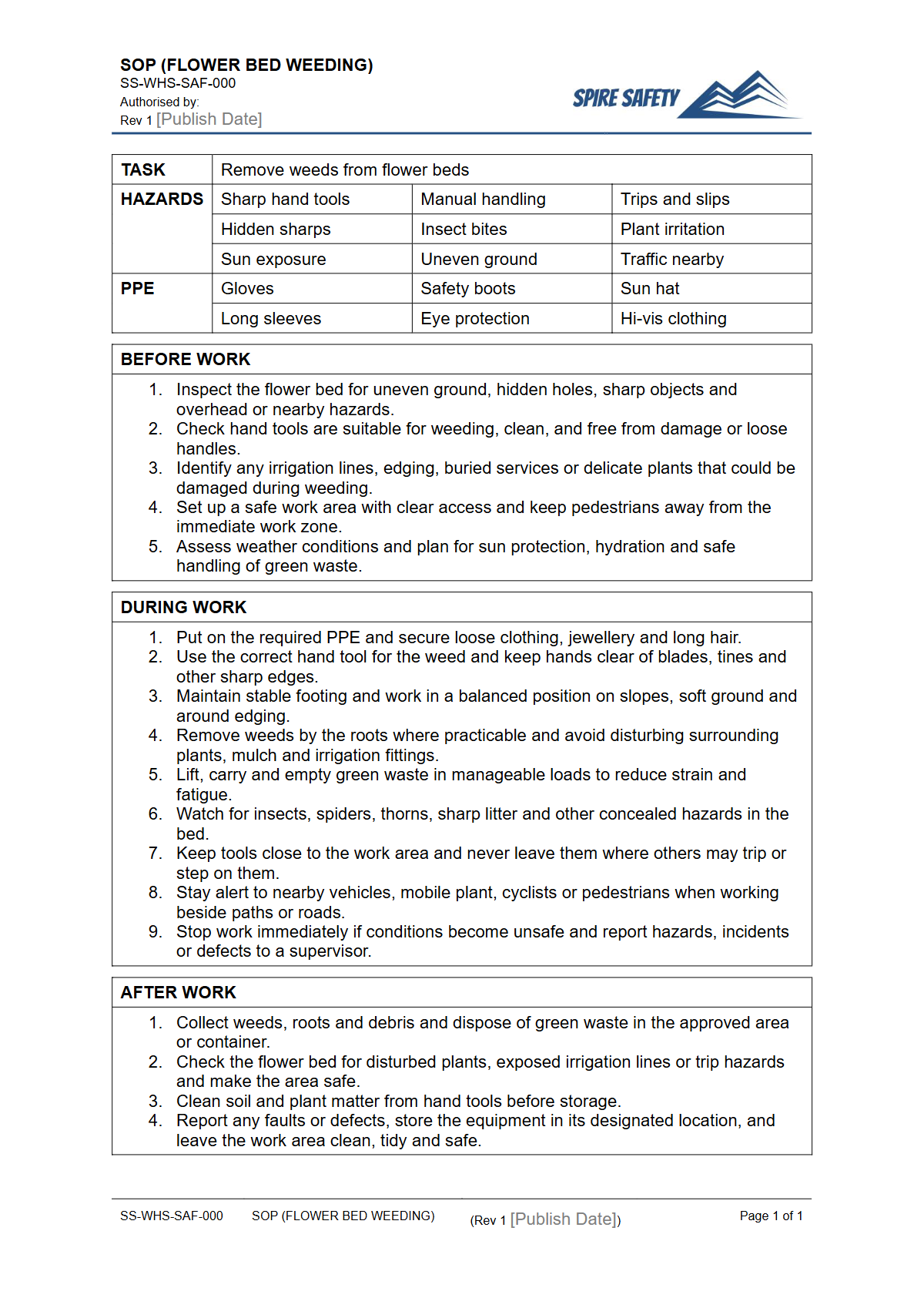
Download our free Safe Operating Procedure for flower bed weeding. This template provides a structured format to document risks and controls.
Free Safe Operating Procedure (Flower Bed Weeding) Template
DOCX • 126 KB + PDF
Updated Oct 2026
No signup required
Purpose of the Free Safe Operating Procedure (Flower Bed Weeding) Template
This Free Safe Operating Procedure (Flower Bed Weeding) Template provides a structured framework for documenting the safest way to perform weeding tasks in gardens and flower beds. Its purpose is to help Persons Conducting a Business or Undertaking (PCBUs) manage health and safety risks by outlining a clear, step-by-step process that workers can follow.
By formalising the procedure, you can minimise the risk of injuries associated with manual handling, tool use, sun exposure, and biological hazards.
A well-developed SOP is a fundamental component of any robust WHS management system. It serves as a practical tool for training, a reference for workers, and evidence of your organisation's commitment to providing a safe system of work. The procedure identifies potential hazards, assesses their associated risks, and specifies the control measures required to ensure worker safety.
Video walkthrough
How to use the Free Safe Operating Procedure (Flower Bed Weeding) Template
To effectively use this Safe Operating Procedure for flower bed weeding, you must adapt it to the unique conditions of your work environment. This document provides a solid foundation based on Australian WHS principles, but it is not a complete, out-of-the-box solution.
The real value comes from customisation.
IMPORTANT: This document is a template only. We have provided a structured starting point, but you must customise it to reflect the specific hazards, equipment, and environment of your workplace.
Consultation with your workers is a critical step in this process.
Customisation Steps:
- Download: Start by downloading the DOCX version, which is fully editable.
- Consult: Discuss the task with the workers who actually perform it. Their input is invaluable for identifying practical hazards and effective controls.
- Assess: Walk through the job and identify all specific hazards. This could include soil conditions, types of weeds, presence of insects or sharp objects, sun exposure, ergonomic strain from bending or kneeling, and the specific tools used (e.g., hand trowels, hoes, secateurs).
- Detail Controls: For each hazard, specify the control measures. This includes required Personal Protective Equipment (PPE) like gloves and sun hats, safe tool handling techniques, hydration protocols, and recommended stretching exercises to prevent musculoskeletal strain.
- Finalise and Approve: Once customised, the SOP should be formally approved by a manager or supervisor.
- Train: Ensure all relevant workers are trained on the final SOP. Keep a record of this training.
The principle of risk assessment and control applies to all work activities. From heavy machinery covered in our free dozer SOP template to simple manual tasks like this one, the process of identifying and managing risk is consistent.
A customised SOP formalises this process for a specific task.
When to use it
A Safe Operating Procedure for flower bed weeding should be used as a primary safety document for the task. It is essential in several scenarios:
- Worker Training: Use it as the foundation for inducting new employees or training existing workers on the correct, safe method for weeding.
- Pre-Task Reference: Workers can review the SOP before starting work to refresh their understanding of the risks and controls.
- Incident Investigation: If a near-miss or injury occurs during weeding, the SOP serves as a benchmark to assess whether procedures were followed and if they need improvement.
- Procedural Changes: The SOP should be reviewed and updated whenever a new tool, chemical, or work method is introduced for the task.
Regular reviews are essential and often form part of a scheduled WHS compliance audit to ensure procedures remain current and effective.
Who should use it
The responsibility for and use of this SOP extends across different roles within an organisation:
- PCBUs and Managers: Have the primary duty of care to ensure safe systems of work are in place. They are responsible for ensuring SOPs are developed, implemented, and reviewed.
- Supervisors: Use the SOP to train, supervise, and monitor workers, ensuring they are adhering to the documented procedures.
- Workers: Must follow the steps outlined in the SOP to perform their work safely. They should also participate in its development and review, providing practical feedback from their direct experience with the task.
This procedure is relevant for any business where manual gardening or landscaping tasks are performed, including horticulture businesses, local councils, schools, and property maintenance companies. For other common tasks, you can explore our complete free WHS resources library.
Common mistakes
Common mistakes to avoid
- Failing to customise the template for the specific tools, site conditions, and workers involved.
- Neglecting to consult with workers who perform the task when drafting or reviewing the procedure.
- Forgetting to conduct and document training on the final, approved SOP.
- Overlooking ergonomic risks like prolonged kneeling, bending, and repetitive hand movements.
Legal references
Legal considerations
The following legal requirements may be relevant to this type of work.
- Work Health and Safety Act (Harmonised) — Provides the primary duties for protecting workers and other people from work health and safety risks.
- Work Health and Safety Regulations (Harmonised) — Sets out requirements supporting the management of workplace hazards and risks.
The following codes may be relevant to this type of work.
- Managing WHS Risks Code of Practice — Provides practical guidance on identifying hazards, assessing risks and applying effective controls.
- Work Health and Safety Consultation, Cooperation and Coordination Code of Practice — Provides practical guidance on consulting workers and coordinating with other duty holders.
- Managing the Work Environment and Facilities Code of Practice — Provides practical guidance on safe work environments, workplace facilities and related controls.
Did you know
Manual Handling Strain
In Australia, injuries from lifting, carrying, or putting down objects are a leading cause of serious workers' compensation claims. Repetitive tasks like weeding contribute to this through cumulative strain.
Hidden Hazards
Garden beds can conceal hidden dangers like broken glass, sharp rocks, or syringes. A key part of any weeding SOP is the instruction to wear puncture-resistant gloves and to inspect the area before starting.
FAQ
Frequently asked questions
01What hazards are involved in flower bed weeding?
02How often should a Safe Operating Procedure be reviewed?
03Is an SOP legally required for a simple task like weeding?
04Can I use this template for commercial landscaping services?
Share this resource
Free Safe Operating Procedure (Flower Bed Weeding) Template
Browse Categories
How To Use It
- 1Download and open in Word or PDF.
- 2Replace the placeholders with your business details.
- 3Get it reviewed by a WHS specialist before rollout.
Need it customised?
Our WHS consultants can adapt this template to your site, run a gap analysis, or audit what you already have in place.
Book a Free Consultation WHS consulting servicesor call 1300 156 382
Related templates
- Free Safe Operating Procedure (Flower Deadheading) Template
- Free Safe Operating Procedure (Flower Potting) Template
- Free Safe Operating Procedure (Fly Press) Template
- Free Safe Operating Procedure (Fogging Machine) Template
- Free Safe Operating Procedure (Food Cart Handling) Template
- Free Safe Operating Procedure (Food Dehydrator) Template