
Free Safe Operating Procedure (Flower Deadheading) Template
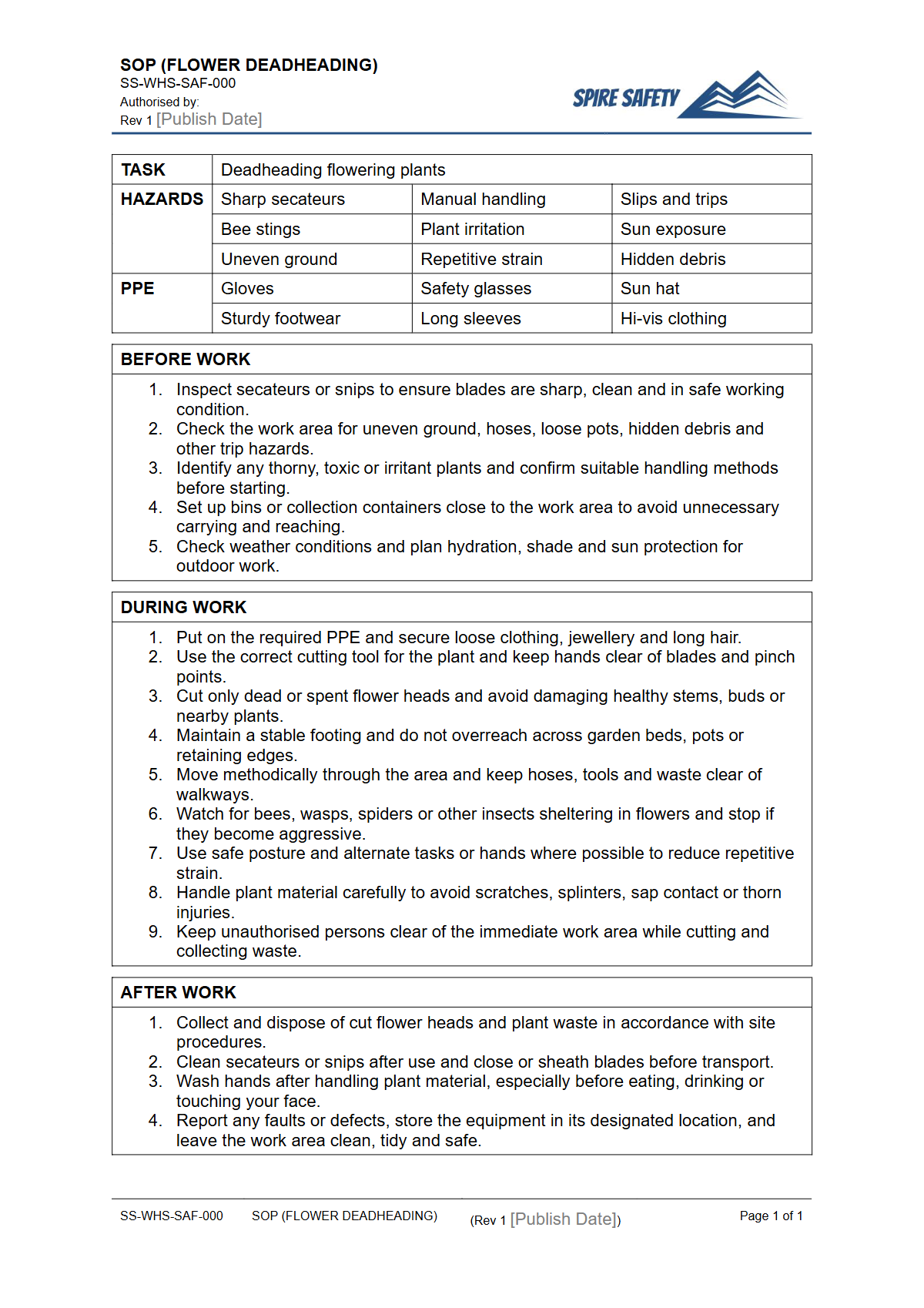
Download our free Safe Operating Procedure (SOP) for flower deadheading.
Free Safe Operating Procedure (Flower Deadheading) Template
DOCX • 126 KB + PDF
Updated Oct 2026
No signup required
Purpose of the Free Safe Operating Procedure (Flower Deadheading) Template
Establishing clear, safe work methods is fundamental to any workplace health and safety program. Our Free Safe Operating Procedure (Flower Deadheading) Template provides a structured starting point for documenting the approved process for this common horticultural task.
While seemingly simple, deadheading flowers can present risks such as musculoskeletal strain from repetitive motions, cuts from secateurs or shears, and slips or falls when working on uneven ground or at height. This template helps a Person Conducting a Business or Undertaking (PCBU) to identify these hazards, implement effective controls, and provide clear instructions to workers, ensuring tasks are performed consistently and safely every time.
Formalising this process is a key component of a proactive safety culture. It serves as a valuable training tool for new employees and a reference for experienced staff.
By clearly defining expectations for equipment use, personal protective equipment (PPE), and emergency response, this SOP helps organisations demonstrate their commitment to safety and meet their duty of care. Integrating task-specific SOPs like this one is a practical way to build robust WHS management systems that are effective and easy for your team to follow.
Video walkthrough
How to use the Free Safe Operating Procedure (Flower Deadheading) Template
This downloadable document is provided in both DOCX and PDF formats for your convenience. The DOCX file is fully editable, allowing you to tailor it to the unique context of your workplace.
To use the template effectively, you should systematically work through each section and replace the placeholder text with information specific to your operations. This includes detailing the exact types of tools used (e.g., brand/model of secateurs), the specific locations where the task is performed, and the unique environmental hazards present, such as slopes, overhead powerlines, or public access areas.
It is crucial to remember that this is a template. We have provided a solid foundation, but you must customise it to reflect the specific equipment, environment, and hazards present in your workplace.
A generic procedure is not sufficient; your SOP must be a true reflection of how work is done safely on your site. When customising, pay close attention to specifying PPE requirements (e.g., cut-resistant gloves, safety glasses), pre-start checks for tools, and first aid procedures. If workers need to work at height to reach taller plants or shrubs, your procedure should reference the safe use of ladders, which can be detailed in a separate FREE Step Ladder SOP Template.
What to include in your Safe Operating Procedure
A comprehensive SOP for flower deadheading should be more than just a list of steps. To be effective, it needs to integrate hazard management into the workflow. Your customised document should include:
- Task Description: A brief overview of the activity.
- Hazard Identification: A list of all potential hazards associated with the task (e.g., sharp blades, ergonomic strain, UV exposure, insect bites, trip hazards).
- Risk Control Measures: The specific actions taken to eliminate or minimise the identified risks. This is the core of the SOP.
- Required PPE: A clear, non-negotiable list of personal protective equipment, such as gloves, eye protection, and sun-safe clothing.
- Step-by-Step Procedure: A logical sequence of actions from starting the task to finishing and cleaning up. This should include pre-start checks of tools and the work area.
- Training and Competency: A section outlining the training requirements for workers performing this task.
- Emergency Procedures: Instructions for what to do in case of an injury or incident.
Creating detailed procedures for all common tasks can feel overwhelming. If you require assistance in developing a suite of SOPs or implementing them effectively within your organisation, engaging external support through WHS consulting can provide valuable expertise and streamline the process.
When to use it
A Safe Operating Procedure is a dynamic document used throughout the employment lifecycle. It should be introduced during the induction and training of new workers before they are permitted to perform the task unsupervised.
It serves as the basis for practical demonstration and assessment of competency. The SOP should also be used for regular refresher training and can be a focus point for toolbox talks, especially before seasonal peaks in gardening activity.
Furthermore, it is a critical document to review and potentially update following any incident or near-miss related to the task, or when new equipment or techniques are introduced. Regular reviews ensure the SOP remains relevant and effective.
Who should use it
This template is designed for use by a broad range of individuals and organisations within the horticultural, landscaping, and grounds maintenance sectors. Business owners and managers (PCBUs) will use it to fulfil their duty of care by establishing and documenting safe systems of work.
WHS managers and supervisors will use it to train staff, conduct workplace inspections, and investigate incidents. For workers, the SOP is a clear guide on how to perform their job safely, protecting them and their colleagues from harm.
Using and enforcing SOPs is a practical demonstration of due diligence, which can be verified through periodic WHS compliance auditing to ensure your safety systems are working as intended.
While the focus is on deadheading, the principles and structure can be adapted for other maintenance tasks involving hand tools. For instance, the process of risk assessment and control is similar when creating procedures for other equipment, as seen in resources like our FREE Circular Saw SOP (Safe Operating Procedure) Template. You can find many more examples in our complete free WHS resources library to help build out your safety documentation.
Common mistakes
Common mistakes to avoid
- Using blunt, damaged, or poorly maintained secateurs, increasing the force required and risk of strain.
- Failing to properly assess the work area for trip hazards like hoses, tools, or uneven ground.
- Over-reaching or working in awkward postures instead of moving closer to the plant or using appropriate access equipment.
- Neglecting to wear appropriate PPE, particularly cut-resistant gloves and eye protection.
Legal references
Legal considerations
The following legal requirements may be relevant to this type of work.
- Work Health and Safety Act (Harmonised) — Provides the primary duties for protecting workers and other people from work health and safety risks.
- Work Health and Safety Regulations (Harmonised) — Sets out requirements supporting the management of workplace hazards and risks.
The following codes may be relevant to this type of work.
- Managing WHS Risks Code of Practice — Provides practical guidance on identifying hazards, assessing risks and applying effective controls.
- Work Health and Safety Consultation, Cooperation and Coordination Code of Practice — Provides practical guidance on consulting workers and coordinating with other duty holders.
- Managing the Work Environment and Facilities Code of Practice — Provides practical guidance on safe work environments, workplace facilities and related controls.
Did you know
Horticultural Hazards
The agriculture, forestry, and fishing industry, which includes many horticultural activities, has one of the highest rates of serious workers' compensation claims in Australia.
FAQ
Frequently asked questions
01Is deadheading flowers really a hazardous task requiring an SOP?
02What PPE should be listed in an SOP for deadheading flowers?
03How do I train my staff using this Safe Operating Procedure template?
04Can I use this SOP template for pruning shrubs or using a hedge trimmer?
Share this resource
Free Safe Operating Procedure (Flower Deadheading) Template
Browse Categories
How To Use It
- 1Download and open in Word or PDF.
- 2Replace the placeholders with your business details.
- 3Get it reviewed by a WHS specialist before rollout.
Need it customised?
Our WHS consultants can adapt this template to your site, run a gap analysis, or audit what you already have in place.
Book a Free Consultation WHS consulting servicesor call 1300 156 382
Related templates
- Free Safe Operating Procedure (Flower Potting) Template
- Free Safe Operating Procedure (Fly Press) Template
- Free Safe Operating Procedure (Fogging Machine) Template
- Free Safe Operating Procedure (Food Cart Handling) Template
- Free Safe Operating Procedure (Food Dehydrator) Template
- Free Safe Operating Procedure (Food Display Cleaning) Template