
Free Safe Operating Procedure (Fogging Machine) Template
Download our free Safe Operating Procedure (Fogging Machine) Template.
Free Safe Operating Procedure (Fogging Machine) Template
DOCX • 126 KB + PDF
Updated Oct 2026
No signup required
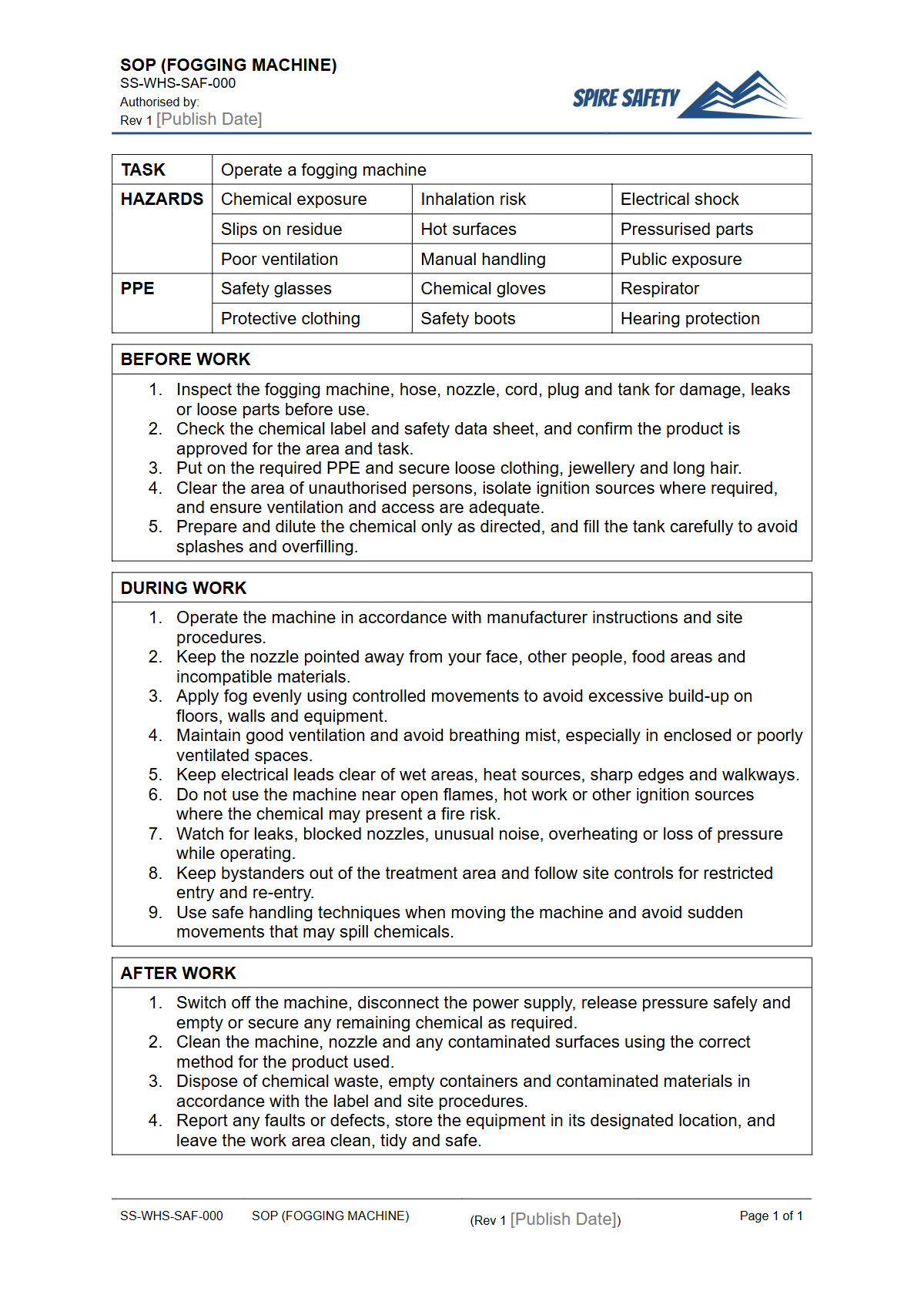
Purpose of the Free Safe Operating Procedure (Fogging Machine) Template
Operating a fogging machine, whether for disinfection, pest control, or special effects, introduces significant workplace hazards. This includes chemical exposure, respiratory irritation, electrical risks, and slip hazards.
Our free Safe Operating Procedure (Fogging Machine) Template provides a structured framework to help your organisation document and manage these risks effectively. A well-developed SOP is a fundamental tool for demonstrating how you ensure, so far as is reasonably practicable, the health and safety of workers and others at the workplace.
It is an essential component of a robust safety management system.
This Safe Operating Procedure acts as a clear, step-by-step guide for operators, outlining pre-operational checks, safe operating steps, post-operational tasks, and emergency responses. By customising and implementing this SOP, you formalise your commitment to safety, providing a consistent training resource and a clear standard for performance.
Integrating such procedures is a key part of building effective WHS management systems that protect your people and support your legal obligations.
Video walkthrough
How to use the Free Safe Operating Procedure (Fogging Machine) Template
This document provides a comprehensive starting point, but it must be adapted to your specific context. Download the DOCX or PDF and integrate your organisation's details, including the specific make and model of the fogging machine, the exact chemicals used, and the unique environmental conditions of your workplace.
Pay close attention to the details provided in the Safety Data Sheet (SDS) for any chemical you intend to use, as this will inform required controls and Personal Protective Equipment (PPE).
A critical step is worker consultation. Involve the operators who will be using the equipment in the drafting and review process.
Their hands-on experience is invaluable for identifying practical risks and effective control measures that might not be immediately obvious. Once finalised, the SOP should be approved by a competent person, such as a manager or WHS representative, and used as the basis for training and competency assessments.
This template is designed for many common pieces of equipment, much like our Free Air Compressor SOP, which also requires site-specific customisation.
Important Note
This Safe Operating Procedure (SOP) template is a starting point and is not a substitute for professional WHS advice. It is essential that you customise this document to reflect the specific equipment, chemicals, tasks, and environment of your workplace.
We recommend a competent person reviews and validates the final SOP.
When to use it
A Safe Operating Procedure for a fogging machine should be used consistently as part of your daily operations. It should be consulted before every use of the equipment to ensure all pre-start checks are completed and safety controls are in place.
It is a critical document during the induction of new workers who will be required to operate the machinery, providing a foundation for their practical training.
Furthermore, the SOP serves as a key piece of evidence during safety reviews and inspections. Should an incident or near-miss occur involving a fogging machine, the SOP will be a reference point for the investigation, helping to determine if procedures were followed and if they remain adequate.
The process of reviewing SOPs is often a core activity during a WHS compliance auditing program.
Who should use it
This SOP is intended for several key roles within an organisation. Primarily, it is for the workers tasked with operating the fogging machine.
It provides them with clear, unambiguous instructions to perform their work safely. Supervisors and team leaders must also be intimately familiar with the SOP to effectively monitor work, enforce safety standards, and provide guidance to their teams.
WHS managers and safety officers will use the template as a tool to standardise procedures across the business, manage risk, and ensure legislative duties are being met. It also serves as a benchmark for what safe and competent operation looks like.
This same principle applies to other high-risk equipment, where documents like a FREE Plasma Cutter SOP are equally essential for managing specific hazards like fumes and radiation.
Key Hazards and Control Measures
Fogging machines combine chemical and mechanical elements, creating a unique set of hazards that require specific controls. The primary risk is often the chemical being dispersed.
Inhalation of toxic or corrosive mists can cause severe respiratory damage, while skin and eye contact can lead to burns or irritation. The most important control for this is to consult the chemical's Safety Data Sheet (SDS) and implement the specified PPE, which may include respirators, chemical-resistant gloves, and safety goggles or face shields.
Engineering controls like ensuring adequate ventilation in the area to be fogged are vital. Administrative controls are also crucial; these include the SOP itself, clear signage, barricading to create exclusion zones, and defined re-entry times to prevent exposure to others. In case of an emergency, such as acute chemical exposure, having clear procedures and accessible equipment is critical, similar to the need for a clear guide like our Free Safe Operating Procedure (Defibrillator Operation) Template.
Review and Continuous Improvement
An SOP is not a static document. It must be a living part of your safety management system that evolves with your business.
Your Fogging Machine SOP should be reviewed on a regular schedule, typically at least annually. A review is also mandatory whenever there is a change in equipment, chemicals, or the process itself.
Crucially, any incident, accident, or near-miss involving the fogging machine must trigger an immediate review of the SOP to identify and correct any deficiencies.
Involving your workers in this review process is just as important as in the initial drafting stage. They can provide feedback on whether the procedure is still practical and effective. If you need assistance in developing or reviewing your safety documentation to ensure it aligns with best practice, consider seeking expert guidance through WHS consulting. For more tools to enhance your workplace safety, explore our complete free WHS resources library.
Common mistakes
Common mistakes to avoid
- Using the wrong type of chemical for the machine, leading to equipment damage or ineffective application.
- Failing to read the Safety Data Sheet (SDS) for the chemical being used, leading to incorrect PPE use.
- Neglecting to establish and clearly signpost adequate exclusion zones and safe re-entry times.
- Using inadequate, poorly fitted, or unmaintained Personal Protective Equipment (PPE), especially respirators.
Legal references
Legal considerations
The following legal requirements may be relevant to this type of work.
- Work Health and Safety Act (Harmonised) — Provides the primary duties for protecting workers and other people from work health and safety risks.
- Work Health and Safety Regulations (Harmonised) — Sets out requirements supporting the management of workplace hazards and risks.
The following codes may be relevant to this type of work.
- Managing WHS Risks Code of Practice — Provides practical guidance on identifying hazards, assessing risks and applying effective controls.
- Work Health and Safety Consultation, Cooperation and Coordination Code of Practice — Provides practical guidance on consulting workers and coordinating with other duty holders.
- Managing the Work Environment and Facilities Code of Practice — Provides practical guidance on safe work environments, workplace facilities and related controls.
Did you know
Thermal vs. ULV Foggers
Thermal foggers use heat to vaporise a solution into a dense, visible fog. In contrast, Ultra-Low Volume (ULV) foggers use cold methods and high pressure to create a fine, almost invisible mist, which presents a different inhalation risk profile.
Re-entry Periods
A critical part of a fogging SOP is defining the 're-entry period'—the minimum time required before an area is safe to enter without PPE after fogging. This is specified on the chemical's label or SDS and must be strictly enforced.
FAQ
Frequently asked questions
01What chemicals can be used in a fogging machine?
02Do I need a specific licence to operate a fogging machine in Australia?
03How often should a Safe Operating Procedure for a fogging machine be reviewed?
04What PPE is required when using a fogging machine?
Share this resource
Free Safe Operating Procedure (Fogging Machine) Template
Browse Categories
How To Use It
- 1Download and open in Word or PDF.
- 2Replace the placeholders with your business details.
- 3Get it reviewed by a WHS specialist before rollout.
Need it customised?
Our WHS consultants can adapt this template to your site, run a gap analysis, or audit what you already have in place.
Book a Free Consultation WHS consulting servicesor call 1300 156 382
Related templates
- Free Safe Operating Procedure (Food Cart Handling) Template
- Free Safe Operating Procedure (Food Dehydrator) Template
- Free Safe Operating Procedure (Food Display Cleaning) Template
- Free Safe Operating Procedure (Food Label Printer) Template
- Free Safe Operating Procedure (Food Prep Sink Cleaning) Template
- Free Safe Operating Procedure (Food Probe Sanitising) Template