
Free Safe Operating Procedure (Defibrillator Operation) Template
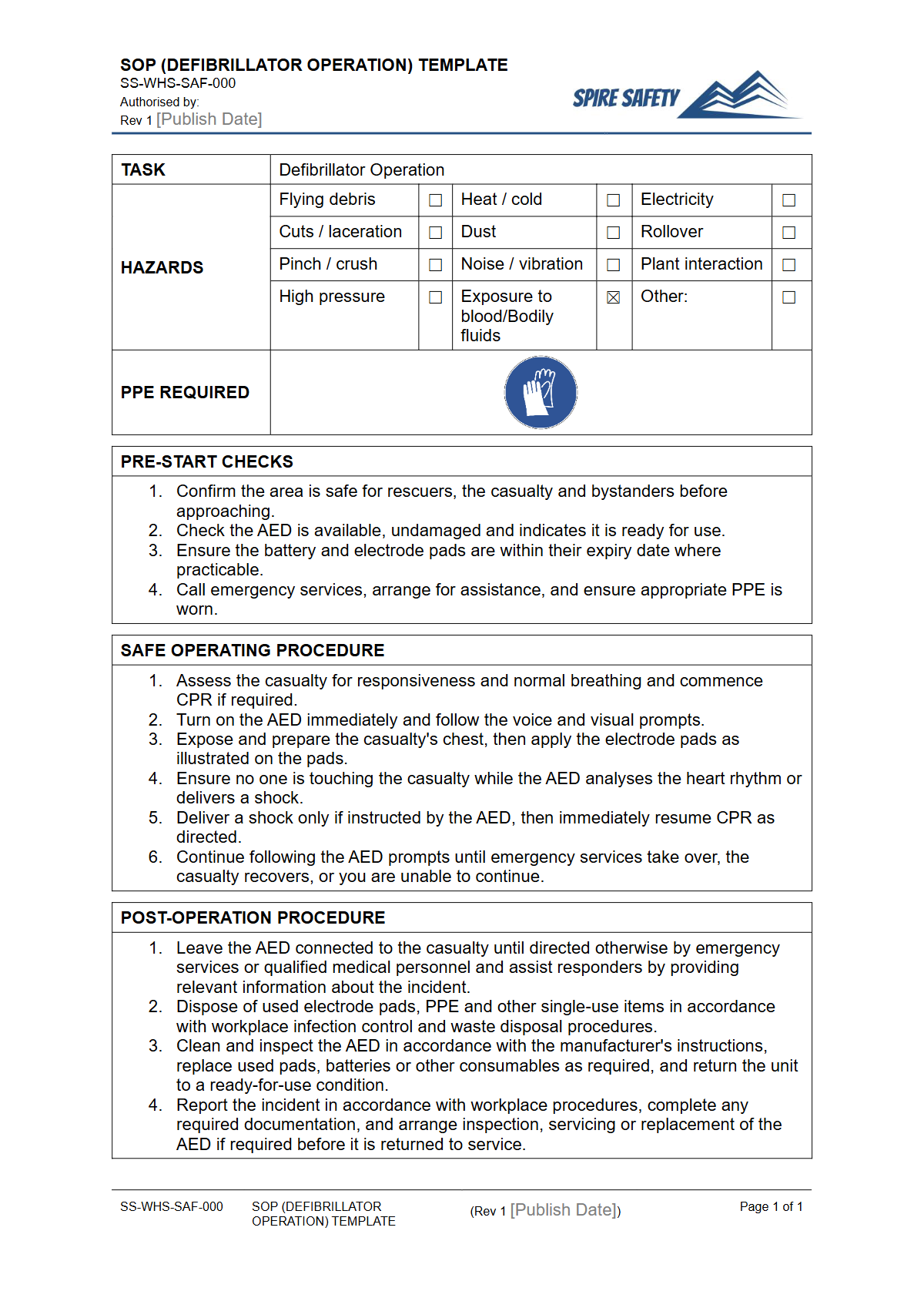
Download our free Safe Operating Procedure (Defibrillator Operation) template. This customisable DOCX & PDF provides a clear framework for emergency use.
Free Safe Operating Procedure (Defibrillator Operation) Template
DOCX • 145 KB + PDF
Updated Oct 2026
No signup required
Purpose of the Free Safe Operating Procedure (Defibrillator Operation) Template
Having an Automated External Defibrillator (AED) on site is a critical step in preparing for a sudden cardiac arrest emergency. However, the device itself is only one part of an effective response.
This Free Safe Operating Procedure (Defibrillator Operation) Template provides a structured, step-by-step guide to ensure personnel can act quickly, confidently, and correctly during a high-stress medical event. The purpose of this SOP is to standardise the emergency response across your organisation, minimising confusion and hesitation when seconds count.
A documented procedure demonstrates a proactive approach to workplace safety and first aid. It serves as a vital training tool for first aiders and other staff, ensuring everyone understands their role in an emergency.
Integrating this SOP into your broader WHS management systems helps formalise your commitment to the health and safety of every person in the workplace, outlining clear actions from identifying the emergency to handing over care to professional medical services.
Video walkthrough
How to use the Free Safe Operating Procedure (Defibrillator Operation) Template
This resource is designed to be a practical foundation for your workplace's specific needs. It outlines the key phases of using a defibrillator, including hazard assessment, casualty assessment, device preparation, and post-incident procedures.
It is available for download in both DOCX and PDF formats, allowing for easy editing and distribution.
To implement this SOP effectively, follow these steps:
- Download: Choose the DOCX version for easy editing or the PDF for immediate printing.
- Customise: This is the most important step. This template provides a solid framework based on Australian first aid principles, but we strongly advise you to customise the document to suit your specific context. You must add details such as the exact location of your AED(s), the specific model of defibrillator used, your site's emergency contact numbers, and the roles of designated first aiders.
- Review and Approve: Have the customised SOP reviewed by a competent person, such as a senior first aider or WHS manager.
- Train Personnel: Use the finalised SOP as a central document for training all relevant staff. Ensure first aiders are confident with the procedure and that all workers know the location of the AED and who to call in an emergency.
- Display: A copy of the SOP should be kept with the defibrillator and in other visible first aid locations.
Effective safety management involves addressing all foreseeable risks, whether they are medical emergencies or hazards from operating equipment like those covered in a circular saw SOP.
When to use a Defibrillator SOP
The primary use for this SOP is during a medical emergency where a person is unresponsive and not breathing normally, indicating a potential sudden cardiac arrest. The clear, sequential instructions guide the user through the process, which is critical in a chaotic and stressful situation.
Beyond emergency use, the SOP is a valuable tool for proactive safety management. It should be used during staff inductions, regular first aid refresher courses, and practical emergency drills to build familiarity and competence.
Regularly scheduled drills help test the effectiveness of your procedure and identify any gaps. These practices are often reviewed during a formal WHS compliance auditing process to verify that your first aid preparations are not just documented but also practical and effective.
This ensures your team is prepared to act decisively when required.
Who should use this Procedure
This SOP is intended for anyone who might be called upon to use a defibrillator in an emergency. While modern AEDs are designed with clear voice prompts for use by untrained individuals, having a documented procedure significantly improves the confidence and efficiency of the response. The primary users include:
- Designated First Aiders: They should be thoroughly trained on this SOP and the specific AED model at your workplace.
- WHS Managers and Officers: Responsible for implementing, reviewing, and facilitating training on the procedure.
- Supervisors and Team Leaders: Must be aware of the procedure to direct their teams and secure the scene in an emergency.
- All Workers: General awareness training ensures everyone knows the location of the AED and understands the first steps of the emergency response plan.
For complex environments or to ensure your overall first aid response is robust, engaging with professional WHS consulting services can provide valuable assurance and expert guidance. By creating clear procedures for all critical tasks, from emergency response to equipment use as seen in our Air Compressor Safe Operating Procedure, you build a resilient safety culture. Find more templates to support your safety goals in our free WHS resources library.
Common mistakes
Common mistakes to avoid
- Failing to perform regular checks on the AED's battery and electrode pad expiry dates.
- Storing the defibrillator in a locked cabinet or an inaccessible, poorly marked location.
- Neglecting to provide any training or awareness for staff on the device's location and use.
- Using a generic SOP without customising it for the specific workplace layout and AED model.
Legal references
Legal considerations
The following legal requirements may be relevant to this type of work.
- Work Health and Safety Act (Harmonised) — Provides the primary duties for protecting workers and other people from work health and safety risks.
- Work Health and Safety Regulations (Harmonised) — Sets out requirements supporting the management of workplace hazards and risks.
The following codes may be relevant to this type of work.
- Managing WHS Risks Code of Practice — Provides practical guidance on identifying hazards, assessing risks and applying effective controls.
- Work Health and Safety Consultation, Cooperation and Coordination Code of Practice — Provides practical guidance on consulting workers and coordinating with other duty holders.
- Managing the Work Environment and Facilities Code of Practice — Provides practical guidance on safe work environments, workplace facilities and related controls.
Did you know
Survival Rates
For every minute that passes without defibrillation, a person's chance of survival from sudden cardiac arrest decreases by about 10%. The immediate use of an AED can increase survival rates to over 70%.
Smart Technology
Modern AEDs will not deliver a shock unless they detect a 'shockable' heart rhythm (like Ventricular Fibrillation). This built-in safety feature prevents the device from being used incorrectly.
FAQ
Frequently asked questions
01Is a Safe Operating Procedure legally required for a defibrillator in Australia?
02Who is allowed to use an Automated External Defibrillator (AED)?
03How often should we check our defibrillator and practice the SOP?
04Where is the best place to keep a defibrillator and the SOP?
Share this resource
Free Safe Operating Procedure (Defibrillator Operation) Template
Browse Categories
How To Use It
- 1Download and open in Word or PDF.
- 2Replace the placeholders with your business details.
- 3Get it reviewed by a WHS specialist before rollout.
Need it customised?
Our WHS consultants can adapt this template to your site, run a gap analysis, or audit what you already have in place.
Book a Free Consultation WHS consulting servicesor call 1300 156 382
Related templates
- Free Safe Operating Procedure (Degreasing Bay) Template
- Free Safe Operating Procedure (Dehumidifier) Template
- Free Safe Operating Procedure (Deli Counter Cleaning) Template
- Free Safe Operating Procedure (Deli Scale Cleaning) Template
- Free Safe Operating Procedure (Demolition Hammer) Template
- Free Safe Operating Procedure (Dense Media Plant) Template