
Free Safe Operating Procedure (Dehumidifier) Template
Download our free Safe Operating Procedure (Dehumidifier) template to manage risks associated with humidity control equipment. Get your DOCX and PDF now.
Free Safe Operating Procedure (Dehumidifier) Template
DOCX • 126 KB + PDF
Updated Oct 2026
No signup required
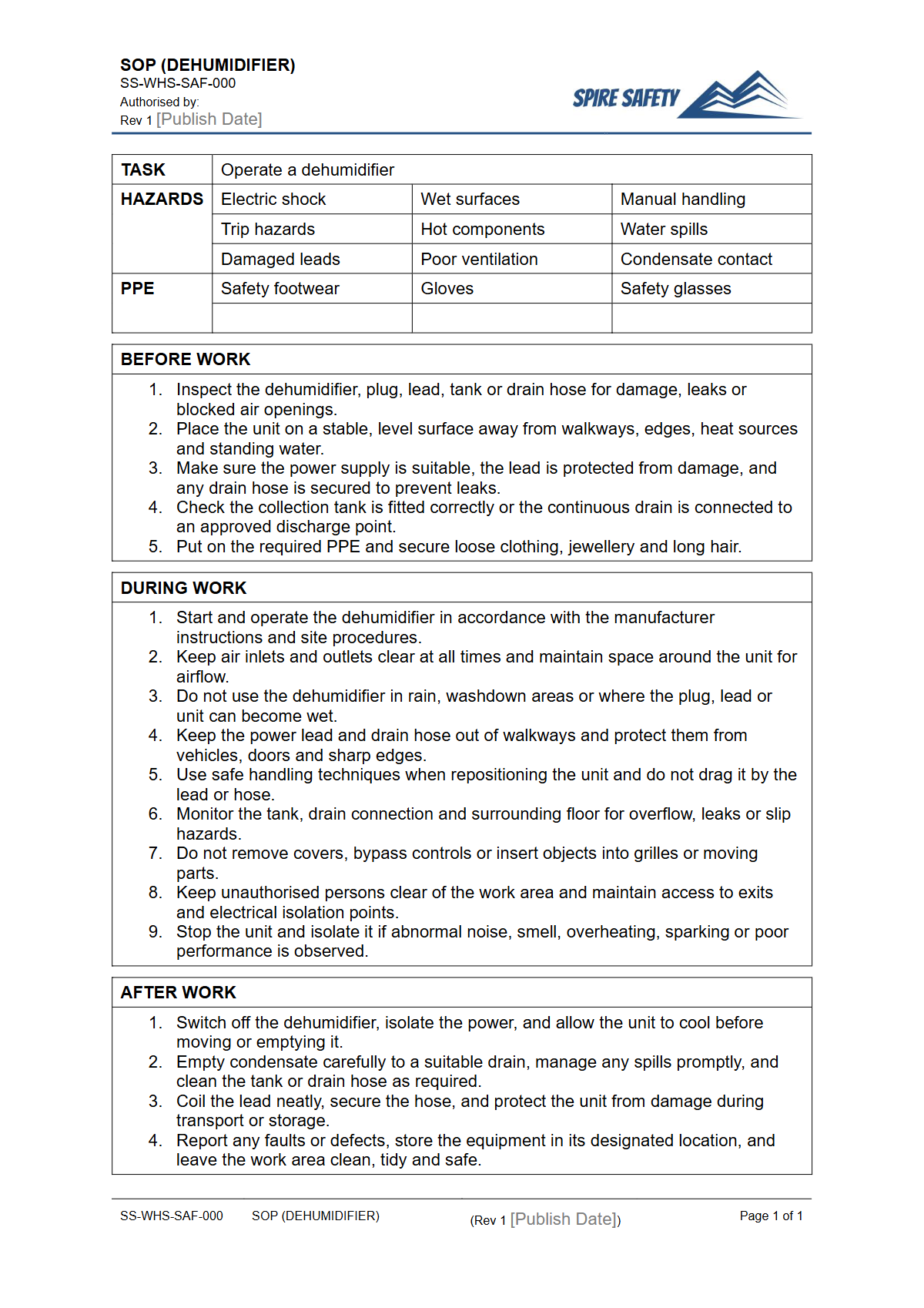
Purpose of the Free Safe Operating Procedure (Dehumidifier) Template
Operating dehumidifiers, particularly in commercial or industrial settings, involves specific risks that must be managed to ensure worker safety. This Safe Operating Procedure (SOP) template provides a structured framework for documenting the required steps to use dehumidifiers safely.
It helps organisations identify hazards and implement control measures related to electrical safety, manual handling, and equipment maintenance. Our free Safe Operating Procedure (Dehumidifier) Template is designed as a comprehensive starting point, guiding you through pre-operational checks, safe operation steps, and shutdown procedures to minimise the risk of incidents and injuries.
It aims to standardise practices, ensuring that all personnel operate the equipment consistently and safely, which is a fundamental component of a robust safety management system.
A well-defined SOP ensures that key safety considerations are not overlooked. This includes tasks like positioning the unit for optimal airflow and stability, managing electrical cords to prevent trip hazards, and correctly handling collected water to avoid slips or biological hazards.
Similar to the procedural diligence required for other plant, documented in resources like our free Air Compressor SOP template, this document provides clarity and supports regulatory compliance efforts by demonstrating a systematic approach to workplace safety.
Video walkthrough
How to use the Free Safe Operating Procedure (Dehumidifier) Template
This document is a template and must be customised to your specific workplace. After downloading the DOCX or PDF file, you should review and adapt its contents to reflect the make and model of the dehumidifiers you use, the environment they operate in, and your organisation's specific safety protocols.
Consult with operators, maintenance staff, and supervisors during the customisation process to ensure the procedure is practical, accurate, and comprehensive. Incorporate details such as specific personal protective equipment (PPE) requirements, lockout-tagout procedures for your site, and emergency contact information.
It is crucial to remember that we provide this document as a starting point; you must customise it to reflect the specific dehumidifier models, workplace environment, and control measures relevant to your organisation. Once finalised, the SOP should be used as a key training tool for all employees who will operate or work near the equipment.
If you require assistance in tailoring this document or developing other complex safety procedures, our WHS consulting services can provide expert guidance to ensure your documentation is fit-for-purpose.
When to use this Safe Operating Procedure
A dehumidifier SOP should be referenced in several key situations. It is essential during the induction and training of new employees or when an existing worker is assigned to operate the equipment for the first time.
The procedure should also be readily accessible in the work area for quick reference during operation. Furthermore, it serves as a critical checklist during routine safety inspections and maintenance activities.
Regularly reviewing the SOP, at least annually or following any incident, ensures it remains current with evolving site conditions or new equipment. This document is a key operational tool within your broader safety framework and is fundamental to the effective implementation of WHS management systems.
Who should use this Safe Operating Procedure
This SOP is intended for a range of personnel within an organisation. Primarily, it is for the direct operators of the dehumidifier, providing them with clear, step-by-step instructions for safe use.
Supervisors and managers should also use the document to oversee work, conduct safety observations, and supports your compliance efforts with established procedures. Additionally, WHS and safety officers will find the template useful for risk assessment, incident investigation, and training development.
Maintenance personnel must also be familiar with the SOP, especially sections relating to safe isolation, cleaning, and servicing. Just as a circular saw SOP is vital for a carpenter, this procedure is essential for anyone interacting with dehumidification equipment.
Key Hazards Addressed
Using dehumidifiers can introduce several hazards if not properly managed. This SOP template prompts you to consider and control for:
- Electrical Hazards: Risks from damaged cords, improper connections, or exposure to water, potentially leading to electric shock. The use of RCD-protected outlets is critical.
- Manual Handling: Injuries from lifting and moving heavy or awkward units. The SOP encourages team lifts or the use of mechanical aids.
- Slips, Trips, and Falls: Hazards created by power cords running across walkways or water spillage during emptying of collection tanks.
- Biological Hazards: Stagnant water in collection tanks can become a breeding ground for mould and bacteria if not emptied and cleaned regularly.
- Fire Risk: Overheating can occur due to blocked vents, poor ventilation, or internal electrical faults.
Regular reviews, as might be conducted during our WHS compliance auditing services, can help verify that controls for these hazards are effectively implemented and maintained.
Integrating with Other Safety Documents
An SOP does not exist in isolation. It should be directly linked to your site's overall risk assessment for dehumidifier use.
The hazards identified in the risk assessment should be addressed with specific control measures documented in this procedure. The SOP also complements training records, verifying that operators have been instructed on its contents.
This aligns with the principles of managing all plant safely, whether you're using this document or our free Telehandler SOP template for mobile equipment. For more procedural documents to build out your safety system, you can explore our complete free WHS resources library.
Common mistakes
Common mistakes to avoid
- Using a domestic-grade unit for a large-scale industrial or construction application, leading to ineffectiveness and overheating.
- Placing the dehumidifier in a corner or against a wall, which restricts airflow and reduces its efficiency.
- Forgetting to regularly clean or replace filters, leading to reduced performance and potential motor strain.
- Running power cords across active walkways or using extension cords that are not rated for the electrical load of the unit.
Legal references
Legal considerations
The following legal requirements may be relevant to this type of work.
- Work Health and Safety Act (Harmonised) — Provides the primary duties for protecting workers and other people from work health and safety risks.
- Work Health and Safety Regulations (Harmonised) — Sets out requirements supporting the management of workplace hazards and risks.
The following codes may be relevant to this type of work.
- Managing WHS Risks Code of Practice — Provides practical guidance on identifying hazards, assessing risks and applying effective controls.
- Work Health and Safety Consultation, Cooperation and Coordination Code of Practice — Provides practical guidance on consulting workers and coordinating with other duty holders.
- Managing the Work Environment and Facilities Code of Practice — Provides practical guidance on safe work environments, workplace facilities and related controls.
Did you know
Hidden Hazard
While dehumidifiers are used to prevent mould growth in a room, the water they collect can become a breeding ground for bacteria and mould if the tank is not emptied and cleaned regularly.
Energy Consumption
Industrial refrigerant dehumidifiers can be significant energy consumers. Their efficiency is heavily dependent on the ambient temperature and humidity, with performance dropping in cooler conditions.
FAQ
Frequently asked questions
01What is a Safe Operating Procedure for a dehumidifier?
02Why is an SOP necessary for a simple machine like a dehumidifier?
03How often should I review the dehumidifier SOP?
04Does this template cover industrial and commercial dehumidifiers?
Share this resource
Free Safe Operating Procedure (Dehumidifier) Template
Browse Categories
How To Use It
- 1Download and open in Word or PDF.
- 2Replace the placeholders with your business details.
- 3Get it reviewed by a WHS specialist before rollout.
Need it customised?
Our WHS consultants can adapt this template to your site, run a gap analysis, or audit what you already have in place.
Book a Free Consultation WHS consulting servicesor call 1300 156 382
Related templates
- Free Safe Operating Procedure (Deli Counter Cleaning) Template
- Free Safe Operating Procedure (Deli Scale Cleaning) Template
- Free Safe Operating Procedure (Demolition Hammer) Template
- Free Safe Operating Procedure (Dense Media Plant) Template
- Free Safe Operating Procedure (Dent Puller) Template
- Free Safe Operating Procedure (Depot Gate Check) Template