
Free Safe Operating Procedure (Dent Puller) Template
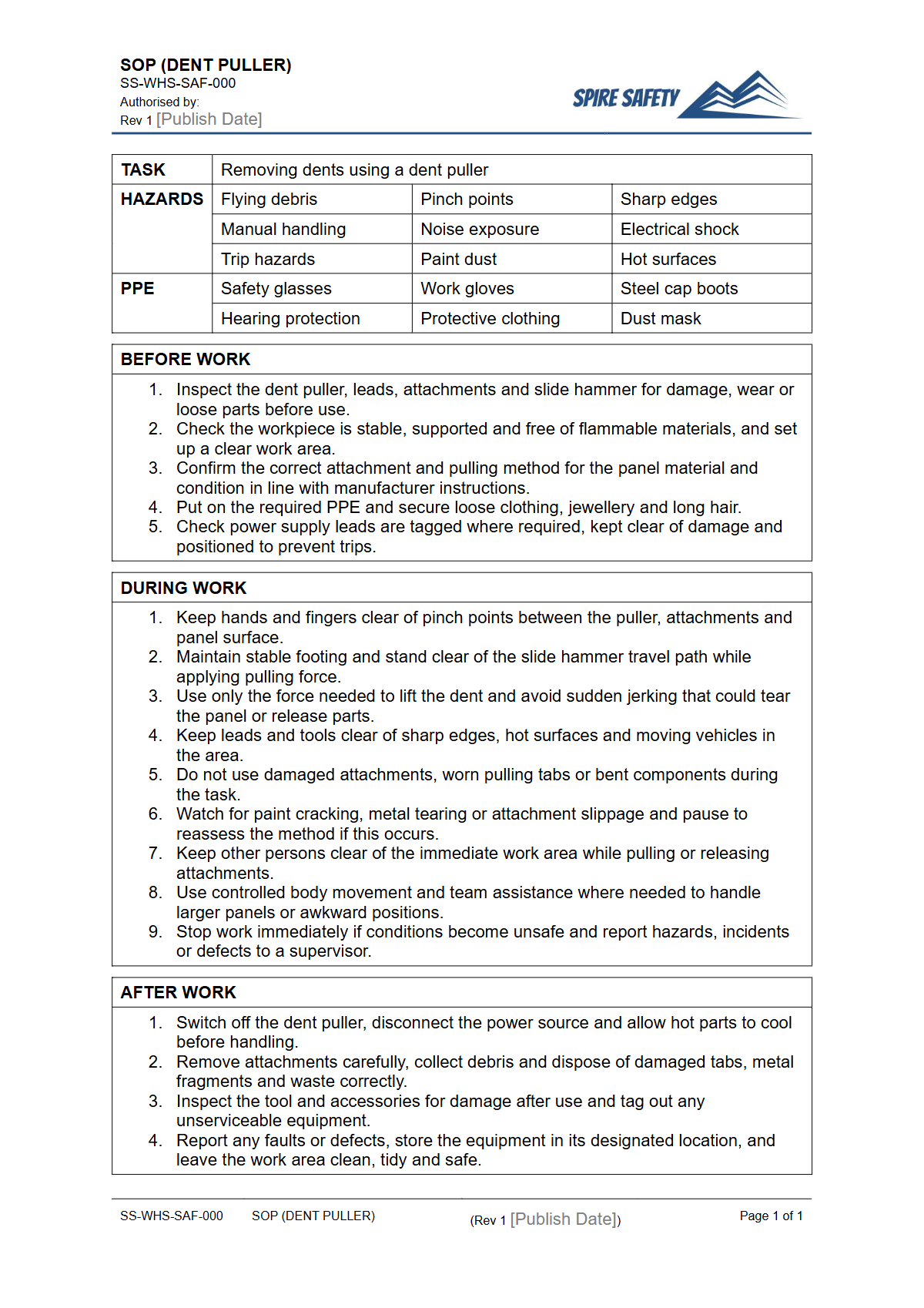
Download our free Safe Operating Procedure (Dent Puller) Template to formalise safety steps for using this common workshop tool.
Free Safe Operating Procedure (Dent Puller) Template
DOCX • 126 KB + PDF
Updated Oct 2026
No signup required
Purpose of the Free Safe Operating Procedure (Dent Puller) Template
Using a dent puller, whether it's a manual slide hammer, a suction device, or an electric stud welder, introduces specific risks into the workshop. This free Safe Operating Procedure (Dent Puller) Template provides a structured framework for documenting the required safety controls for this task.
It helps your business systematically address hazards such as projectiles from tool failure, ergonomic injuries from improper use, electric shock, and burns. Formalising these steps is a critical part of demonstrating a safe system of work and fulfilling your duties under Australian WHS legislation.
An SOP is a foundational document within your overall safety framework. Integrating procedures like this one into your daily operations ensures that safety is not an afterthought but a planned activity.
A well-defined SOP forms a key part of your broader WHS management system, helping to standardise safe work practices across your team and create a consistent safety culture.
Video walkthrough
How to use the Free Safe Operating Procedure (Dent Puller) Template
This template is designed for ease of use. Simply download the DOCX file and open it in your preferred word processor.
The document is logically structured with sections for PPE, pre-operational checks, step-by-step operating instructions, and shutdown procedures. Fill in the details specific to the make and model of the dent puller used in your workshop, the environment it is used in, and your organisation's specific safety protocols.
IMPORTANT: This is a template only. We are not your safety advisors.
You MUST customise this document to reflect the specific equipment, tasks, hazards, and control measures relevant to your workplace. Generic procedures are not sufficient for WHS compliance and may not adequately control the risks in your specific environment.
If you need help tailoring this document, engaging professional WHS consulting services can provide tailored support.
When should you use this Safe Operating Procedure?
A Safe Operating Procedure for dent pullers should be used consistently as part of your daily work routine. It is an essential tool for:
- Worker Training: Use it to induct new employees or apprentices on the safe method for pulling dents.
- Pre-Task Planning: Operators should review the SOP before starting a job to refresh their memory on key safety checks and steps.
- Risk Management: The SOP serves as a reference during risk assessments and helps identify control measures that need to be implemented.
- Incident Investigation: If an incident occurs, the SOP can be reviewed to determine if procedures were followed or if they need to be updated.
This procedure should exist alongside others that cover common workshop tasks. For instance, many dent pulling jobs occur in environments where compressed air is used, making a Free Air Compressor SOP equally important for ensuring comprehensive safety coverage.
Who should use this SOP?
This SOP is intended for all personnel involved with vehicle repair and maintenance tasks that require a dent puller. This includes:
- Panel beaters and smash repair technicians
- Vehicle mechanics and apprentices
- Workshop supervisors and managers
- WHS officers and representatives
Supervisors are responsible for ensuring that workers have been trained on the SOP and are following it correctly. This involves regular observation and providing feedback.
To ensure your procedures are effective and being implemented as intended, you might consider periodic WHS compliance auditing to verify practices on the workshop floor.
Key Elements of a Dent Puller SOP
Our template prompts you to detail several critical safety areas, ensuring a comprehensive procedure. These include identifying required PPE like safety glasses and gloves, outlining pre-start checks such as inspecting cords and ensuring the work area is clear, and detailing a logical sequence for the task itself.
It also covers post-operation steps, including proper cleaning and storage. In a diverse workshop, this level of detail is needed for all equipment, from hand tools to more powerful machinery covered by a FREE Circular Saw SOP.
By using this template, you create a practical tool that guides workers and helps your business maintain a safer working environment. You can find many more helpful documents in our complete free WHS resources library to build out your safety management system.
Common mistakes
Common mistakes to avoid
- Using a generic SOP without customising it for the specific make and model.
- Failing to conduct pre-operational checks on equipment, especially power cords and pulling attachments.
- Neglecting to wear appropriate Personal Protective Equipment (PPE), particularly high-impact eye protection.
- Applying excessive or uncontrolled force, leading to panel tearing or sudden tool failure.
Legal references
Legal considerations
The following legal requirements may be relevant to this type of work.
- Work Health and Safety Act (Harmonised) — Provides the primary duties for protecting workers and other people from work health and safety risks.
- Work Health and Safety Regulations (Harmonised) — Sets out requirements supporting the management of workplace hazards and risks.
The following codes may be relevant to this type of work.
- Managing WHS Risks Code of Practice — Provides practical guidance on identifying hazards, assessing risks and applying effective controls.
- Work Health and Safety Consultation, Cooperation and Coordination Code of Practice — Provides practical guidance on consulting workers and coordinating with other duty holders.
- Managing the Work Environment and Facilities Code of Practice — Provides practical guidance on safe work environments, workplace facilities and related controls.
Did you know
Instant Power
Modern dent pullers, especially stud welders, can deliver thousands of amps of current in a split second to weld a pin to the panel, creating significant electrical and burn hazards if not used correctly.
Controlled Force
The principle behind many dent pullers isn't just brute force; it's about applying a controlled, outward force to relieve the stress in stretched metal, allowing it to return to its original shape.
FAQ
Frequently asked questions
01What are the main hazards of using a dent puller?
02Is a Safe Operating Procedure a legal requirement in Australia?
03How often should an SOP for a dent puller be reviewed?
04Can I use this template for any type of dent puller?
Share this resource
Free Safe Operating Procedure (Dent Puller) Template
Browse Categories
How To Use It
- 1Download and open in Word or PDF.
- 2Replace the placeholders with your business details.
- 3Get it reviewed by a WHS specialist before rollout.
Need it customised?
Our WHS consultants can adapt this template to your site, run a gap analysis, or audit what you already have in place.
Book a Free Consultation WHS consulting servicesor call 1300 156 382
Related templates
- Free Safe Operating Procedure (Depot Gate Check) Template
- Free Safe Operating Procedure (Depot Yard Inspection) Template
- Free Safe Operating Procedure (Descaling Equipment) Template
- Free Safe Operating Procedure (Dewatering Pump) Template
- Free Safe Operating Procedure (Dewatering Screen) Template
- Free Safe Operating Procedure (Diamond Core Drill) Template