
Free Safe Operating Procedure (Dewatering Pump) Template
Effectively manage risks associated with dewatering pump operations with our free SOP template.
Free Safe Operating Procedure (Dewatering Pump) Template
DOCX • 126 KB + PDF
Updated Oct 2026
No signup required
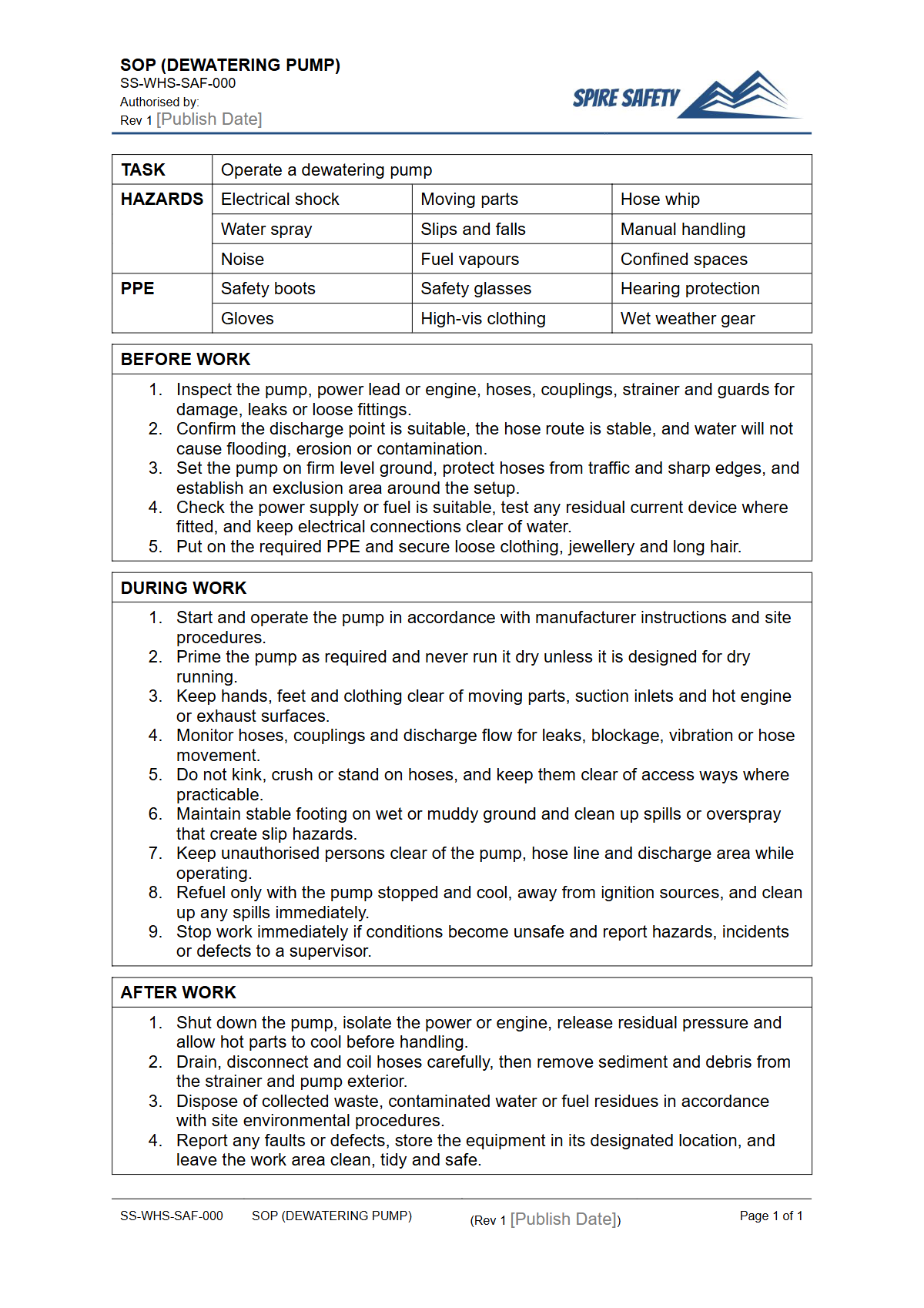
Purpose of the Free Safe Operating Procedure (Dewatering Pump) Template
Operating a dewatering pump, while a common task on construction, mining, and agricultural sites, involves significant hazards that must be controlled. This Free Safe Operating Procedure (Dewatering Pump) Template provides a structured framework for documenting the required steps to perform the task safely.
Its primary purpose is to help Persons Conducting a Business or Undertaking (PCBUs) meet their duty of care by identifying risks and outlining robust control measures. By using this template, you can formalise procedures for pre-start checks, operation, shutdown, and maintenance, ensuring all workers have clear and consistent instructions.
A well-developed SOP is a critical component of a proactive safety culture. It serves as a key training tool for new operators and a reference for experienced workers, reinforcing safe work habits.
This document helps standardise your approach to managing hazards such as electrocution from faulty wiring, drowning in excavated areas, entanglement with moving parts, noise exposure, and manual handling injuries. Integrating specific SOPs like this into your overarching WHS management systems demonstrates a systematic approach to workplace safety and risk management.
Video walkthrough
How to use the Free Safe Operating Procedure (Dewatering Pump) Template
This template is a starting point designed for customisation. A generic document is not sufficient to ensure safety; it must reflect the specific equipment, environment, and tasks at your workplace.
Download the DOCX or PDF and adapt it by following a consultative process.
Steps for effective implementation:
- Consult with your team: Involve the workers who actually operate the dewatering pumps. Their practical experience is invaluable for identifying real-world hazards and effective, workable controls.
- Conduct a site-specific risk assessment: Evaluate the specific pump model (e.g., petrol, diesel, electric, submersible), the location of use (e.g., near an open excavation, in a confined space), and the substances being pumped.
- Populate the template: Fill in the required fields with detailed information, including the specific make and model of the pump, required Personal Protective Equipment (PPE) like hearing protection and gloves, and site-specific emergency procedures.
- Review and approve: Have a competent person, such as a supervisor or WHS manager, review and formally approve the finalised SOP before it is issued.
- Train and communicate: Use the completed SOP as a central document for training all relevant personnel. Ensure it is readily accessible to operators at all times.
Important: This document is a template only. We are not responsible for its customisation or implementation.
You must adapt it to your specific machinery, work environment, and legal obligations.
When to use it
A Safe Operating Procedure for a dewatering pump should be developed and implemented before the equipment is ever used on site. It is a proactive tool, not a reactive one.
The SOP should be a key part of the planning phase for any job that requires water removal, ensuring safety is considered from the outset. It is particularly crucial when working in or near excavations, where the risk of ground collapse or drowning is elevated; for such tasks, you might also require procedures like our FREE Trencher SOP Template to manage associated risks.
Beyond initial setup and training, the SOP is a living document used for ongoing safety management. It should be referenced for pre-start inspections, refresher training, and supervision.
It also becomes an essential piece of evidence during safety reviews or WHS compliance auditing, demonstrating that formal processes are in place. In the unfortunate event of an incident or near-miss, the SOP provides a benchmark against which behaviour and conditions can be assessed during an investigation.
Who should use it
The responsibility for developing, implementing, and using an SOP for a dewatering pump is shared across several roles within an organisation:
- PCBU/Management: Holds the primary duty of care to ensure, so far as is reasonably practicable, the provision and maintenance of safe plant and safe systems of work. This includes resourcing the development and implementation of SOPs.
- Supervisors and Team Leaders: Are responsible for ensuring that workers are trained on the SOP and follow it correctly. They must enforce the documented procedures and monitor for compliance on the ground.
- Workers/Operators: Must follow the procedures outlined in the SOP. They also have a responsibility to contribute to its development and report any hazards or deficiencies they identify with the equipment or the procedure itself.
- WHS Managers/Advisors: Often facilitate the risk assessment and drafting process, providing technical expertise and ensuring the SOP aligns with legislative requirements and the organisation's overall safety system. Expert guidance from WHS consulting professionals can streamline this process.
Ultimately, the SOP is for anyone involved in the lifecycle of the dewatering task, from planning and setup to operation and pack-down. The process of using equipment like pumps and compressors can be streamlined with clear documentation, such as our Free Air Compressor SOP (Safe Operating Procedure) Template. For a broader range of procedural documents, you can explore our complete free WHS resources library.
Common mistakes
Common mistakes to avoid
- Using a generic SOP without customising it for the specific pump model and site conditions.
- Failing to inspect hoses, power cords, and fuel lines for damage before each use.
- Placing the pump on unstable ground or too close to the edge of an excavation.
- Neglecting to isolate the power source before attempting to clear a blockage or perform maintenance.
Legal references
Legal considerations
The following legal requirements may be relevant to this type of work.
- Work Health and Safety Act (Harmonised) — Provides the primary duties for protecting workers and other people from work health and safety risks.
- Work Health and Safety Regulations (Harmonised) — Sets out requirements supporting the management of workplace hazards and risks.
The following codes may be relevant to this type of work.
- Managing WHS Risks Code of Practice — Provides practical guidance on identifying hazards, assessing risks and applying effective controls.
- Work Health and Safety Consultation, Cooperation and Coordination Code of Practice — Provides practical guidance on consulting workers and coordinating with other duty holders.
- Managing the Work Environment and Facilities Code of Practice — Provides practical guidance on safe work environments, workplace facilities and related controls.
Did you know
Silent Hazard
Many portable dewatering pumps can generate noise levels well over 85 dBA, the exposure standard for noise. Prolonged operation without hearing protection can lead to permanent hearing damage.
Water Weight
Water is heavy, weighing approximately 1 kilogram per litre. A standard 50mm dewatering hose full of water can be extremely difficult and hazardous to move manually, leading to sprains and strains.
FAQ
Frequently asked questions
01What are the main hazards of using a dewatering pump?
02Does this SOP template cover both petrol and electric dewatering pumps?
03Who is responsible for creating a Safe Operating Procedure?
04How often should an SOP for a dewatering pump be reviewed?
Share this resource
Free Safe Operating Procedure (Dewatering Pump) Template
Browse Categories
How To Use It
- 1Download and open in Word or PDF.
- 2Replace the placeholders with your business details.
- 3Get it reviewed by a WHS specialist before rollout.
Need it customised?
Our WHS consultants can adapt this template to your site, run a gap analysis, or audit what you already have in place.
Book a Free Consultation WHS consulting servicesor call 1300 156 382
Related templates
- Free Safe Operating Procedure (Dewatering Screen) Template
- Free Safe Operating Procedure (Diamond Core Drill) Template
- Free Safe Operating Procedure (Diaphragm Pump) Template
- Free Safe Operating Procedure (Diesel Refuelling) Template
- Free Safe Operating Procedure (Diesel Transfer Tank) Template
- Free Safe Operating Procedure (Differential Oil Change) Template