
Free Safe Operating Procedure (Dewatering Screen) Template
Manage risks associated with dewatering screens using our structured Safe Operating Procedure. Download this free template in Word or PDF to get started.
Free Safe Operating Procedure (Dewatering Screen) Template
DOCX • 126 KB + PDF
Updated Oct 2026
No signup required
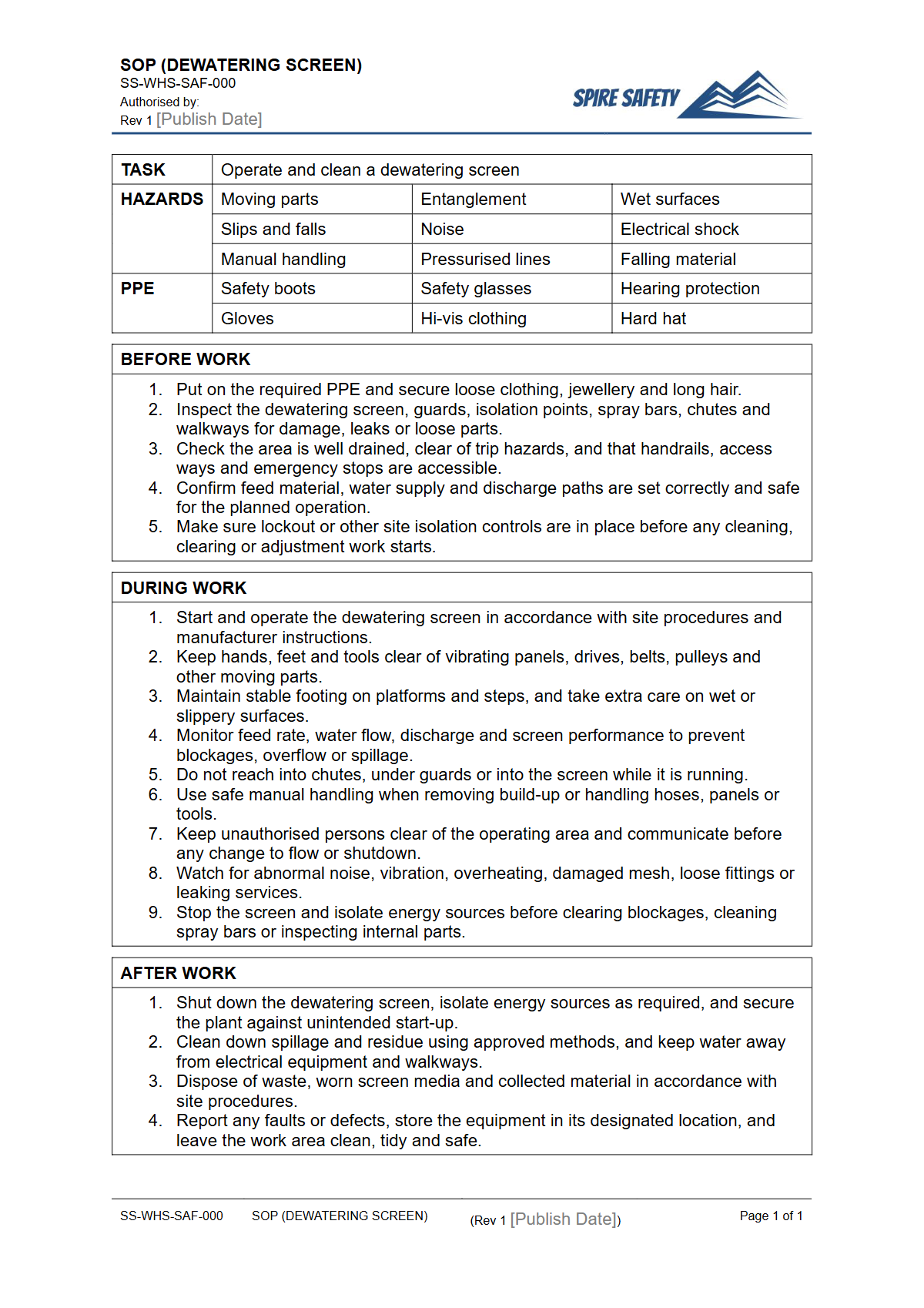
Purpose of the Free Safe Operating Procedure (Dewatering Screen) Template
Operating heavy machinery like a dewatering screen introduces significant workplace hazards. A Safe Operating Procedure (SOP) is an essential administrative control that provides clear, step-by-step instructions for workers to follow, ensuring tasks are performed safely and consistently.
This Free Safe Operating Procedure (Dewatering Screen) Template serves as a comprehensive starting point for your organisation to formalise its processes. It is designed to help you document the required pre-operational checks, operational steps, shutdown procedures, and emergency responses associated with dewatering screen equipment.
By implementing a detailed SOP, you create a safer working environment, reduce the likelihood of incidents, and demonstrate a commitment to fulfilling your work health and safety duties. It helps in systematically identifying hazards such as mechanical entanglement, high-pressure water jets, electrical faults, excessive noise, and slip and fall risks.
The procedure then outlines the control measures required to mitigate these risks to a level that is as low as reasonably practicable (ALARP). An effective SOP is a cornerstone of a robust safety framework, working alongside other critical documents like a Conveyer System SOP for associated plant.
Key Hazards Associated with Dewatering Screens
Dewatering screens present a unique combination of mechanical, electrical, and environmental hazards. A thorough SOP must address these specific risks:
- Mechanical Hazards: The primary risk involves entanglement or crushing from moving parts, including the vibrating screen mechanism, springs, and drive components. Guards must be in place and effective.
- Electrical Hazards: As the equipment uses both electricity and water, the risk of electric shock is high. Procedures must cover inspection of cables, proper grounding, and isolation protocols.
- Noise and Vibration: High-frequency screen vibration and the general noise of a processing plant can lead to permanent hearing loss and other health issues like Hand-Arm Vibration Syndrome (HAVS) over time.
- Slips, Trips, and Falls: Water spillage around the machine creates a constant slip hazard. Walkways and access platforms must be kept clear and have non-slip surfaces.
- Blockages: Clearing material blockages from the screen deck or underpan presents a major risk if the machine is not properly isolated and de-energised first.
Video walkthrough
How to use the Free Safe Operating Procedure (Dewatering Screen) Template
This document is a foundational template that must be adapted to your specific operational context. It is not a complete, ready-to-use procedure.
To use it effectively, you should undertake a consultative customisation process.
Important: It's critical to recognise that this document is a template, not a finished product. We have provided a structured starting point based on common WHS practice, but you must customise it to reflect the specific dewatering screen model, site conditions, maintenance schedules, and legal obligations of your workplace.
A generic procedure is insufficient for ensuring safety.
Follow these steps to adapt the template:
- Consult with Workers: Engage with the operators, maintenance staff, and supervisors who work directly with the dewatering screen. Their hands-on experience is invaluable for identifying real-world hazards and practical control measures.
- Conduct a Risk Assessment: Use the template as a guide to perform a specific risk assessment on your dewatering screen. Document the findings and ensure the control measures listed in the SOP are adequate and relevant.
- Add Specific Details: Insert the make, model, and location of your equipment. Add site-specific rules, emergency contact numbers, and details about required Personal Protective Equipment (PPE).
- Review and Approve: Once customised, the SOP should be reviewed by a competent person (such as a WHS manager or supervisor) and formally approved for use. An effective SOP is a vital component of your broader WHS management systems.
When to use it
A dewatering screen SOP should be a living document that is used consistently throughout the equipment's lifecycle. It is not a 'set and forget' piece of paperwork. The procedure should be used:
- During Worker Training: As the primary training document for new operators.
- For Refresher Training: For periodic retraining of existing workers to prevent complacency.
- Before Starting Work: As a reference for completing pre-operational checks.
- During Operations: As a guide for correct and safe task execution.
- For Audits and Inspections: To benchmark safe work practices during internal or external audits. Regular reviews are essential, and formal WHS compliance auditing can verify that procedures are being correctly implemented in practice.
Who should use it
Any person whose work involves or occurs near a dewatering screen must be familiar with the contents of the Safe Operating Procedure. This includes a range of roles within an organisation:
- Plant Operators: The primary users who are responsible for the day-to-day operation of the machine.
- Maintenance Personnel: Workers responsible for servicing, repairing, or clearing blockages from the screen must strictly follow isolation and lockout/tagout procedures detailed in the SOP.
- Supervisors and Managers: Responsible for ensuring workers are trained on the SOP and adhere to it at all times. They use it as a tool for monitoring and instruction.
- WHS Representatives: Use the SOP to assist in workplace inspections and risk management discussions.
By integrating this procedure across all relevant roles, you create a unified approach to safety. This same principle applies to other heavy machinery on site, which should also have documented procedures, such as a Dozer SOP, to ensure comprehensive site safety.
Common mistakes
Common mistakes to avoid
- Failing to customise the generic template for the specific machine model and site conditions.
- Neglecting to conduct and document pre-start checks before every use.
- Becoming complacent with lockout/tagout procedures before clearing blockages or performing maintenance.
- Not providing adequate training on the finalised SOP to all operators and maintenance staff.
Legal references
Legal considerations
The following legal requirements may be relevant to this type of work.
- Work Health and Safety Act (Harmonised) — Provides the primary duties for protecting workers and other people from work health and safety risks.
- Work Health and Safety Regulations (Harmonised) — Sets out requirements supporting the management of workplace hazards and risks.
The following codes may be relevant to this type of work.
- Managing WHS Risks Code of Practice — Provides practical guidance on identifying hazards, assessing risks and applying effective controls.
- Work Health and Safety Consultation, Cooperation and Coordination Code of Practice — Provides practical guidance on consulting workers and coordinating with other duty holders.
- Managing the Work Environment and Facilities Code of Practice — Provides practical guidance on safe work environments, workplace facilities and related controls.
Did you know
High Throughput
Modern dewatering screens can process hundreds of tonnes of material per hour, making the efficiency and reliability of their safety systems absolutely critical to preventing serious incidents.
Hidden Danger
The high-frequency vibration that allows a dewatering screen to function is also a significant long-term health hazard. Without proper controls, prolonged exposure can lead to Hand-Arm Vibration Syndrome (HAVS).
FAQ
Frequently asked questions
01What should be included in a dewatering screen SOP?
02How often should a Safe Operating Procedure be reviewed?
03Who is responsible for writing a Safe Operating Procedure?
04Is a dewatering screen SOP a legal requirement in Australia?
Share this resource
Free Safe Operating Procedure (Dewatering Screen) Template
Browse Categories
How To Use It
- 1Download and open in Word or PDF.
- 2Replace the placeholders with your business details.
- 3Get it reviewed by a WHS specialist before rollout.
Need it customised?
Our WHS consultants can adapt this template to your site, run a gap analysis, or audit what you already have in place.
Book a Free Consultation WHS consulting servicesor call 1300 156 382
Related templates
- Free Safe Operating Procedure (Diamond Core Drill) Template
- Free Safe Operating Procedure (Diaphragm Pump) Template
- Free Safe Operating Procedure (Diesel Refuelling) Template
- Free Safe Operating Procedure (Diesel Transfer Tank) Template
- Free Safe Operating Procedure (Differential Oil Change) Template
- Free Safe Operating Procedure (Digital Thermometer) Template