
Free Safe Operating Procedure (Diesel Transfer Tank) Template
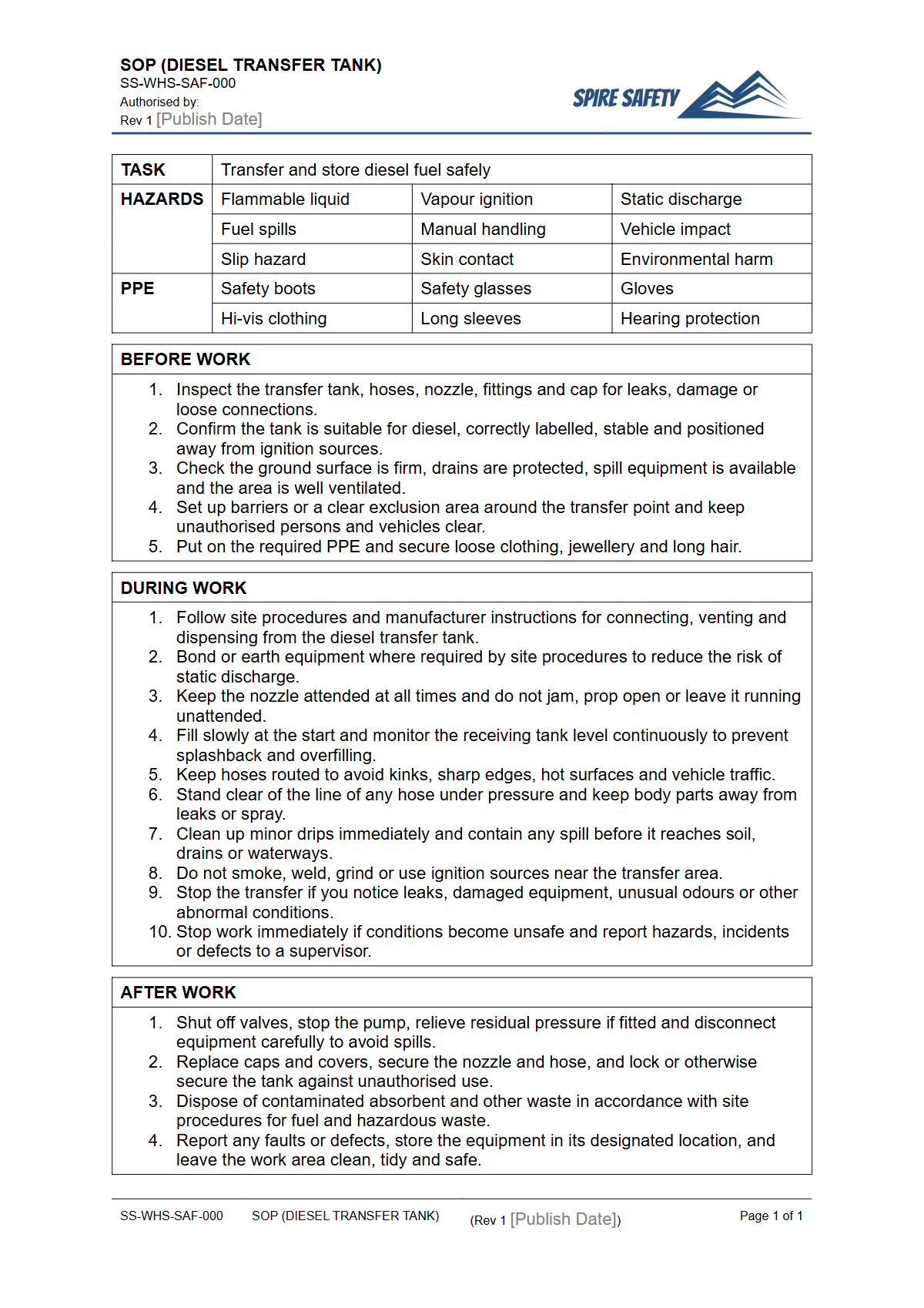
Download our free Safe Operating Procedure (Diesel Transfer Tank) template to define safe work methods. This customisable document helps you manage risks.
Free Safe Operating Procedure (Diesel Transfer Tank) Template
DOCX • 126 KB + PDF
Updated Oct 2026
No signup required
Purpose of the Free Safe Operating Procedure (Diesel Transfer Tank) Template
Effectively managing the risks associated with diesel transfer is critical on any worksite. Our free Safe Operating Procedure (Diesel Transfer Tank) template provides a structured starting point for documenting the required steps to refuel plant and equipment safely.
Using a diesel transfer tank, whether portable, skid-mounted, or vehicle-mounted, introduces significant hazards, including fire, explosion, chemical exposure, environmental contamination, and manual handling injuries. This SOP helps your organisation establish and communicate a standardised, safe system of work to control these risks, ensuring that all workers follow a consistent and pre-approved process.
A documented procedure is a fundamental component of a robust safety management system. It serves as an essential training tool for new workers and a reference for experienced operators, promoting a proactive safety culture.
By clearly outlining responsibilities, pre-operational checks, emergency actions, and correct operating techniques, this template helps you fulfil your primary duty of care under Australian WHS legislation. It is designed to be adapted to your specific operational needs, forming a key part of your risk management framework for handling hazardous chemicals.
For broader system support, our experts can assist with developing comprehensive WHS management systems for your business.
Video walkthrough
How to use the Free Safe Operating Procedure (Diesel Transfer Tank) Template
This Safe Operating Procedure for diesel transfer tanks is available for immediate download in both DOCX and PDF formats. The DOCX file is fully editable, allowing you to tailor the content to the specific models of transfer tanks used at your workplace, the types of vehicles or machinery being refuelled, and your site-specific environmental conditions and emergency procedures.
The PDF version is ideal for easy printing and distribution once your customisation is complete.
Important: This document is a template and must be customised to your workplace. We are not responsible for the outcomes of any action taken based on the information provided.
You must consult with your workers and other stakeholders to ensure the final SOP is practical, comprehensive, and accurately reflects the tasks and risks involved. Integrating site-specific details, such as the location of spill kits and fire extinguishers, is essential for the procedure to be effective.
Key Components of a Diesel Transfer Tank SOP
A thorough SOP for this task should be more than just a simple checklist. Our template prompts you to consider several critical areas to create a comprehensive safe work method. These include:
- Personal Protective Equipment (PPE): Specifies required PPE, such as safety glasses, chemical-resistant gloves, and safety footwear.
- Pre-Operational Checks: A sequence of inspections to perform before use, covering the tank, hoses, nozzles, bonding wires, pumps, and emergency stop functions. This ensures the equipment is in safe working order.
- Step-by-Step Operating Procedure: Details the entire refuelling process, from positioning the vehicle and earthing the equipment to monitoring the fuel transfer and securely stowing the nozzle and hoses. This section is vital for tasks involving heavy machinery, and can be used alongside other procedures like a Dozer SOP.
- Emergency Procedures: Outlines immediate actions to be taken in the event of a fuel spill, fire, or personal injury. This includes activating emergency stops, using spill kits, and contacting emergency services.
- Post-Operational Checks: Steps to take after refuelling is complete, such as securing the tank, completing logbooks, and reporting any faults or issues.
Properly managing the transfer of diesel is just one of many high-risk tasks on a worksite. Standardising procedures for all equipment, such as with a Telehandler SOP, creates a more predictable and safer environment for everyone.
When to Use This SOP
This Safe Operating Procedure should be the primary reference document for any task involving a diesel transfer tank. It should be used during worker inductions and for task-specific training to ensure competency before an operator is authorised to refuel equipment independently.
It also serves as a valuable tool for conducting refresher training, especially for infrequent users. Furthermore, the SOP must be reviewed and referenced during incident investigations or after a near-miss to identify any gaps or areas for improvement in your current process.
Regular reviews ensure it remains current with your operational practices and any changes in equipment. If your reviews identify systemic issues, consider engaging professional WHS consulting to assess your overall safety framework.
Who Should Use It
This SOP is intended for a range of personnel within an organisation. Primary users are the workers and operators who physically carry out the refuelling tasks. Supervisors and team leaders must also be intimately familiar with the procedure to effectively oversee the work, conduct inspections, and supports your compliance efforts. Safety officers and managers should use this document as a baseline for risk assessments, training development, and workplace audits. It provides a clear standard against which actual work practices can be measured, similar to how procedures like a Grader SOP are used to ensure safe operation of specific plant. You can find more templates like these in our free WHS resources library to support all your operational needs.
Common mistakes
Common mistakes to avoid
- Failing to properly earth or bond the tank and vehicle before transfer.
- Overfilling the vehicle or machinery tank, leading to spills.
- Using mobile phones or other non-intrinsically safe electronics near the refuelling point.
- Neglecting pre-operational checks on hoses, nozzles, and emergency stop functions.
Legal references
Legal considerations
The following legal requirements may be relevant to this type of work.
- Work Health and Safety Act (Harmonised) — Provides the primary duties for protecting workers and other people from work health and safety risks.
- Work Health and Safety Regulations (Harmonised) — Sets out requirements supporting the management of workplace hazards and risks.
The following codes may be relevant to this type of work.
- Managing WHS Risks Code of Practice — Provides practical guidance on identifying hazards, assessing risks and applying effective controls.
- Work Health and Safety Consultation, Cooperation and Coordination Code of Practice — Provides practical guidance on consulting workers and coordinating with other duty holders.
- Managing the Work Environment and Facilities Code of Practice — Provides practical guidance on safe work environments, workplace facilities and related controls.
Did you know
Static Spark Risk
A static electricity spark, often too small to see or feel, can have enough energy to ignite diesel vapours during transfer. Always ensure the tank, nozzle, and vehicle are properly bonded or earthed before starting to refuel.
Diesel Bug
Water condensation inside a diesel tank can promote the growth of microbes, commonly known as 'diesel bug'. This contamination creates a sludge that can clog fuel filters and injectors, potentially causing engine failure.
FAQ
Frequently asked questions
01What are the main hazards of using a diesel transfer tank?
02Is a Safe Operating Procedure a legal requirement for diesel transfer tanks in Australia?
03How often should a diesel transfer tank SOP be reviewed?
04Can I use this template for transferring petrol?
Share this resource
Free Safe Operating Procedure (Diesel Transfer Tank) Template
Browse Categories
How To Use It
- 1Download and open in Word or PDF.
- 2Replace the placeholders with your business details.
- 3Get it reviewed by a WHS specialist before rollout.
Need it customised?
Our WHS consultants can adapt this template to your site, run a gap analysis, or audit what you already have in place.
Book a Free Consultation WHS consulting servicesor call 1300 156 382
Related templates
- Free Safe Operating Procedure (Differential Oil Change) Template
- Free Safe Operating Procedure (Digital Thermometer) Template
- Free Safe Operating Procedure (Dining Aid Cleaning) Template
- Free Safe Operating Procedure (Dining Room Cleaning) Template
- Free Safe Operating Procedure (Dining Room Reset) Template
- Free Safe Operating Procedure (Dirty Utility Cleaning) Template