
Free Safe Operating Procedure (Dirty Utility Cleaning) Template
Download our free Safe Operating Procedure (Dirty Utility Cleaning) template to formalise your infection control and cleaning processes.
Free Safe Operating Procedure (Dirty Utility Cleaning) Template
DOCX • 126 KB + PDF
Updated Oct 2026
No signup required
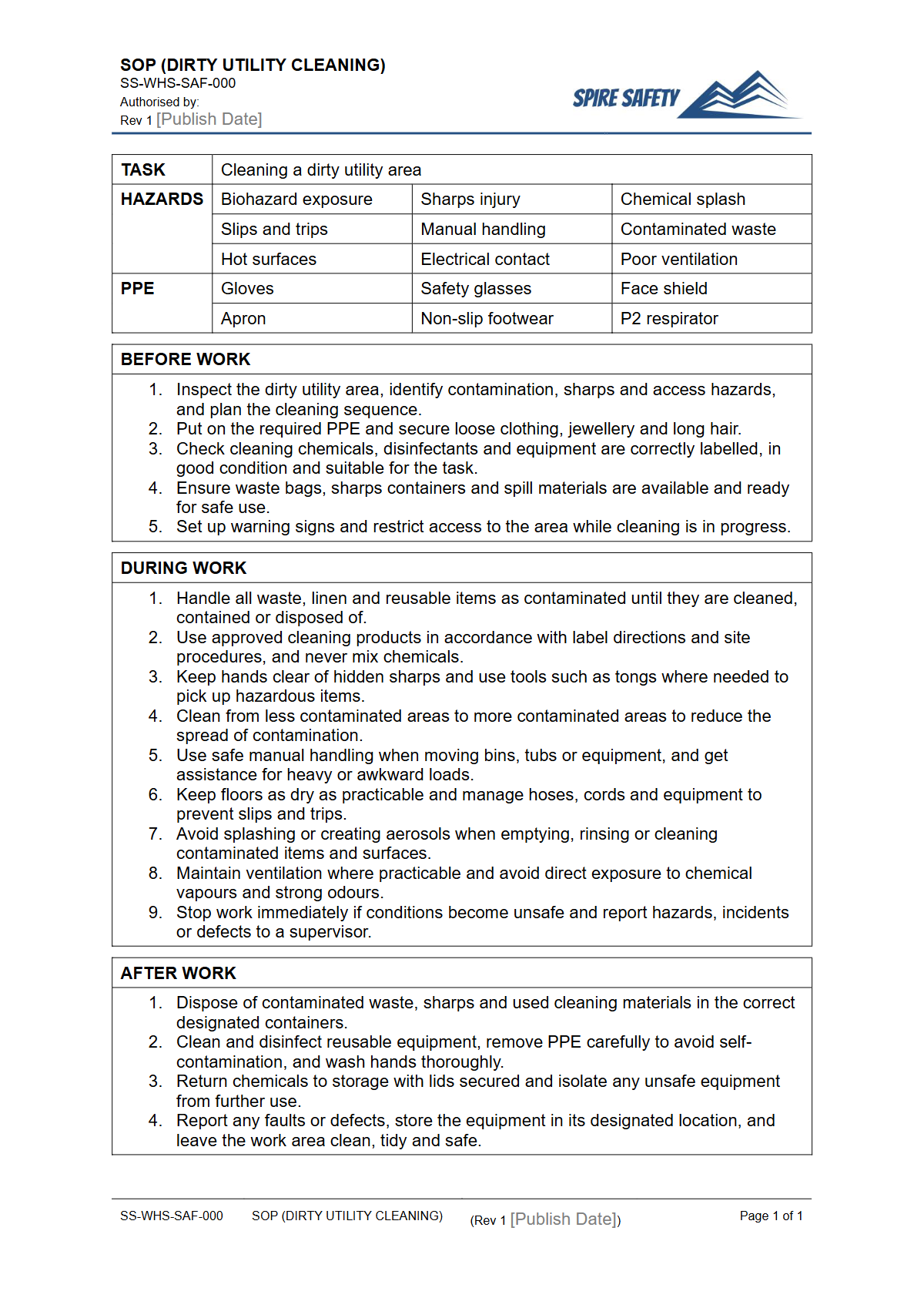
Purpose of the Free Safe Operating Procedure (Dirty Utility Cleaning) Template
This free Safe Operating Procedure (Dirty Utility Cleaning) template is designed to help organisations establish and document a consistent, safe method for cleaning and maintaining dirty utility rooms. These areas, common in healthcare, aged care, and laboratory settings, are critical control points for preventing infection and managing biohazards.
Using this SOP helps define the step-by-step process for handling contaminated items, using cleaning agents, and managing waste, thereby reducing the risk of injury and illness to workers and others. Formalising this process is a fundamental part of a proactive safety culture.
A well-drafted SOP provides clear instructions, minimises ambiguity, and ensures all personnel perform the task to the same standard. This is essential for high-risk tasks involving potential exposure to pathogens and hazardous chemicals.
This document serves as a structured starting point, aligned with Australian WHS principles, for creating a procedure specific to your site's equipment, chemicals, and layout. Integrating SOPs like this one is a key component of building robust WHS management systems that protect your workers and your organisation.
Video walkthrough
How to use the Free Safe Operating Procedure (Dirty Utility Cleaning) Template
To effectively use this Free Safe Operating Procedure (Dirty Utility Cleaning) Template, begin by downloading the DOCX version and customising it to reflect the specific realities of your workplace. The template is a framework, not a finished document.
You must review each section and replace the placeholder text with details relevant to your facility’s specific equipment (e.g., pan sanitisers, sluice sinks), approved chemical agents, required Personal Protective Equipment (PPE), and emergency procedures. Consultation with the workers who perform these cleaning tasks is critical to ensure the procedure is practical and effective.
Important: This is a template that you must customise. We are not WHS consultants for your business, and this document cannot account for the unique hazards of your specific site.
You are responsible for ensuring the final document is tailored to your workplace and provides adequate controls for all identified risks. For complex environments or if you are unsure about meeting your obligations, engaging professional WHS consulting services is a recommended step.
When to use it
A Safe Operating Procedure for dirty utility cleaning should be used consistently for all cleaning and decontamination activities within that space. It is a primary training document for new employees and a vital refresher tool for existing staff.
The SOP should be readily accessible in or near the dirty utility room for easy reference during operations. It should also be reviewed whenever a change occurs, such as the introduction of a new cleaning chemical, a piece of equipment is updated, a near-miss or incident occurs, or on a regularly scheduled basis (e.g., annually) as part of your safety management system's review cycle.
Who should use it
This SOP is intended for all personnel whose duties involve entering and working in a dirty utility room. This typically includes cleaners, nurses, aged care workers, patient care assistants, laboratory technicians, and maintenance staff.
Managers and supervisors should also use the document to train staff, monitor performance, and conduct safety observations or inspections. WHS officers and committee members can use the SOP as a benchmark for risk assessments and when conducting internal audits.
A consistent procedure ensures every person follows the same safe steps, which is vital for infection prevention and control. The principles of documenting systematic processes also apply to other equipment; for example, many facilities rely on a Free Air Compressor SOP (Safe Operating Procedure) Template for their maintenance workshops.
The process of systematically documenting procedures is a cornerstone of workplace safety. Whether managing cleaning processes or operating machinery like those covered in our FREE Conveyer System SOP (Safe Operating Procedure) Template, the goal is to create clarity and reduce risk.
Periodically verifying that these procedures are being followed correctly through formal assessments is also crucial. These verifications are often managed through regular WHS compliance auditing to ensure ongoing safety. For a wider range of document templates, you can browse our complete free WHS resources library.
Common mistakes
Common mistakes to avoid
- Using domestic cleaning products that are not effective against clinical pathogens.
- Failing to provide and enforce the use of correct Personal Protective Equipment (PPE).
- Improper segregation and disposal of different waste streams (general, clinical, sharps).
- Neglecting to customise the generic SOP template to reflect site-specific equipment and chemicals.
Legal references
Legal considerations
The following legal requirements may be relevant to this type of work.
- Work Health and Safety Act (Harmonised) — Provides the primary duties for protecting workers and other people from work health and safety risks.
- Work Health and Safety Regulations (Harmonised) — Sets out requirements supporting the management of workplace hazards and risks.
The following codes may be relevant to this type of work.
- Managing WHS Risks Code of Practice — Provides practical guidance on identifying hazards, assessing risks and applying effective controls.
- Work Health and Safety Consultation, Cooperation and Coordination Code of Practice — Provides practical guidance on consulting workers and coordinating with other duty holders.
- Managing the Work Environment and Facilities Code of Practice — Provides practical guidance on safe work environments, workplace facilities and related controls.
Did you know
Infection Control
According to the Australian Commission on Safety and Quality in Health Care, effective environmental cleaning is a crucial element in preventing healthcare-associated infections (HAIs), which affect tens of thousands of Australian patients each year.
FAQ
Frequently asked questions
01What are the main hazards in a dirty utility room?
02What Personal Protective Equipment (PPE) is essential for dirty utility cleaning?
03How often should a dirty utility cleaning SOP be reviewed?
04Can this SOP template be used for settings outside of healthcare?
Share this resource
Free Safe Operating Procedure (Dirty Utility Cleaning) Template
Browse Categories
How To Use It
- 1Download and open in Word or PDF.
- 2Replace the placeholders with your business details.
- 3Get it reviewed by a WHS specialist before rollout.
Need it customised?
Our WHS consultants can adapt this template to your site, run a gap analysis, or audit what you already have in place.
Book a Free Consultation WHS consulting servicesor call 1300 156 382
Related templates
- Free Safe Operating Procedure (Disability Van Loading) Template
- Free Safe Operating Procedure (Disease Plant Removal) Template
- Free Safe Operating Procedure (Dishwasher Glasswasher Operation) Template
- Free Safe Operating Procedure (Dispatch Area Cleanup) Template
- Free Safe Operating Procedure (Dispatch Documentation) Template
- Free Safe Operating Procedure (Dispatch Load Check) Template