
Free Safe Operating Procedure (Dishwasher Glasswasher Operation) Template
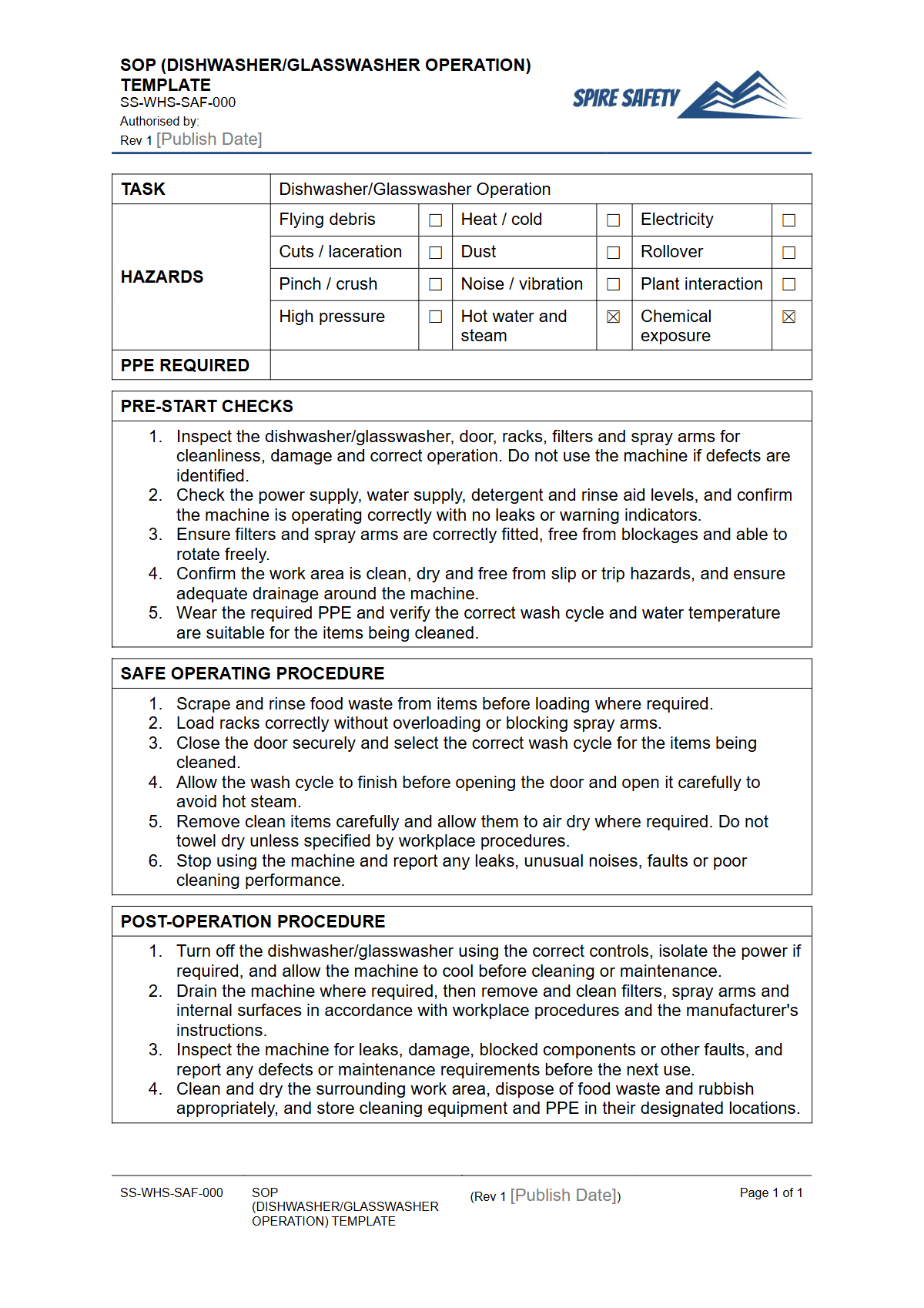
Download our free Safe Operating Procedure (SOP) template for dishwasher and glasswasher operation.
Free Safe Operating Procedure (Dishwasher Glasswasher Operation) Template
DOCX • 137 KB + PDF
Updated Oct 2026
No signup required
Purpose of the Free Safe Operating Procedure (Dishwasher Glasswasher Operation) Template
Operating commercial dishwashers and glasswashers presents several workplace hazards, including thermal burns, chemical exposure, electrical shock, and manual handling injuries. This free Safe Operating Procedure (Dishwasher Glasswasher Operation) Template provides a structured framework for documenting and communicating the safest way to perform this common task.
It helps your organisation meet its duty of care by establishing clear, step-by-step instructions that minimise risk to workers. A documented SOP is a critical tool for training, operational consistency, and demonstrating a commitment to health and safety.
Using this template helps you formalise pre-operational checks, safe operating steps, and shutdown procedures. It also provides a clear reference point for workers, supervisors, and safety personnel, ensuring everyone understands the expected safety standards and controls.
Implementing a robust SOP is a foundational element of a proactive safety culture in any hospitality or commercial kitchen environment.
Video walkthrough
How to use the Free Safe Operating Procedure (Dishwasher Glasswasher Operation) Template
This document is designed as a comprehensive starting point. To implement it effectively, you must adapt it to the specific context of your workplace.
Download the template in DOCX format for easy editing or as a PDF for immediate use after customisation.
Follow these steps to get the most out of your Safe Operating Procedure:
- Identify Your Equipment: Record the specific make, model, and location of the dishwasher or glasswasher.
- Consult and Collaborate: Involve the workers who operate the machine daily. Their practical experience is invaluable for identifying real-world risks and effective control measures. Also, review the manufacturer's operating manual.
- Detail Specific Hazards: Assess the risks associated with your particular machine, the chemicals used (detergents, rinse aids, sanitisers), and the surrounding environment (e.g., wet floors).
- Customise Procedures: Modify the pre-start, operational, and post-operation steps to match your workflow precisely. Include details on the correct personal protective equipment (PPE) required, such as heat-resistant gloves and safety glasses.
- Review and Approve: Once customised, the SOP should be formally reviewed and approved by a supervisor or manager before being issued.
Please note: this document is a template. To be effective, it must be customised for your specific equipment, chemicals, and workplace procedures.
We recommend a consultation with operators and a review of the manufacturer's instructions during this process.
When to use a Safe Operating Procedure
An SOP for dishwasher and glasswasher operation should be a living document, used consistently throughout the workplace. It is most critical during worker induction and training, ensuring new employees learn the correct, safe method from the outset.
It should also be readily accessible near the equipment for quick reference during daily operations. Furthermore, the SOP serves as a key document during safety audits and after any incident or near-miss, where it can be reviewed and updated to prevent recurrence.
Regular reviews, typically annually or when changes occur, are essential to maintaining its relevance and effectiveness.
Who should use this resource
This Safe Operating Procedure template is intended for a range of personnel within any organisation that uses commercial dishwashing equipment, particularly in the hospitality, healthcare, and food service industries. Key users include:
- PCBU's (Persons Conducting a Business or Undertaking): To fulfil their primary duty of care to provide safe systems of work.
- Managers and Supervisors: To train staff, monitor safe work practices, and enforce safety standards.
- WHS/HSE Representatives: To assist in risk assessments and the development of control measures.
- Workers: As a clear guide for operating equipment safely and as a tool for their own safety and the safety of their colleagues.
Properly implementing this SOP helps integrate safety into your broader WHS management systems, ensuring a systematic approach to risk control.
Key Hazards and Control Measures
Operating commercial dishwashers involves several significant risks that must be controlled. The SOP should clearly outline these hazards and the specific measures to mitigate them.
Common Hazards:
- Burns: Contact with hot water, steam, or hot surfaces and dishware.
- Chemical Exposure: Splashes of corrosive detergents or sanitisers onto skin or into eyes.
- Electrical Hazards: Faulty wiring or water ingress into electrical components, creating a risk of electric shock.
- Slips, Trips, and Falls: Water spillage onto surrounding floors.
- Manual Handling: Awkward postures or heavy loads when loading and unloading dish racks.
- Cuts and Lacerations: Handling broken glass or sharp items.
Control Measures:
Your SOP should detail controls such as requiring specific PPE (e.g., thermal gloves, eye protection, non-slip footwear), procedures for safely handling and dispensing chemicals, regular electrical testing and tagging, and good housekeeping practices to keep floors dry. If you need assistance in developing or refining these controls, engaging professional WHS consulting services can provide expert guidance tailored to your needs.
This SOP is one of many procedural documents your business may need; you can explore our entire free WHS resources library for more templates.
For workplaces with varied equipment, it's vital to have specific SOPs for each major item. For example, a maintenance team might require an air compressor SOP for cleaning tasks, which carries its own unique set of risks separate from kitchen operations.
Consistency in documentation and training across all equipment types is key to a strong safety culture.
Finally, your procedures should be periodically checked to ensure they are being followed correctly. This is often achieved through formalised safety checks or as part of a scheduled WHS compliance auditing program, which can verify that documented procedures match actual workplace practices.
Common mistakes
Common mistakes to avoid
- Overloading dish racks, which leads to poor cleaning results and potential damage to the machine.
- Using incorrect or improperly diluted cleaning chemicals, causing damage or ineffective sanitation.
- Failing to wear appropriate personal protective equipment (PPE), especially thermal gloves and eye protection.
- Neglecting pre-start checks and ignoring warning signs like leaks or unusual noises.
Legal references
Legal considerations
The following legal requirements may be relevant to this type of work.
- Work Health and Safety Act (Harmonised) — Provides the primary duties for protecting workers and other people from work health and safety risks.
- Work Health and Safety Regulations (Harmonised) — Sets out requirements supporting the management of workplace hazards and risks.
The following codes may be relevant to this type of work.
- Managing WHS Risks Code of Practice — Provides practical guidance on identifying hazards, assessing risks and applying effective controls.
- Work Health and Safety Consultation, Cooperation and Coordination Code of Practice — Provides practical guidance on consulting workers and coordinating with other duty holders.
- Managing the Work Environment and Facilities Code of Practice — Provides practical guidance on safe work environments, workplace facilities and related controls.
Did you know
Extreme Temperatures
Commercial dishwashers use extremely high temperatures to sanitise dishware effectively. The final rinse cycle can reach temperatures above 82°C, capable of causing severe burns in seconds.
Hospitality's Common Injury
According to Safe Work Australia, slips, trips, and falls are the most common cause of serious injury claims in the accommodation and food services industry, highlighting the importance of managing water spillage from dishwashers.
FAQ
Frequently asked questions
01What are the main hazards of using a commercial dishwasher?
02How often should an SOP for a dishwasher be reviewed?
03Is specific training required to use a commercial glasswasher?
04Why can't I just use the manufacturer's manual instead of an SOP?
Share this resource
Free Safe Operating Procedure (Dishwasher Glasswasher Operation) Template
Browse Categories
How To Use It
- 1Download and open in Word or PDF.
- 2Replace the placeholders with your business details.
- 3Get it reviewed by a WHS specialist before rollout.
Need it customised?
Our WHS consultants can adapt this template to your site, run a gap analysis, or audit what you already have in place.
Book a Free Consultation WHS consulting servicesor call 1300 156 382
Related templates
- Free Safe Operating Procedure (Dispatch Area Cleanup) Template
- Free Safe Operating Procedure (Dispatch Documentation) Template
- Free Safe Operating Procedure (Dispatch Load Check) Template
- Free Safe Operating Procedure (Display Stand Setup) Template
- Free Safe Operating Procedure (Disposable Apron Use) Template
- Free Safe Operating Procedure (Disposable Gown Use) Template