
Free Safe Operating Procedure (Dispatch Area Cleanup) Template
Streamline your warehouse safety with our free Safe Operating Procedure (Dispatch Area Cleanup) template. Download the customisable DOCX and PDF today.
Free Safe Operating Procedure (Dispatch Area Cleanup) Template
DOCX • 126 KB + PDF
Updated Oct 2026
No signup required
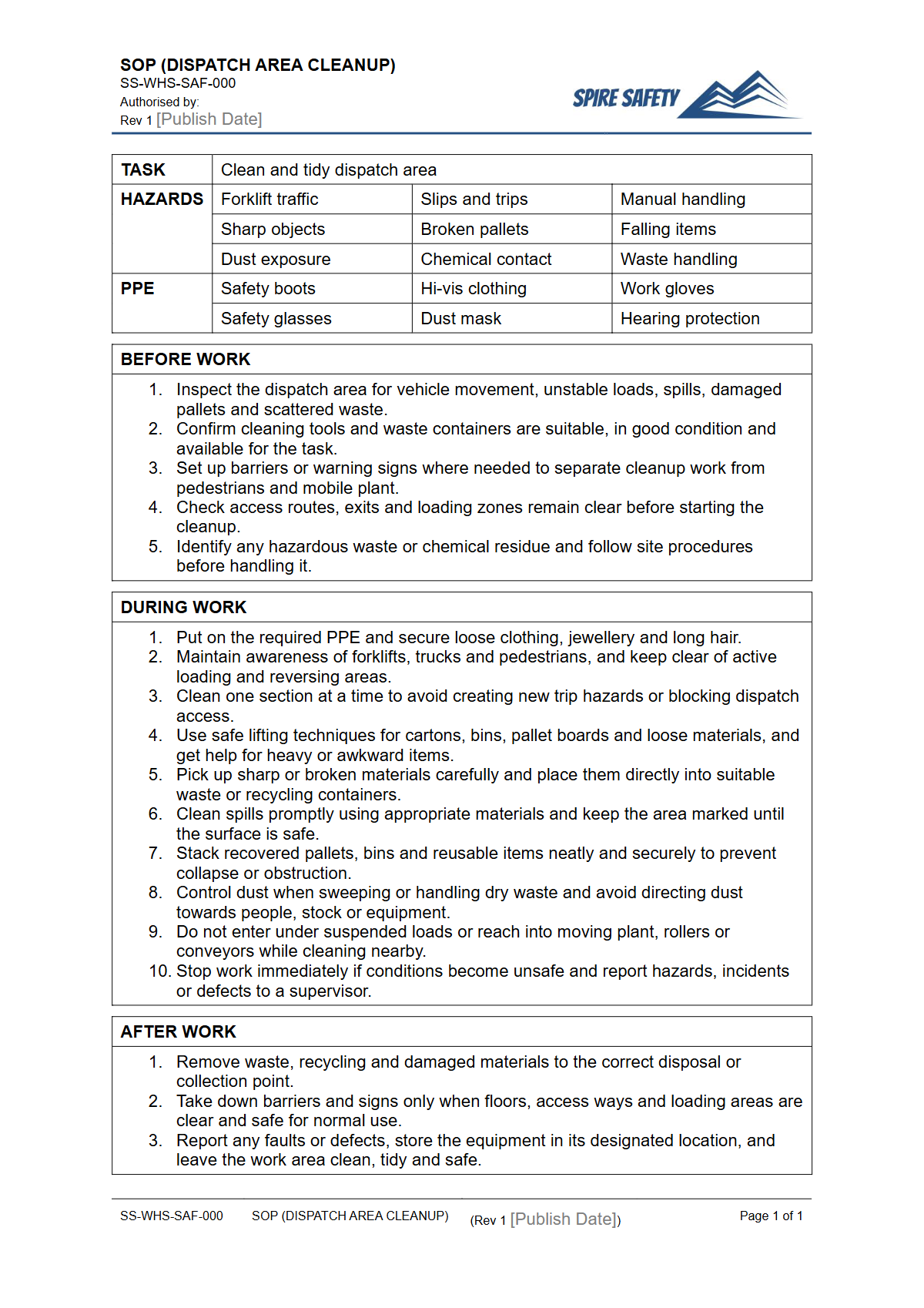
Purpose of the Free Safe Operating Procedure (Dispatch Area Cleanup) Template
A clean and organised dispatch area is fundamental to a safe and efficient workplace. This free Safe Operating Procedure (Dispatch Area Cleanup) Template provides a structured framework for documenting the required steps to maintain a hazard-free environment.
It helps organisations meet their primary duty of care under WHS legislation by formalising processes, controlling risks, and ensuring consistency. A documented procedure minimises risks such as slips, trips, and falls from clutter or spills; musculoskeletal injuries from poor manual handling techniques; and collisions between pedestrians and mobile plant.
Using a standardised SOP ensures that all workers, including new starters and temporary staff, understand the expected standards and methods for cleanup. It clarifies responsibilities, required personal protective equipment (PPE), and waste disposal protocols.
Formalising these steps helps embed safe work practices into your team’s daily behaviour, moving beyond ad-hoc cleaning to a systematic approach to safety. This is particularly important in dynamic environments where equipment like forklifts or pallet movers are active, and clear access ways are critical for preventing incidents.
Integrating this SOP with procedures for specific equipment, such as our FREE Telehandler SOP Template, creates a more comprehensive safety system.
Video walkthrough
How to use the Free Safe Operating Procedure (Dispatch Area Cleanup) Template
This document is a template and must be customised to reflect the specific hazards, equipment, and layout of your workplace. Before implementation, a competent person should adapt it in consultation with the workers who will be performing the task.
Effective customisation involves conducting a site-specific risk assessment to identify all potential hazards associated with dispatch area cleanup, from chemical spills to handling bulky waste.
To implement this SOP effectively, follow these steps:
- Consult: Engage with your dispatch team, supervisors, and HSRs. Their direct experience is invaluable for identifying practical risks and effective control measures.
- Customise: Modify the template to include details about your specific location, the types of waste generated, cleaning agents used, and the tools or machinery involved. If your process includes fixed plant, you may need to cross-reference other documents, such as a FREE Conveyer System SOP.
- Train: Provide training to all relevant personnel to ensure they understand the procedures outlined in the final document. Keep records of this training.
- Approve and Display: Have the final SOP signed off by management and display it in a visible location within the dispatch area.
- Review: Schedule regular reviews of the SOP, especially after an incident, a change in process, or when new equipment is introduced. This process is a key element of building robust WHS management systems.
When to use it
The Dispatch Area Cleanup SOP should be integrated into your regular work schedule. It is designed for both routine housekeeping and responsive cleaning.
It should be used at scheduled intervals, such as at the end of each shift or on a daily basis, to maintain a baseline level of cleanliness and organisation. This proactive approach prevents the gradual accumulation of hazards like packaging materials, strapping, and pallet debris.
The procedure should also be triggered immediately following specific events, such as a liquid spill, the unboxing of a large delivery that generates significant waste, or at the conclusion of a peak loading/unloading period. Having a clear, documented process ensures a fast and safe response, reducing the time that hazards are present in the work area.
Some cleanup tasks may require specific tools, and this SOP should work alongside procedures for that equipment, like our Free Air Compressor SOP (Safe Operating Procedure) Template for cleaning tasks involving compressed air.
Who should use it
This Safe Operating Procedure is intended for all personnel involved in operations within the dispatch area. This includes warehouse operators, forklift drivers, pickers and packers, and delivery drivers who may use the space.
Supervisors and team leaders are responsible for ensuring the procedures are followed correctly and for providing the necessary resources and training.
Work Health and Safety (WHS) managers and committees should also use this template as a tool for risk management and compliance verification. It serves as evidence of a implemented control measure for identified hazards. The document is a critical reference during safety inspections and incident investigations. Regular verification that the SOP is being followed can form part of a broader audit schedule, which can be supported by professional WHS compliance auditing services to ensure ongoing effectiveness. You can find many more templates like this one in our free WHS resources library.
Common mistakes
Common mistakes to avoid
- Using a generic template without customising it for site-specific hazards.
- Failing to train all relevant workers on the finalised procedure.
- Not making the SOP easily accessible to workers in the dispatch area.
- Forgetting to review and update the SOP after an incident or process change.
Legal references
Legal considerations
The following legal requirements may be relevant to this type of work.
- Work Health and Safety Act (Harmonised) — Provides the primary duties for protecting workers and other people from work health and safety risks.
- Work Health and Safety Regulations (Harmonised) — Sets out requirements supporting the management of workplace hazards and risks.
The following codes may be relevant to this type of work.
- Managing WHS Risks Code of Practice — Provides practical guidance on identifying hazards, assessing risks and applying effective controls.
- Work Health and Safety Consultation, Cooperation and Coordination Code of Practice — Provides practical guidance on consulting workers and coordinating with other duty holders.
- Managing the Work Environment and Facilities Code of Practice — Provides practical guidance on safe work environments, workplace facilities and related controls.
Did you know
Slips, Trips and Falls
According to Safe Work Australia, slips, trips and falls are a leading cause of serious workplace injuries, with poor housekeeping being a major contributing factor.
Duty to Consult
Australian WHS law requires businesses to consult with their workers on matters that directly affect their health and safety. This includes developing procedures for tasks like dispatch area cleanup.
FAQ
Frequently asked questions
01What hazards should be covered in a dispatch area cleanup SOP?
02How often should we review our Dispatch Area Cleanup SOP?
03Is a Safe Operating Procedure a legal requirement in Australia?
04What is the difference between a Safe Operating Procedure (SOP) and a Safe Work Method Statement (SWMS)?
Share this resource
Free Safe Operating Procedure (Dispatch Area Cleanup) Template
Browse Categories
How To Use It
- 1Download and open in Word or PDF.
- 2Replace the placeholders with your business details.
- 3Get it reviewed by a WHS specialist before rollout.
Need it customised?
Our WHS consultants can adapt this template to your site, run a gap analysis, or audit what you already have in place.
Book a Free Consultation WHS consulting servicesor call 1300 156 382
Related templates
- Free Safe Operating Procedure (Dispatch Documentation) Template
- Free Safe Operating Procedure (Dispatch Load Check) Template
- Free Safe Operating Procedure (Display Stand Setup) Template
- Free Safe Operating Procedure (Disposable Apron Use) Template
- Free Safe Operating Procedure (Disposable Gown Use) Template
- Free Safe Operating Procedure (Dissolved Oxygen Meter) Template