
Free Safe Operating Procedure (Dissolved Oxygen Meter) Template
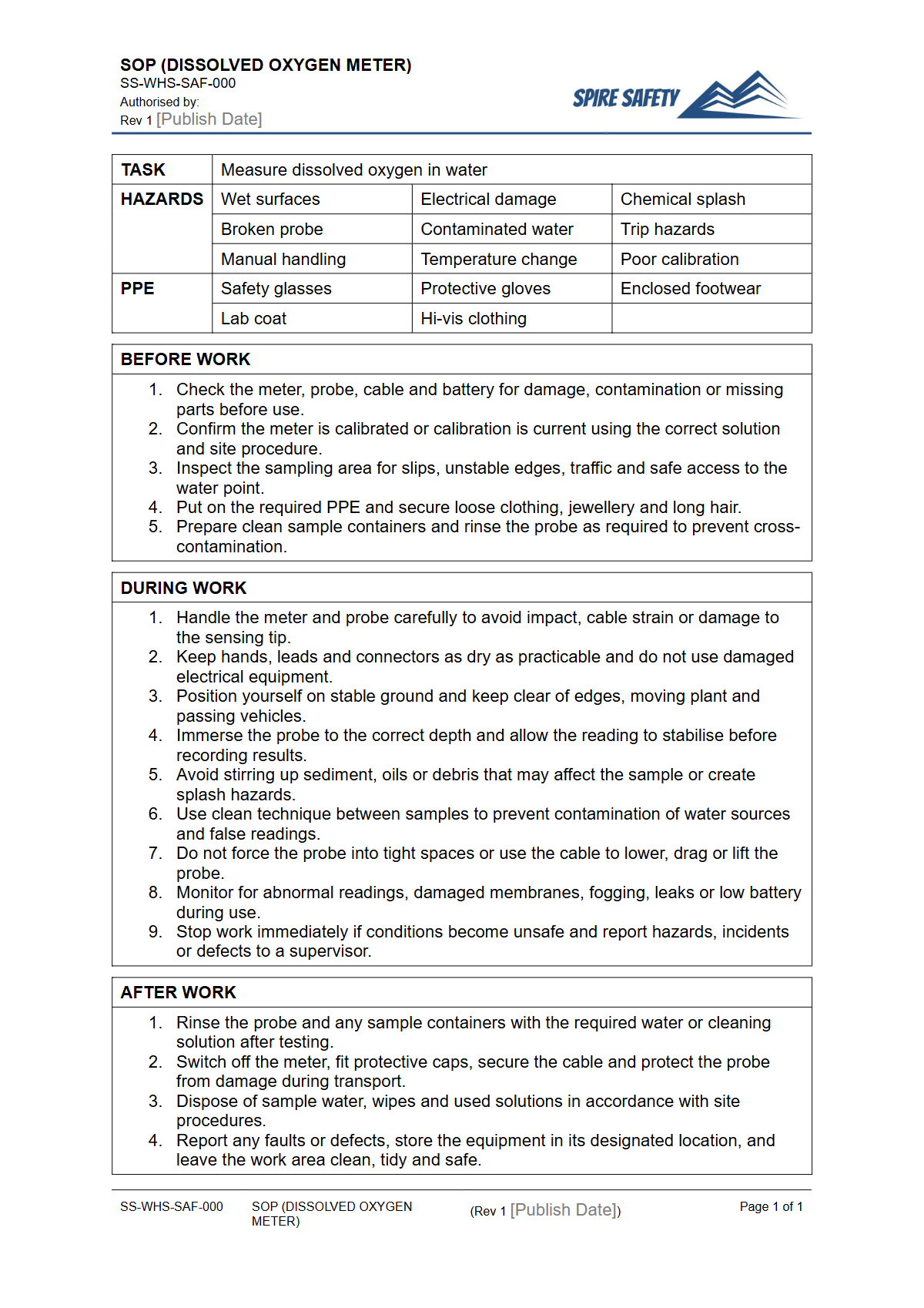
Download our free Safe Operating Procedure (Dissolved Oxygen Meter) Template. This document provides a structured format for outlining safe work methods.
Free Safe Operating Procedure (Dissolved Oxygen Meter) Template
DOCX • 126 KB + PDF
Updated Oct 2026
No signup required
Purpose of the Free Safe Operating Procedure (Dissolved Oxygen Meter) Template
A Safe Operating Procedure (SOP) is a crucial document that outlines a step-by-step, safe method for performing a specific task. This Free Safe Operating Procedure (Dissolved Oxygen Meter) Template provides a structured foundation for documenting the process of using, calibrating, and maintaining a DO meter.
Using a DO meter, while generally low-risk, involves potential hazards such as electrical shock, exposure to calibration chemicals, and biological risks from water samples. This SOP helps to identify these hazards and establish clear control measures to protect workers.
By implementing a formal SOP, your organisation can ensure that all personnel perform the task consistently and safely, reducing the risk of incidents and improving the reliability of measurements. It serves as a key training tool for new employees and a reference for experienced operators.
Documented procedures like this are a fundamental part of effective and comprehensive WHS management systems, demonstrating a commitment to proactive safety management.
Video walkthrough
How to use the Free Safe Operating Procedure (Dissolved Oxygen Meter) Template
This template is provided in an easy-to-use DOCX format, allowing for full customisation to suit your specific operational needs. Simply download the file and edit the content to align with your equipment model, workplace environment, and internal safety protocols.
It is essential to conduct a site-specific risk assessment for the task and incorporate the findings into the final document.
Important: This document is a template, not a finished procedure. We've drafted it as a starting point, but you must customise it to reflect the specific hazards, equipment (brand and model), calibration solutions, and procedures in your workplace.
Always consult with the workers who will be using the equipment during the drafting and review process to ensure the SOP is practical and effective. Once finalised and implemented, the effectiveness of the procedure should be periodically checked as part of a regular WHS compliance auditing program.
When to use a Safe Operating Procedure
An SOP for a dissolved oxygen meter should be used in several key situations. It is essential for training new laboratory technicians, field scientists, or water treatment operators before they use the equipment for the first time.
It also serves as a valuable tool for annual refresher training to ensure established safety protocols are not forgotten over time.
The SOP should be readily accessible in the work area for quick reference during operation, particularly for non-routine tasks like troubleshooting or specific calibration sequences. Furthermore, it becomes a critical reference document during incident investigations or when reviewing and updating your risk assessments.
Having clear, documented procedures for all key equipment, including something as specific as a DO meter or as common as our free Air Compressor SOP, creates a more predictable and safer working environment.
Who should use it
This Safe Operating Procedure template is designed for use by a range of personnel within an organisation. WHS Managers and Safety Officers can use it to develop and standardise procedures across the business.
Laboratory Managers, Environmental Coordinators, and Team Leaders are responsible for customising the template for their specific teams and ensuring workers are trained in its use.
The end-users are the operators themselves—the environmental scientists, technicians, aquaculture workers, and plant operators who handle the DO meter daily. They should be deeply involved in the customisation process and use the final document as their guide for safe operation.
In industries like agriculture where various types of equipment are used, maintaining a library of SOPs, from this document to a free Spreader SOP Template, is best practice for managing operational risk.
Key Components of a DO Meter SOP
When customising this template, ensure you include several critical sections to make the procedure comprehensive. These should cover:
- Required Personal Protective Equipment (PPE): Specify the necessary PPE, such as safety glasses and gloves, especially when handling calibration buffer solutions or potentially contaminated water samples.
- Pre-Operational Checks: Detail the checks required before use, including inspecting the probe, cable, and meter for damage, and checking battery levels.
- Step-by-Step Procedure: Provide a clear, sequential guide for calibration, measurement, and storage. Use simple language and break down complex steps.
- Maintenance and Cleaning: Outline the required frequency and method for cleaning the probe and membrane to prevent biofouling and ensure accurate readings.
- Emergency Procedures: Detail the response actions for situations like chemical spills (from buffers), electric shock, or equipment malfunction.
By covering these areas, you create a robust safety document that supports both compliance and practical safety on the ground. You can explore our free WHS resources library for other templates to support your safety management system.
Common mistakes
Common mistakes to avoid
- Using expired or improperly stored calibration solutions, leading to incorrect calibration.
- Failing to account for temperature and barometric pressure during calibration and measurement.
- Inadequate cleaning of the probe, resulting in biofouling and inaccurate readings.
- Not allowing the probe sufficient time to stabilise in the sample before taking a reading.
Legal references
Legal considerations
The following legal requirements may be relevant to this type of work.
- Work Health and Safety Act (Harmonised) — Provides the primary duties for protecting workers and other people from work health and safety risks.
- Work Health and Safety Regulations (Harmonised) — Sets out requirements supporting the management of workplace hazards and risks.
The following codes may be relevant to this type of work.
- Managing WHS Risks Code of Practice — Provides practical guidance on identifying hazards, assessing risks and applying effective controls.
- Work Health and Safety Consultation, Cooperation and Coordination Code of Practice — Provides practical guidance on consulting workers and coordinating with other duty holders.
- Managing the Work Environment and Facilities Code of Practice — Provides practical guidance on safe work environments, workplace facilities and related controls.
Did you know
Membrane Fouling
The semi-permeable membrane on many optical or polarographic DO sensors is delicate. Biofouling from organisms or a buildup of minerals can cause inaccurate readings and requires specific cleaning procedures outlined in your SOP.
Temperature's Impact
The solubility of oxygen in water is highly dependent on temperature. Colder water can hold more dissolved oxygen than warmer water, a critical variable that must be accounted for in environmental monitoring and calibration.
FAQ
Frequently asked questions
01What hazards are associated with using a dissolved oxygen meter?
02Why is calibration important for a DO meter SOP?
03Does this template meet all legal WHS requirements?
04Who should be consulted when writing an SOP for a DO meter?
Share this resource
Free Safe Operating Procedure (Dissolved Oxygen Meter) Template
Browse Categories
How To Use It
- 1Download and open in Word or PDF.
- 2Replace the placeholders with your business details.
- 3Get it reviewed by a WHS specialist before rollout.
Need it customised?
Our WHS consultants can adapt this template to your site, run a gap analysis, or audit what you already have in place.
Book a Free Consultation WHS consulting servicesor call 1300 156 382
Related templates
- Free Safe Operating Procedure (Dock Crane) Template
- Free Safe Operating Procedure (Dock Fender Inspection) Template
- Free Safe Operating Procedure (Dock Ladder Inspection) Template
- Free Safe Operating Procedure (Dock Leveller) Template
- Free Safe Operating Procedure (Dock Line Handling) Template
- Free Safe Operating Procedure (Dockside Waste Cleanup) Template