
Free Safe Operating Procedure (Dockside Waste Cleanup) Template
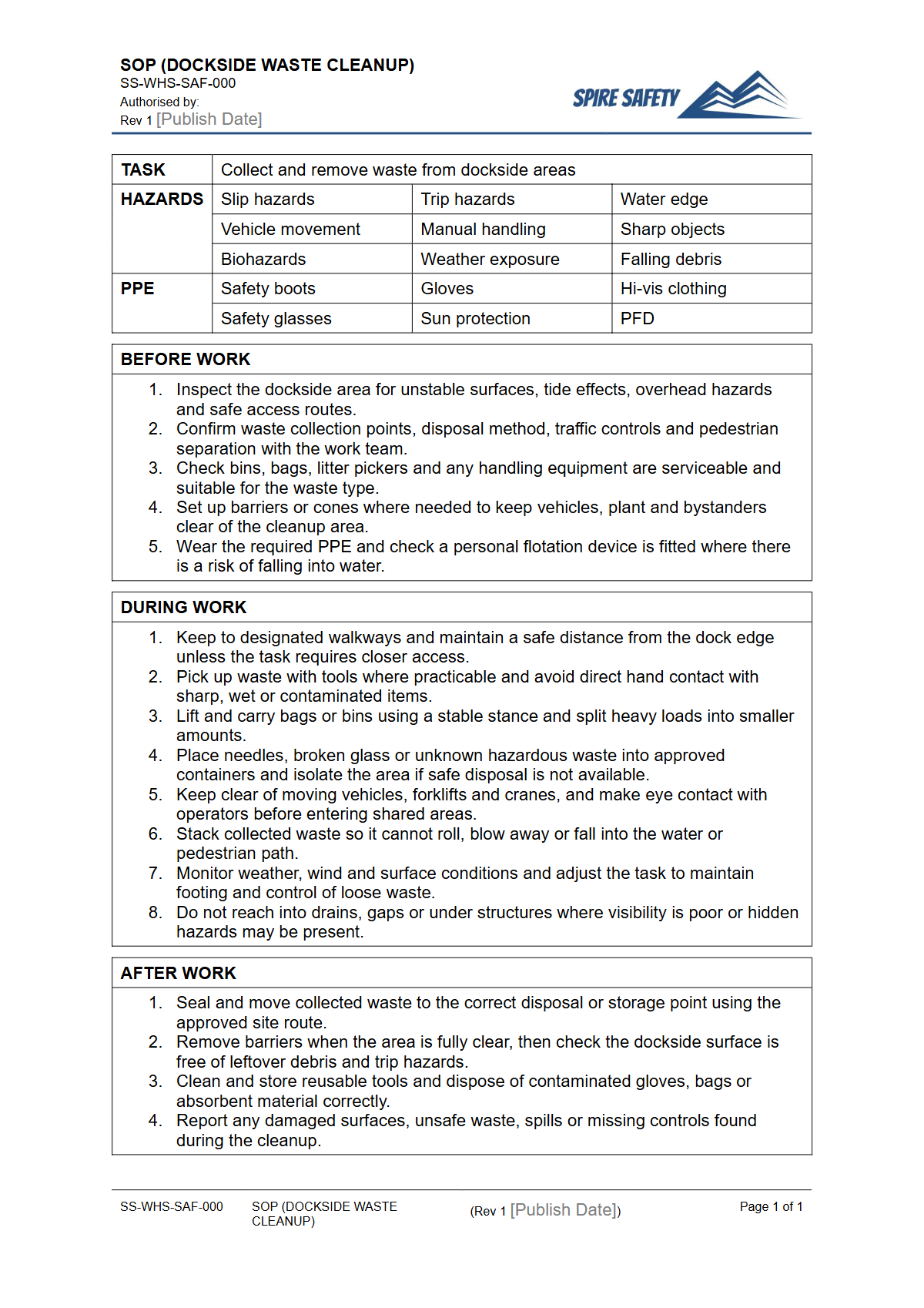
Formalise your dockside waste management with our structured Safe Operating Procedure template.
Free Safe Operating Procedure (Dockside Waste Cleanup) Template
DOCX • 126 KB + PDF
Updated Oct 2026
No signup required
Purpose of the Free Safe Operating Procedure (Dockside Waste Cleanup) Template
Managing waste in a dockside or marine environment presents unique safety and environmental challenges. This Free Safe Operating Procedure (Dockside Waste Cleanup) Template provides a structured framework for documenting the required steps to perform these tasks safely.
It helps organisations identify significant hazards—such as slips on wet surfaces, falls into water, manual handling injuries, and marine pollution—and outline effective control measures. Using a formal SOP ensures all workers follow a consistent, pre-approved process, reducing the risk of incidents and demonstrating a commitment to workplace safety. This document is an essential tool for integrating specific operational risks into a robust WHS management system.
Video walkthrough
How to use the Free Safe Operating Procedure (Dockside Waste Cleanup) Template
This template is provided as a starting point. To make it effective, you must adapt it to your specific operational context.
Download the DOCX file and begin by conducting a risk assessment of your dockside cleanup tasks in consultation with your workers. Identify the specific equipment used (e.g., pressure washers, trolleys, cranes), types of waste handled, and the unique layout and conditions of your wharf or marina.
Update the sections on PPE, emergency procedures, and step-by-step instructions to reflect your findings. Ensure the final document is reviewed and approved by a competent person before being used to train your team.
Important: This is a template only. We have provided a structured guide, but you must customise it to reflect the specific hazards, equipment, chemicals, and environmental conditions at your worksite.
You are responsible for ensuring the final SOP is site-specific and accurately reflects your processes. If you require assistance with document customisation or risk assessments, consider engaging specialist WHS consulting services.
When to use it
A Safe Operating Procedure for dockside waste cleanup should be implemented and referenced before and during any cleanup activities in a marine or wharf environment. This includes routine tasks like clearing general rubbish from pontoons and jetties, as well as non-routine jobs such as cleaning up minor spills of cargo, fuel, or oil.
The SOP is a critical reference for worker inductions, pre-start meetings, and task-specific training. It should also be readily available at the worksite for supervisors and workers to consult as needed, especially when conditions change, such as during adverse weather.
In some cases, cleanup may involve moving large bins or pallets, which requires attention to the safe operation of telehandlers or other mobile plant.
Who should use it
This SOP is intended for a range of personnel involved in port, marina, and dockside operations. This includes stevedores, maintenance crews, deckhands, marina staff, and cleaning contractors tasked with waste management.
Supervisors and managers must use the SOP to guide their oversight, ensure procedures are followed correctly, and conduct safety observations. For a Person Conducting a Business or Undertaking (PCBU), having and implementing such a procedure is a key part of fulfilling their primary duty of care under WHS law. The document can also be used by safety officers and auditors as a benchmark during workplace inspections or a WHS compliance audit.
Key Considerations for Dockside Cleanup
When developing your site-specific SOP, pay close attention to the unique hazards of a waterside environment. A thorough risk assessment should address:
- Environmental Protection: Implementing controls to prevent debris, cleaning chemicals, and contaminated water from entering the waterway is crucial. This may involve using bunding, spill kits, and correct disposal methods for all collected waste.
- Falls from Height: The dock edge presents a constant fall hazard. Controls may include designated exclusion zones, use of safety harnesses where appropriate, and ensuring adequate lighting.
- Slips, Trips, and Falls: Surfaces are often wet, oily, and uneven. Non-slip footwear, good housekeeping, and immediate cleanup of spills are fundamental controls.
- Hazardous Substances: Workers may encounter unknown substances. The procedure must specify the use of appropriate PPE, such as gloves and eye protection, and outline steps for identifying and safely handling potentially hazardous materials.
- Plant and Equipment: Tasks may involve machinery like pressure washers or vacuums, which can be powered by electricity or fuel. You can use our free Air Compressor SOP template if compressed air is used for cleaning.
Explore our free WHS resources library for other templates that can support your safety management system.
Common mistakes
Common mistakes to avoid
- Using a generic SOP without customising it for the specific dock, equipment, and waste types.
- Failing to provide adequate PPE for handling potentially hazardous or unknown waste materials.
- Neglecting to implement controls to prevent runoff and contamination of the adjacent waterway.
- Not training workers on the procedure or confirming their understanding before work commences.
Legal references
Legal considerations
The following legal requirements may be relevant to this type of work.
- Work Health and Safety Act (Harmonised) — Provides the primary duties for protecting workers and other people from work health and safety risks.
- Work Health and Safety Regulations (Harmonised) — Sets out requirements supporting the management of workplace hazards and risks.
The following codes may be relevant to this type of work.
- Managing WHS Risks Code of Practice — Provides practical guidance on identifying hazards, assessing risks and applying effective controls.
- Work Health and Safety Consultation, Cooperation and Coordination Code of Practice — Provides practical guidance on consulting workers and coordinating with other duty holders.
- Managing the Work Environment and Facilities Code of Practice — Provides practical guidance on safe work environments, workplace facilities and related controls.
Did you know
A Silent Hazard
Slips, trips, and falls are a leading cause of serious injuries in Australian workplaces. On a wet or oily dockside, this risk is significantly heightened, making good housekeeping a critical control measure.
Marine Pollution Risk
Under Australian environmental law, allowing waste or contaminants to enter waterways can result in significant fines for both individuals and companies. A proper cleanup procedure is a key part of environmental due diligence.
FAQ
Frequently asked questions
01What should be included in a Dockside Waste Cleanup SOP?
02How often should a Safe Operating Procedure for dockside cleanup be reviewed?
03Is this template suitable for major chemical spills at a port?
04Who is responsible for providing the SOP for dockside cleanup tasks?
Share this resource
Free Safe Operating Procedure (Dockside Waste Cleanup) Template
Browse Categories
How To Use It
- 1Download and open in Word or PDF.
- 2Replace the placeholders with your business details.
- 3Get it reviewed by a WHS specialist before rollout.
Need it customised?
Our WHS consultants can adapt this template to your site, run a gap analysis, or audit what you already have in place.
Book a Free Consultation WHS consulting servicesor call 1300 156 382
Related templates
- Free Safe Operating Procedure (Dog Park Cleaning) Template
- Free Safe Operating Procedure (Door Alarm Testing) Template
- Free Safe Operating Procedure (Door Closer Adjustment) Template
- Free Safe Operating Procedure (Door Glass Cleaning) Template
- Free Safe Operating Procedure (Door Hinge Lubrication) Template
- Free Safe Operating Procedure (Door Seal Cleaning) Template