
Free Safe Operating Procedure (Door Seal Cleaning) Template
Formalise your cleaning processes with our free Safe Operating Procedure for door seal cleaning. Download the customisable DOCX and PDF template today.
Free Safe Operating Procedure (Door Seal Cleaning) Template
DOCX • 126 KB + PDF
Updated Oct 2026
No signup required
Purpose of the Free Safe Operating Procedure (Door Seal Cleaning) Template
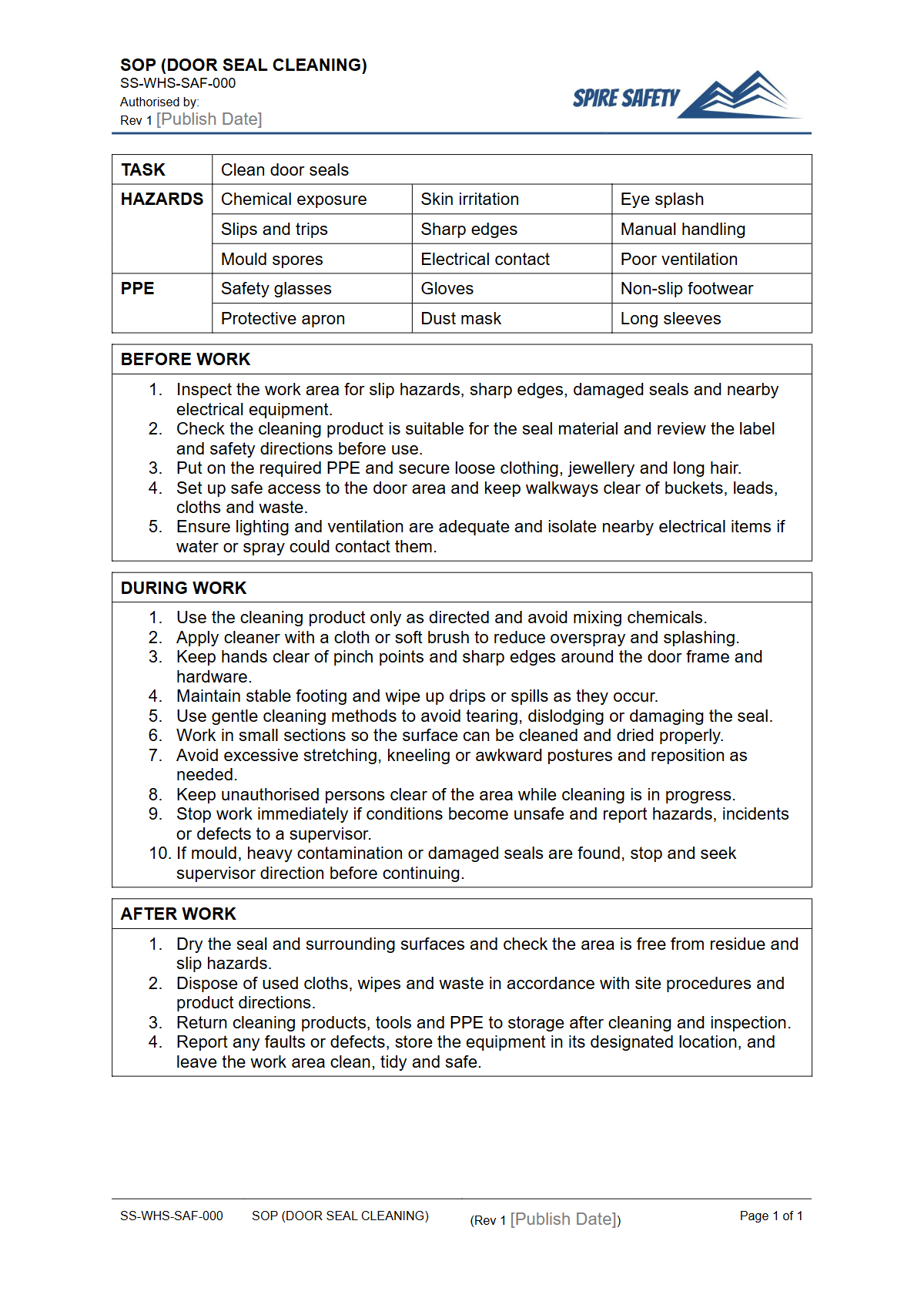
Maintaining the integrity and cleanliness of door seals is a critical task in many industries, including food service, healthcare, and manufacturing. This Free Safe Operating Procedure (Door Seal Cleaning) Template provides a structured framework for documenting the required steps to perform this task safely and effectively.
Using an SOP ensures consistency, reduces the risk of contamination, and protects workers from potential hazards such as chemical exposure or ergonomic injuries.
A documented SOP is a fundamental component of a proactive safety culture. It serves as a clear training tool for new employees and a reference point for experienced staff, ensuring everyone follows the same approved process.
Formalising this procedure helps your organisation meet its duty of care and demonstrates a commitment to operational excellence and safety. It forms a key part of your broader WHS management systems, integrating seamlessly with risk assessments and training records.
Video walkthrough
How to use the Free Safe Operating Procedure (Door Seal Cleaning) Template
This template is designed as a comprehensive starting point, not a finished document. You must adapt it to the specific context of your workplace.
To effectively implement this SOP, you should:
- Identify the Equipment: List the specific types of equipment the SOP applies to (e.g., commercial ovens, autoclaves, refrigerators, vehicle doors).
- Review Chemical Safety: Consult the Safety Data Sheets (SDS) for all cleaning agents and disinfectants used. Incorporate specific PPE requirements, first aid measures, and handling instructions from the SDS into the SOP.
- Conduct a Risk Assessment: Identify all potential hazards associated with the task, such as chemical splashes, manual handling risks, slips and trips, or contact with hot surfaces. Implement control measures to mitigate these risks.
- Consult Your Workers: Involve the employees who perform the cleaning task in the development and review of the SOP. Their practical experience is invaluable for creating a procedure that is both safe and workable.
- Customise the Steps: Edit the step-by-step instructions to match your exact process, including details on preparation, cleaning, disinfecting, rinsing, and post-cleaning inspection. When tailoring the document, consider all equipment involved in the process, not just the item being cleaned. For example, if compressed air is used to dry the seals, you may need to reference a specific free Air Compressor SOP to ensure that part of the task is also performed safely.
Note: We have pre-filled this document with common steps and considerations. It is your responsibility to remove or add information to ensure the final SOP accurately reflects your site-specific machinery, chemicals, and risk controls.
If you require assistance with this process, our WHS consulting services can provide expert guidance.
When to use it
This Safe Operating Procedure should be used whenever door seals on specified equipment require cleaning. This may be determined by a fixed schedule (e.g., daily, weekly), or it may be event-based.
Triggers for using the SOP include routine preventative maintenance schedules, post-production cleaning in food manufacturing, or decontamination procedures in a laboratory setting. This SOP is vital for any workplace where equipment hygiene is paramount, from commercial kitchens to manufacturing plants. It formalises tasks that occur alongside other operational processes, which might have their own procedures, such as those detailed in our FREE Conveyer System SOP.
Who should use it
This SOP should be used by all personnel authorised and trained to clean equipment door seals. This includes maintenance staff, cleaning crews, kitchen hands, or machine operators, depending on your organisational structure. Supervisors and managers are responsible for ensuring that workers are trained on the SOP, have access to the required PPE and equipment, and follow the procedure correctly. Regular WHS compliance auditing can verify that these procedures are being followed correctly by the designated personnel and that the SOP remains relevant to the task. Explore our full free WHS resources library for more templates to support your safety management system.
Common mistakes
Common mistakes to avoid
- Using incompatible or overly harsh chemicals that degrade the seal material, leading to premature failure.
- Neglecting to thoroughly rinse cleaning agents, leaving behind residue that can contaminate products.
- Failing to inspect the seal for cracks, tears, or compression damage during the cleaning process.
- Skipping the required 'contact time' for disinfectants, resulting in ineffective sanitisation.
Legal references
Legal considerations
The following legal requirements may be relevant to this type of work.
- Work Health and Safety Act (Harmonised) — Provides the primary duties for protecting workers and other people from work health and safety risks.
- Work Health and Safety Regulations (Harmonised) — Sets out requirements supporting the management of workplace hazards and risks.
The following codes may be relevant to this type of work.
- Managing WHS Risks Code of Practice — Provides practical guidance on identifying hazards, assessing risks and applying effective controls.
- Work Health and Safety Consultation, Cooperation and Coordination Code of Practice — Provides practical guidance on consulting workers and coordinating with other duty holders.
- Managing the Work Environment and Facilities Code of Practice — Provides practical guidance on safe work environments, workplace facilities and related controls.
Did you know
Biofilm Risk
Damaged or improperly cleaned door seals can harbour biofilms—colonies of microorganisms that are highly resistant to sanitisers. A thorough cleaning and inspection process is essential to remove them.
Contact Time is Critical
For a disinfectant to be effective, it must remain wet on the surface for a specific period known as 'contact time', which is specified by the manufacturer. Wiping it off too soon can render the disinfection step useless.
FAQ
Frequently asked questions
01Why do I need an SOP for a simple task like cleaning door seals?
02What personal protective equipment (PPE) is needed for door seal cleaning?
03How often should a Safe Operating Procedure for cleaning be reviewed?
04Can this template be used for cleaning seals on different types of equipment?
Share this resource
Free Safe Operating Procedure (Door Seal Cleaning) Template
Browse Categories
How To Use It
- 1Download and open in Word or PDF.
- 2Replace the placeholders with your business details.
- 3Get it reviewed by a WHS specialist before rollout.
Need it customised?
Our WHS consultants can adapt this template to your site, run a gap analysis, or audit what you already have in place.
Book a Free Consultation WHS consulting servicesor call 1300 156 382
Related templates
- Free Safe Operating Procedure (Door Track Cleaning) Template
- Free Safe Operating Procedure (Dough Divider) Template
- Free Safe Operating Procedure (Dough Mixer) Template
- Free Safe Operating Procedure (Dough Moulder) Template
- Free Safe Operating Procedure (Dough Rounder) Template
- Free Safe Operating Procedure (Dough Sheeter) Template