
Free Safe Operating Procedure (Dough Divider) Template
Download our free Safe Operating Procedure for dough dividers, a key tool for bakery and food production safety. Start customising your procedure today.
Free Safe Operating Procedure (Dough Divider) Template
DOCX • 126 KB + PDF
Updated Oct 2026
No signup required
Purpose of the Free Safe Operating Procedure (Dough Divider) Template
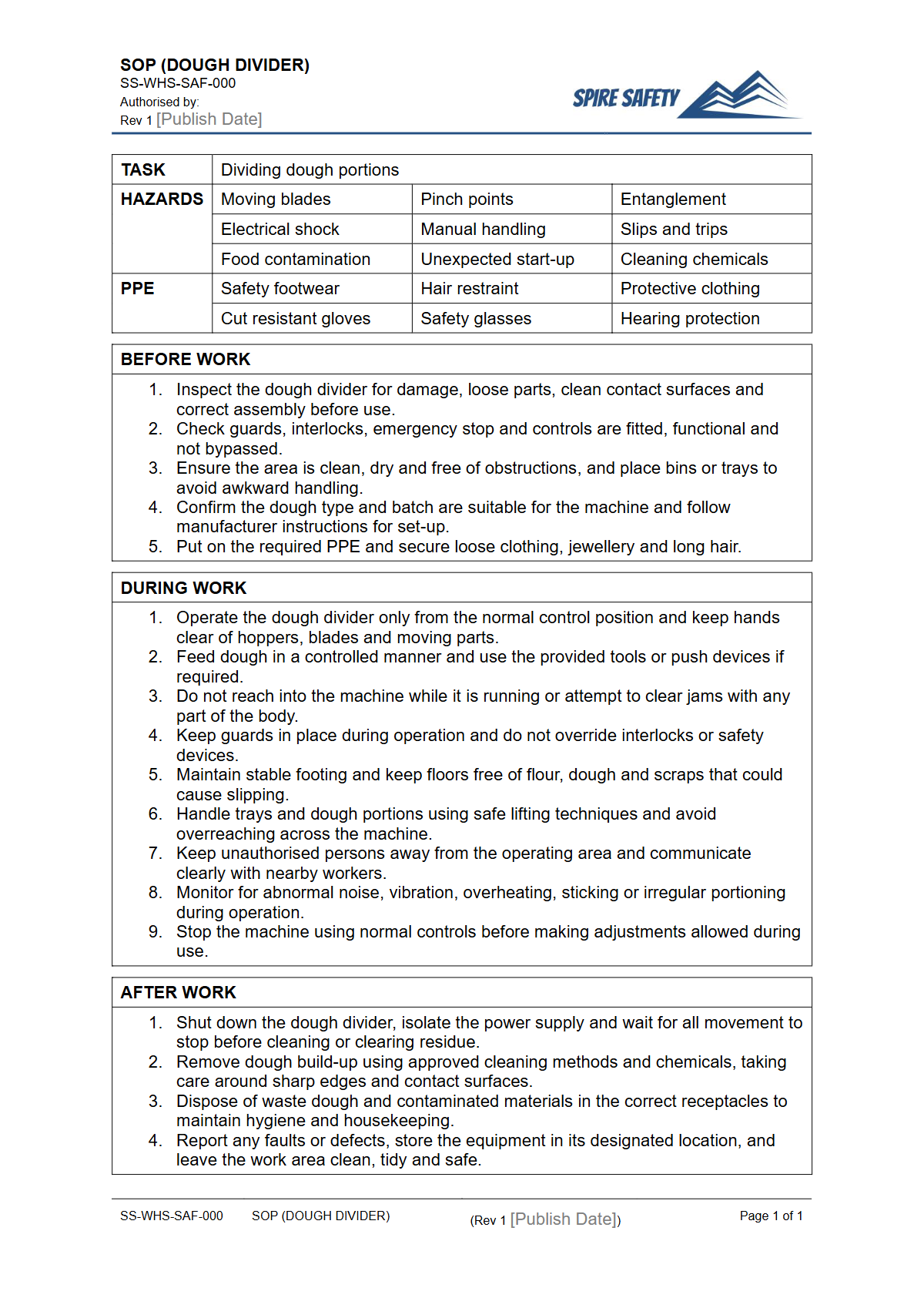
Dough dividers are essential in commercial bakeries and food manufacturing, but they also introduce significant workplace hazards. This Free Safe Operating Procedure (Dough Divider) Template provides a structured starting point for documenting the required steps to operate this machinery safely.
By formalising procedures, organisations can manage risks such as entanglement in moving parts, crushing injuries from hydraulic or mechanical components, and electrical hazards. A documented SOP is a practical way to fulfil your duty of care and protect your workers from harm.
A well-drafted SOP is a fundamental component of a safety-first workplace culture. It serves not just as an instruction manual for workers but also as evidence of your commitment to proactive risk management.
Integrating equipment-specific procedures like this one into broader WHS management systems ensures a consistent and systematic approach to health and safety across your entire operation.
Video walkthrough
How to use the Free Safe Operating Procedure (Dough Divider) Template
This template is available for download in both DOCX for easy editing and PDF for straightforward distribution. The first and most critical step is to adapt the content to your specific circumstances.
A generic procedure is not sufficient for compliance or safety. You must review and modify the template to reflect the exact make and model of the dough divider used in your workplace, the specific tasks performed, the associated hazards, and the established control measures.
Important: We provide this template as a starting point. It is your responsibility to ensure the final document is tailored to your unique operational context.
We are not liable for any incidents resulting from the use of an unmodified or improperly customised template. The document is structured to guide you through detailing key safety elements, including pre-operational checks, specific operating steps, personal protective equipment (PPE) requirements, and emergency and shutdown protocols. This level of detail is necessary for all high-risk plant, just as you would outline in a safe operating procedure for conveyor systems.
When to use a Safe Operating Procedure for a Dough Divider
An SOP should be a living document, integrated into daily operations. It is essential during the induction and training of new employees to ensure they understand the correct, safe method of operation from day one.
It also serves as a critical tool for refresher training, helping to prevent complacency among experienced operators. The procedure should be readily accessible near the equipment for quick reference.
Furthermore, the SOP must be reviewed and updated regularly. This should occur at least annually, or immediately following any change to the equipment, work environment, or process.
It should also be reviewed as part of any investigation after an incident or near-miss. Regular reviews, which can be formalised through internal checks or external WHS compliance audits, ensure the procedure remains relevant and effective.
Who should use this Safe Operating Procedure
This document is intended for several key roles within an organisation. Primarily, machine operators must be thoroughly trained on the SOP and are expected to follow its instructions precisely during every use.
Supervisors and managers are responsible for enforcing the procedure, ensuring operators are competent, and conducting periodic checks to verify adherence.
Safety managers or WHS officers will use the template as a foundation for developing and implementing risk controls. They are often responsible for leading the customisation process and ensuring the final SOP aligns with the organisation's overall safety framework.
Maintenance personnel should also be familiar with the SOP, particularly the lockout-tagout and isolation procedures required before any servicing or cleaning work begins. Their safety program might also include instructions for tools used in their tasks, such as a safe work procedure for circular saws used for on-site repairs.
For more templates and guidance on creating a safer workplace, you can browse our library of free WHS resources, covering a wide range of equipment and tasks.
Common mistakes
Common mistakes to avoid
- Failing to customise the template for the specific machine model and workplace.
- Not including detailed, equipment-specific lockout-tagout (LOTO) procedures for cleaning.
- Neglecting to train workers on the finalised SOP and verify their understanding.
- Using the SOP for initial training but failing to conduct regular refresher courses.
Legal references
Legal considerations
The following legal requirements may be relevant to this type of work.
- Work Health and Safety Act (Harmonised) — Provides the primary duties for protecting workers and other people from work health and safety risks.
- Work Health and Safety Regulations (Harmonised) — Sets out requirements supporting the management of workplace hazards and risks.
The following codes may be relevant to this type of work.
- Managing WHS Risks Code of Practice — Provides practical guidance on identifying hazards, assessing risks and applying effective controls.
- Work Health and Safety Consultation, Cooperation and Coordination Code of Practice — Provides practical guidance on consulting workers and coordinating with other duty holders.
- Managing the Work Environment and Facilities Code of Practice — Provides practical guidance on safe work environments, workplace facilities and related controls.
Did you know
Amputation Risk
The moving parts and blades in dough dividers are a leading cause of amputations in the baking industry, making lockout-tagout procedures non-negotiable during cleaning and maintenance.
Flour Dust
While the machine itself is a hazard, its operation can generate airborne flour dust, which is a respiratory sensitiser and can cause occupational asthma if not controlled with proper ventilation.
FAQ
Frequently asked questions
01What are the main hazards associated with a dough divider?
02Does this SOP template cover cleaning and maintenance procedures?
03How often should an SOP for a dough divider be reviewed?
04Is a Safe Operating Procedure a legal requirement in Australia?
Share this resource
Free Safe Operating Procedure (Dough Divider) Template
Browse Categories
How To Use It
- 1Download and open in Word or PDF.
- 2Replace the placeholders with your business details.
- 3Get it reviewed by a WHS specialist before rollout.
Need it customised?
Our WHS consultants can adapt this template to your site, run a gap analysis, or audit what you already have in place.
Book a Free Consultation WHS consulting servicesor call 1300 156 382
Related templates
- Free Safe Operating Procedure (Dough Mixer) Template
- Free Safe Operating Procedure (Dough Moulder) Template
- Free Safe Operating Procedure (Dough Rounder) Template
- Free Safe Operating Procedure (Dough Sheeter) Template
- Free Safe Operating Procedure (Dough Tray Handling) Template
- Free Safe Operating Procedure (Drain Cleaning Machine) Template