
Free Safe Operating Procedure (Dough Tray Handling) Template
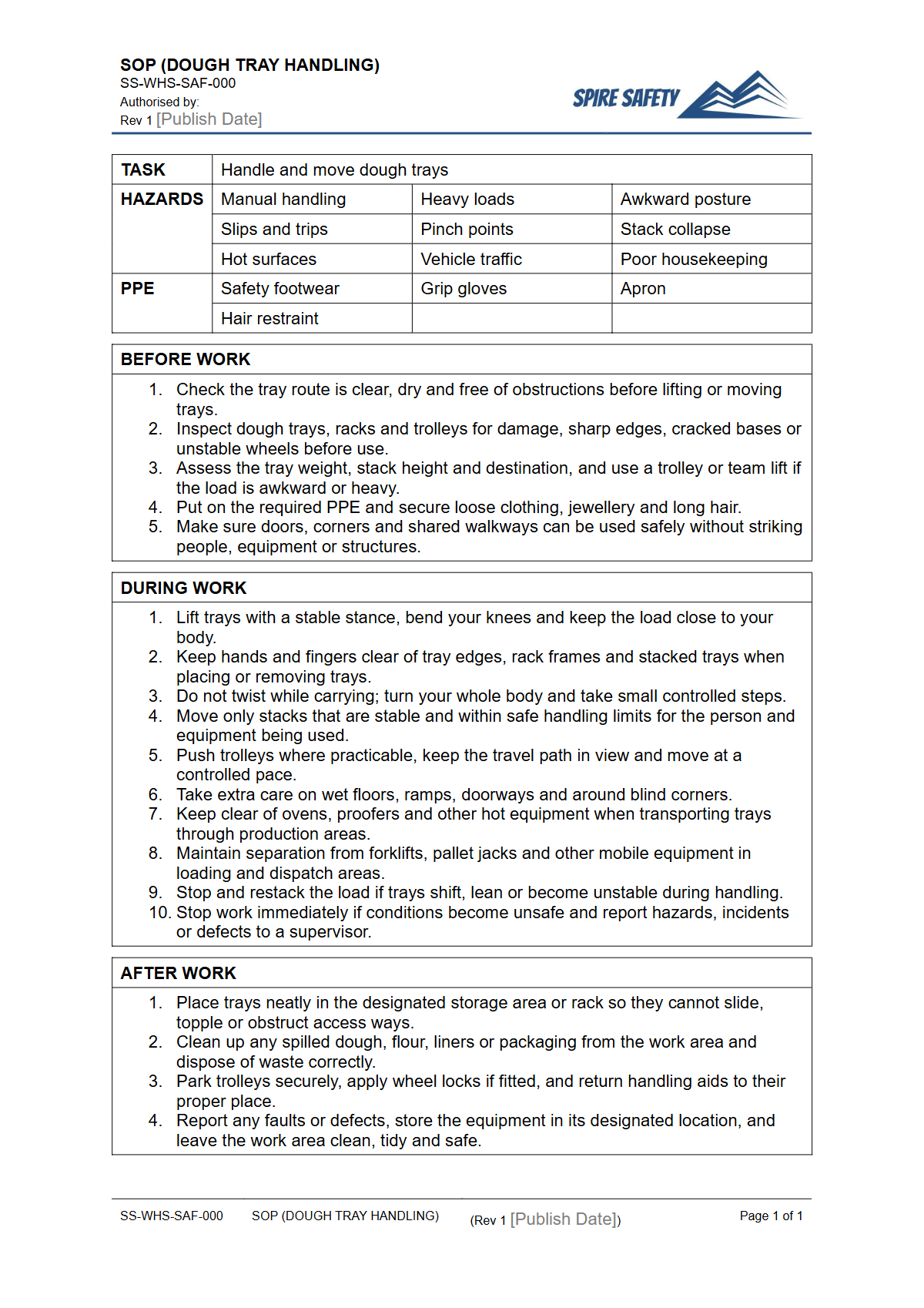
Outline safe procedures for handling dough trays to prevent manual handling injuries. Download our free Safe Operating Procedure template to get started.
Free Safe Operating Procedure (Dough Tray Handling) Template
DOCX • 126 KB + PDF
Updated Oct 2026
No signup required
Purpose of the Free Safe Operating Procedure (Dough Tray Handling) Template
Handling dough trays, a common task in bakeries, pizzerias, and food manufacturing facilities, presents significant manual handling risks. Repetitive lifting, carrying, pushing, and pulling of often heavy and awkward trays can lead to musculoskeletal disorders (MSDs), including sprains and strains to the back, shoulders, and arms.
This Free Safe Operating Procedure (Dough Tray Handling) Template provides a structured starting point for documenting and implementing controls to manage these risks effectively.
A documented SOP formalises your organisation's commitment to worker safety. It standardises the procedure for handling trays, ensuring every worker follows the safest method.
This not only helps in reducing the frequency and severity of injuries but also provides a clear basis for training, supervision, and incident investigation. By defining best practices—such as proper lifting techniques, designated stacking heights, and the use of mechanical aids—this SOP helps create a safer work environment.
Integrating this procedure is a key component of robust WHS management systems that proactively address workplace hazards.
Video walkthrough
How to use the Free Safe Operating Procedure (Dough Tray Handling) Template
This template is provided in both DOCX for easy editing and PDF for straightforward distribution. To use it effectively, you must first download the document and thoroughly adapt it to the specific conditions of your workplace.
Generic procedures are not sufficient; a site-specific risk assessment should inform the final content.
Note: This document is a template and must be customised to your workplace. We recommend a comprehensive review process where you walk through the task on-site, consult with the workers performing the job, and identify all specific hazards present.
You should edit the procedure to include details about your specific trays (weight, size), trolleys, racks, and facility layout. If you require assistance with risk assessments or customising procedures, consider engaging professional WHS consulting services for guidance.
The process often involves identifying where dough trays are moved, such as from a mixer to a proofing rack or onto a production line. For tasks involving automated equipment, you may also need to reference our free Conveyer System SOP to ensure seamless integration of safety protocols between manual and automated processes.
Once customised, the SOP should be approved by management and communicated to all relevant personnel through a formal training session.
When to use it
A Safe Operating Procedure for dough tray handling should be used as a primary reference tool in several key situations. It is essential during the induction and training of new employees, ensuring they learn the correct, safe method from their first day.
The SOP should also be a central part of regular refresher training for existing staff to prevent complacency and reinforce safe work habits.
Supervisors and managers should use the SOP as a benchmark for observing work practices and providing constructive feedback. It also serves as a critical document following a near miss or incident involving dough trays, providing a baseline against which current practices can be reviewed and improved.
Furthermore, it should be readily accessible in the work area for quick reference whenever a worker is unsure about a step in the process.
Who should use it
This Safe Operating Procedure is intended for multiple roles within an organisation. Primarily, it is for the workers who directly handle the dough trays, such as bakers, kitchen hands, and production line operators.
They must understand and follow the procedures to protect themselves and their colleagues from injury.
Supervisors and team leaders have a responsibility to enforce the SOP. They must ensure that workers are adequately trained, have access to any required mechanical aids, and are consistently adhering to the documented safe work method.
It is their role to monitor compliance and correct unsafe behaviour.
Management and WHS personnel are responsible for the development, review, and maintenance of the SOP. They must ensure it is based on a thorough risk assessment and remains current with operational changes.
Periodic reviews, sometimes supported by WHS compliance auditing, can verify the procedure's effectiveness and identify opportunities for improvement. This SOP is one of many documents available in our free WHS resources library designed to support your safety goals.
Common mistakes
Common mistakes to avoid
- Failing to customise the template for specific workplace layouts, tray weights, and equipment.
- Not consulting with workers who actually perform the task when drafting or reviewing the procedure.
- Treating the SOP as a 'set and forget' document instead of a live tool for training and supervision.
- Overlooking the use of mechanical aids like trolleys or lifters as a primary control measure.
Legal references
Legal considerations
The following legal requirements may be relevant to this type of work.
- Work Health and Safety Act (Harmonised) — Provides the primary duties for protecting workers and other people from work health and safety risks.
- Work Health and Safety Regulations (Harmonised) — Sets out requirements supporting the management of workplace hazards and risks.
The following codes may be relevant to this type of work.
- Managing WHS Risks Code of Practice — Provides practical guidance on identifying hazards, assessing risks and applying effective controls.
- Work Health and Safety Consultation, Cooperation and Coordination Code of Practice — Provides practical guidance on consulting workers and coordinating with other duty holders.
- Managing the Work Environment and Facilities Code of Practice — Provides practical guidance on safe work environments, workplace facilities and related controls.
Did you know
A Heavy Burden
Hazardous manual tasks, including lifting items like dough trays, are a leading cause of serious workers' compensation claims in Australia, making documented procedures a critical risk control.
Team Lifts
For particularly heavy or awkward stacks of trays, the safest approach is often a two-person lift. This technique should be documented as a specific procedure within your customised SOP.
FAQ
Frequently asked questions
01What are the main hazards of handling dough trays?
02How high can you safely stack dough trays?
03Is training required to use this Dough Tray Handling SOP?
04How often should a Safe Operating Procedure for dough trays be reviewed?
Share this resource
Free Safe Operating Procedure (Dough Tray Handling) Template
Browse Categories
How To Use It
- 1Download and open in Word or PDF.
- 2Replace the placeholders with your business details.
- 3Get it reviewed by a WHS specialist before rollout.
Need it customised?
Our WHS consultants can adapt this template to your site, run a gap analysis, or audit what you already have in place.
Book a Free Consultation WHS consulting servicesor call 1300 156 382
Related templates
- Free Safe Operating Procedure (Drain Cleaning Machine) Template
- Free Safe Operating Procedure (Drain Grate Cleaning) Template
- Free Safe Operating Procedure (Drain Inlet Cleaning) Template
- Free Safe Operating Procedure (Drain Outfall Check) Template
- Free Safe Operating Procedure (Drain Sediment Removal) Template
- Free Safe Operating Procedure (Drain Snake) Template