
Free Safe Operating Procedure (Drain Cleaning Machine) Template
Operating a drain cleaning machine presents significant risks. Our free template helps you document step-by-step instructions for safe use, so download your copy.
Free Safe Operating Procedure (Drain Cleaning Machine) Template
DOCX • 126 KB + PDF
Updated Oct 2026
No signup required
Purpose of the Free Safe Operating Procedure (Drain Cleaning Machine) Template
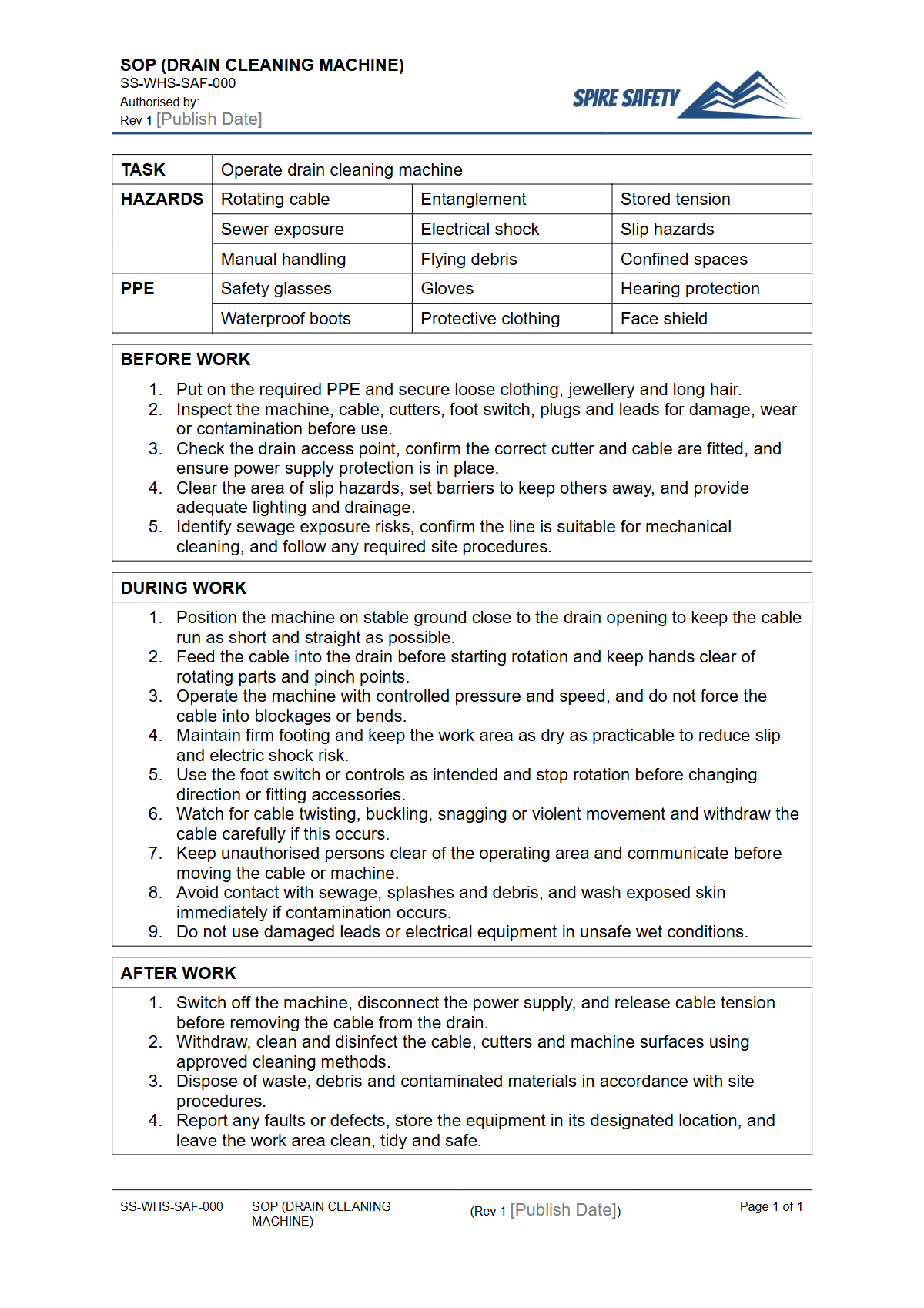
This Free Safe Operating Procedure (Drain Cleaning Machine) Template provides a structured framework for documenting the hazards and control measures associated with using powered drain and sewer cleaning equipment. Operating these machines involves significant risks, including entanglement with rotating cables, electric shock, biological exposure to sewage, and musculoskeletal injuries.
A documented SOP is a fundamental tool for any Person Conducting a Business or Undertaking (PCBU) to ensure that workers are provided with clear, consistent instructions for performing this high-risk task safely. By formalising the process, you can standardise training, simplify supervision, and demonstrate a commitment to managing workplace risks effectively.
A well-developed SOP serves as a critical component of your overall safety framework, helping to meet your primary duty of care under Australian WHS legislation. Integrating specific procedures like this one is essential for building robust WHS management systems that are practical and effective at the operational level.
It provides a clear reference point for workers and supervisors, reducing the likelihood of incidents caused by misunderstanding or procedural shortcuts.
Video walkthrough
How to use the Free Safe Operating Procedure (Drain Cleaning Machine) Template
This downloadable document is provided in both DOCX and PDF formats. It is designed as a foundational template, aligned with Australian WHS principles, that you must adapt to your specific operational context.
To use it effectively, open the DOCX file and systematically work through each section, replacing the placeholder text with information relevant to your worksite, the specific models of drain cleaning machines in use, and your established safety protocols. This includes detailing the exact make and model of the equipment, listing site-specific hazards, and specifying the required Personal Protective Equipment (PPE).
Important: This is a template, not a finished document. We have provided a comprehensive starting point, but you must customise it with your specific operational details.
Generic procedures are insufficient for managing risk; your SOP must reflect the actual equipment, environment, and tasks performed by your workers to be effective. The process of customisation is also a valuable risk management activity in itself, encouraging a thorough review of your current practices.
Key Components to Customise
- Plant and Equipment Details: List the specific make, model, and unique identifiers for each drain cleaning machine.
- Risk Assessment: Link to your specific risk assessment for this task. Identify hazards such as rotating parts, electrical faults, hazardous chemicals, biological waste, and manual handling risks.
- Personal Protective Equipment (PPE): Specify the exact type of PPE required, such as heavy-duty gloves (never loose-fitting), safety glasses or a face shield, waterproof boots, and respiratory protection if required.
- Pre-Start Inspection: Create a detailed checklist for inspecting the machine, cables, cutters, and electrical cords (including RCDs) before each use. A similar level of detail is required for our Free Air Compressor SOP (Safe Operating Procedure) Template.
- Step-by-Step Operating Instructions: Detail the entire process from setup to operation and pack-down. Include instructions for feeding and retrieving the cable, managing torque, and clearing blockages safely.
- Emergency Procedures: Outline clear steps for responding to electric shock, entanglement, chemical splash, or equipment failure.
When to use it
A Safe Operating Procedure for a drain cleaning machine should be a living document integrated into your daily operations. Its primary use is as a training tool for new operators and for refresher training for experienced workers to ensure standards do not slip.
It should be readily available at the worksite and consulted during pre-task planning or for toolbox talks. Furthermore, the SOP is an essential reference document during incident investigations to determine if procedures were followed, and it should be reviewed and updated as part of that process. Regular internal safety checks can help verify that the documented procedures are being followed correctly in practice, a process that can be formalised through WHS compliance auditing.
Who should use it
This SOP is intended for use by multiple roles within an organisation. Workers and Operators are the primary users, consulting it to understand and follow the correct, safe steps for operating the equipment.
Supervisors and Team Leaders use the SOP to induct new workers, enforce safety standards, and conduct workplace inspections. PCBUs and Managers are responsible for ensuring that adequate resources, such as this SOP, are developed, implemented, and regularly reviewed to fulfil their legal obligations.
Their involvement is key to fostering a safety culture where procedures are valued and followed. Similar to our FREE Trencher SOP Template, this document helps formalise high-risk work across different levels of your organisation.
If you require more templates for other tasks or equipment, you can explore our complete free WHS resources library for more options.
Common mistakes
Common mistakes to avoid
- Using the machine without a functioning Residual Current Device (RCD).
- Wearing loose-fitting gloves that can easily become entangled in the cable.
- Forcing a cable when it meets a hard obstruction, causing it to kink or break.
- Failing to inspect the full length of the cable for frays or damage before use.
Legal references
Legal considerations
The following legal requirements may be relevant to this type of work.
- Work Health and Safety Act (Harmonised) — Provides the primary duties for protecting workers and other people from work health and safety risks.
- Work Health and Safety Regulations (Harmonised) — Sets out requirements supporting the management of workplace hazards and risks.
The following codes may be relevant to this type of work.
- Managing WHS Risks Code of Practice — Provides practical guidance on identifying hazards, assessing risks and applying effective controls.
- Work Health and Safety Consultation, Cooperation and Coordination Code of Practice — Provides practical guidance on consulting workers and coordinating with other duty holders.
- Managing the Work Environment and Facilities Code of Practice — Provides practical guidance on safe work environments, workplace facilities and related controls.
Did you know
Entanglement Hazard
The rotating cable of a drain cleaning machine can snag a loose glove or clothing in a fraction of a second, causing severe hand and arm injuries before the operator can react.
Biological Risks
Raw sewage can contain dangerous pathogens like E. coli, Salmonella, and Hepatitis A. Proper PPE and hygiene practices outlined in an SOP are critical to prevent infection.
FAQ
Frequently asked questions
01What are the main hazards of using a drain cleaning machine?
02Does this SOP template cover both electric and petrol-powered drain cleaners?
03Who is responsible for developing and implementing a Safe Operating Procedure?
04How often should an SOP for a drain cleaning machine be reviewed?
Share this resource
Free Safe Operating Procedure (Drain Cleaning Machine) Template
Browse Categories
How To Use It
- 1Download and open in Word or PDF.
- 2Replace the placeholders with your business details.
- 3Get it reviewed by a WHS specialist before rollout.
Need it customised?
Our WHS consultants can adapt this template to your site, run a gap analysis, or audit what you already have in place.
Book a Free Consultation WHS consulting servicesor call 1300 156 382
Related templates
- Free Safe Operating Procedure (Drain Grate Cleaning) Template
- Free Safe Operating Procedure (Drain Inlet Cleaning) Template
- Free Safe Operating Procedure (Drain Outfall Check) Template
- Free Safe Operating Procedure (Drain Sediment Removal) Template
- Free Safe Operating Procedure (Drain Snake) Template
- Free Safe Operating Procedure (Drain Trap Cleaning) Template