
Free Safe Operating Procedure (Drain Trap Cleaning) Template
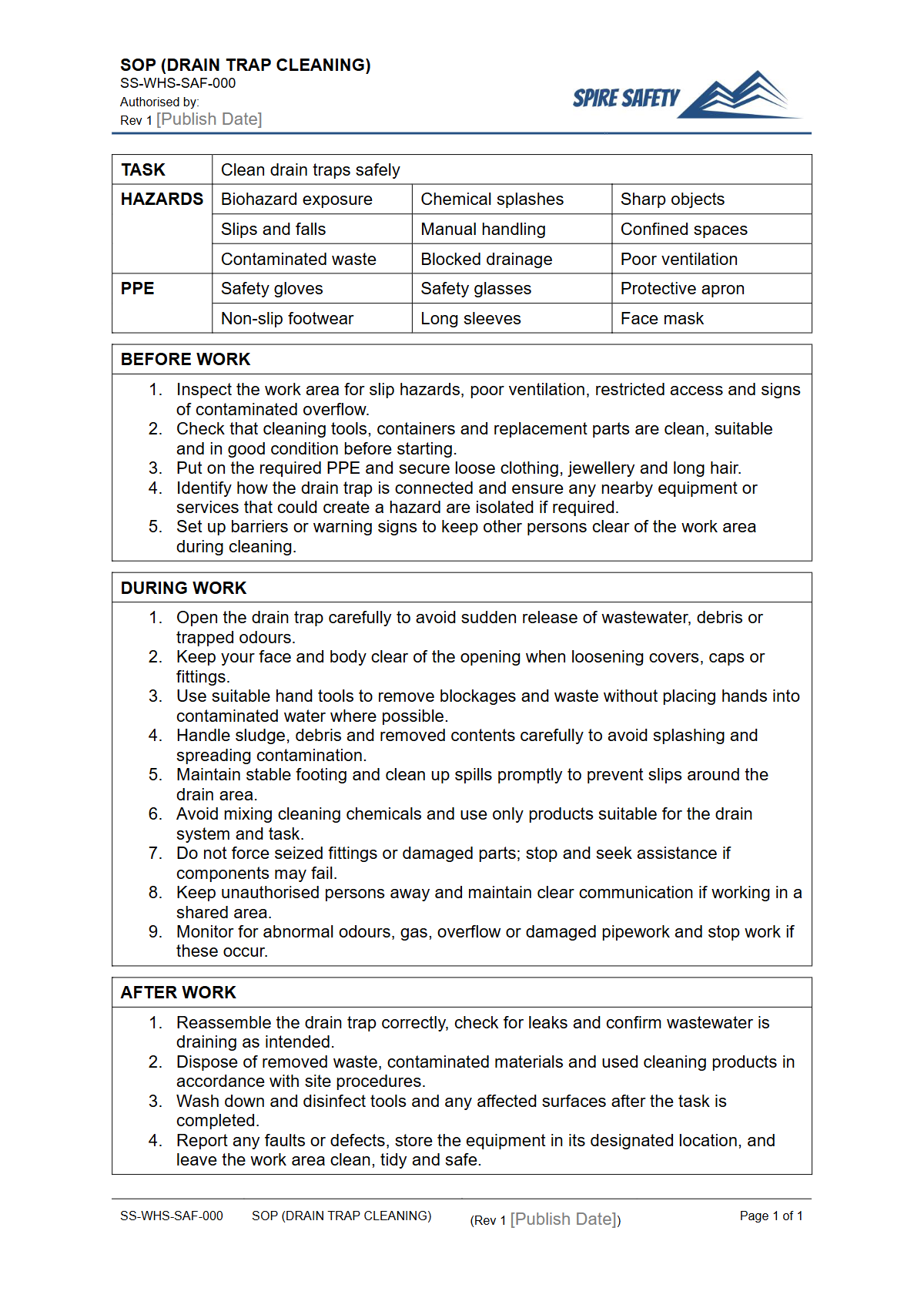
Download our free Safe Operating Procedure (Drain Trap Cleaning) template to manage risks. This customisable document helps formalise your safety process.
Free Safe Operating Procedure (Drain Trap Cleaning) Template
DOCX • 126 KB + PDF
Updated Oct 2026
No signup required
Purpose of the Free Safe Operating Procedure (Drain Trap Cleaning) Template
Effectively managing routine maintenance is a cornerstone of a safe workplace. This Free Safe Operating Procedure (Drain Trap Cleaning) Template provides a structured framework to guide workers through the process safely and efficiently.
Cleaning drain traps, while seemingly simple, involves significant hazards that must be controlled. These include exposure to hazardous cleaning chemicals, contact with biological agents from waste water, ergonomic strains from working in awkward positions, and slips or trips from water spillage.
Using a documented SOP helps standardise the task across all workers, ensuring everyone follows the same safety-checked steps every time. This consistency is vital for minimising risks and preventing incidents.
An SOP also serves as a crucial training tool for new employees and a reference for experienced staff. It formalises risk controls, such as the required Personal Protective Equipment (PPE), safe chemical handling, and emergency response actions, turning safety from an assumption into a deliberate, documented process.
Hazards Addressed by This Safe Operating Procedure
- Chemical Hazards: Exposure to corrosive or toxic drain cleaning agents.
- Biological Hazards: Contact with bacteria, viruses, and other pathogens in wastewater.
- Ergonomic Hazards: Muscle strains from bending, kneeling, or applying force in awkward postures.
- Physical Hazards: Slips, trips, and falls on wet surfaces; potential for cuts from broken pipes or equipment.
Video walkthrough
How to use the Free Safe Operating Procedure (Drain Trap Cleaning) Template
This template is provided in both DOCX and PDF formats for your convenience. The DOCX version is fully editable, allowing you to tailor the procedure to the unique context of your business.
A generic template is a starting point, not a final solution. To be effective, it must reflect the specific equipment, chemicals, work environment, and personnel at your site.
Important: You must customise this document to align with your specific operational risks. We recommend a competent person reviews and adapts the content, adding details such as:
- The specific types and models of equipment used.
- The exact names and safe handling procedures for chemicals in use, referencing their Safety Data Sheets (SDS).
- Site-specific emergency procedures, including contact numbers and spill kit locations.
- Consultation with workers who perform the task to ensure the procedure is practical and reflects how the work is actually done.
Integrating tailored SOPs like this one is a key part of developing robust WHS management systems that actively protect your team and support compliance obligations.
When to use this Safe Operating Procedure
A Safe Operating Procedure for drain trap cleaning should be used consistently whenever the task is performed. It is not just for complex blockages but also for routine preventative maintenance.
Implementing it as a standard part of your workflow ensures that safety protocols are never overlooked. It should be used as a primary document for training new staff members on the correct procedure and as a pre-start checklist for all workers before commencing the task.
This SOP should also be reviewed and referenced after any incident or near-miss related to drain cleaning to identify and rectify gaps in the procedure. Similarly, if your team performs other maintenance tasks, it is best practice to have documented procedures for those as well, such as our Free Air Compressor SOP for workshop equipment.
Who should use this Safe Operating Procedure
This document is intended for any person required to clean drain traps as part of their duties. This can include maintenance personnel, plumbers, janitorial staff, and other designated workers in commercial, industrial, or residential settings.
It provides them with clear, step-by-step instructions to perform the job without endangering themselves or others.
Supervisors and managers also have a critical role. They must use the SOP to ensure workers are adequately trained and are following the prescribed safety measures.
For Health and Safety Managers, this template is a tool to be integrated into the broader safety framework, providing evidence of a systematic approach to risk management. This documentation is often a key focus during WHS compliance auditing.
A maintenance team is often multi-skilled, and their safety documentation should cover all their high-risk activities. If your team also undertakes fabrication or repair work, you may find our Free Circular Saw SOP to be a useful addition to your safety library.
Developing and implementing a suite of SOPs can be a complex task. If you require assistance in adapting this template or creating procedures for other high-risk tasks, consider engaging specialist WHS consulting to ensure your documentation is practical and fit-for-purpose. For more templates and checklists, browse our complete free WHS resources library.
Common mistakes
Common mistakes to avoid
- Using inappropriate or excessive force, leading to damaged pipes and costly repairs.
- Mixing different cleaning chemicals, which can create dangerous chemical reactions and toxic gases.
- Failing to wear the correct Personal Protective Equipment (PPE), risking skin burns, eye damage, or respiratory issues.
- Neglecting to flush the system with adequate water after cleaning, leaving corrosive chemicals in the pipes.
Legal references
Legal considerations
The following legal requirements may be relevant to this type of work.
- Work Health and Safety Act (Harmonised) — Provides the primary duties for protecting workers and other people from work health and safety risks.
- Work Health and Safety Regulations (Harmonised) — Sets out requirements supporting the management of workplace hazards and risks.
The following codes may be relevant to this type of work.
- Managing WHS Risks Code of Practice — Provides practical guidance on identifying hazards, assessing risks and applying effective controls.
- Work Health and Safety Consultation, Cooperation and Coordination Code of Practice — Provides practical guidance on consulting workers and coordinating with other duty holders.
- Managing the Work Environment and Facilities Code of Practice — Provides practical guidance on safe work environments, workplace facilities and related controls.
Did you know
The P-Trap's Purpose
The "P" shape in a drain trap is designed to hold a plug of water, which acts as a seal to prevent foul-smelling and potentially harmful sewer gases from entering the building.
Hidden Hazards
Blocked drains can produce hydrogen sulfide gas, which has a "rotten egg" smell. At low concentrations it's an irritant, but at high concentrations it is toxic and immediately dangerous to life and health.
FAQ
Frequently asked questions
01What are the main hazards when cleaning a drain trap?
02What PPE is required for cleaning drain traps?
03How often should a Safe Operating Procedure be reviewed?
04Can I use household drain cleaners in a commercial workplace?
Share this resource
Free Safe Operating Procedure (Drain Trap Cleaning) Template
Browse Categories
How To Use It
- 1Download and open in Word or PDF.
- 2Replace the placeholders with your business details.
- 3Get it reviewed by a WHS specialist before rollout.
Need it customised?
Our WHS consultants can adapt this template to your site, run a gap analysis, or audit what you already have in place.
Book a Free Consultation WHS consulting servicesor call 1300 156 382
Related templates
- Free Safe Operating Procedure (Drainage Channel Check) Template
- Free Safe Operating Procedure (Drainage Channel Clean) Template
- Free Safe Operating Procedure (Drainage Outlet Check) Template
- Free Safe Operating Procedure (Drainage Outlet Clean) Template
- Free Safe Operating Procedure (Drainage Swale Cleaning) Template
- Free Safe Operating Procedure (Drill Bit Change) Template