
Free Safe Operating Procedure (Drainage Outlet Clean) Template
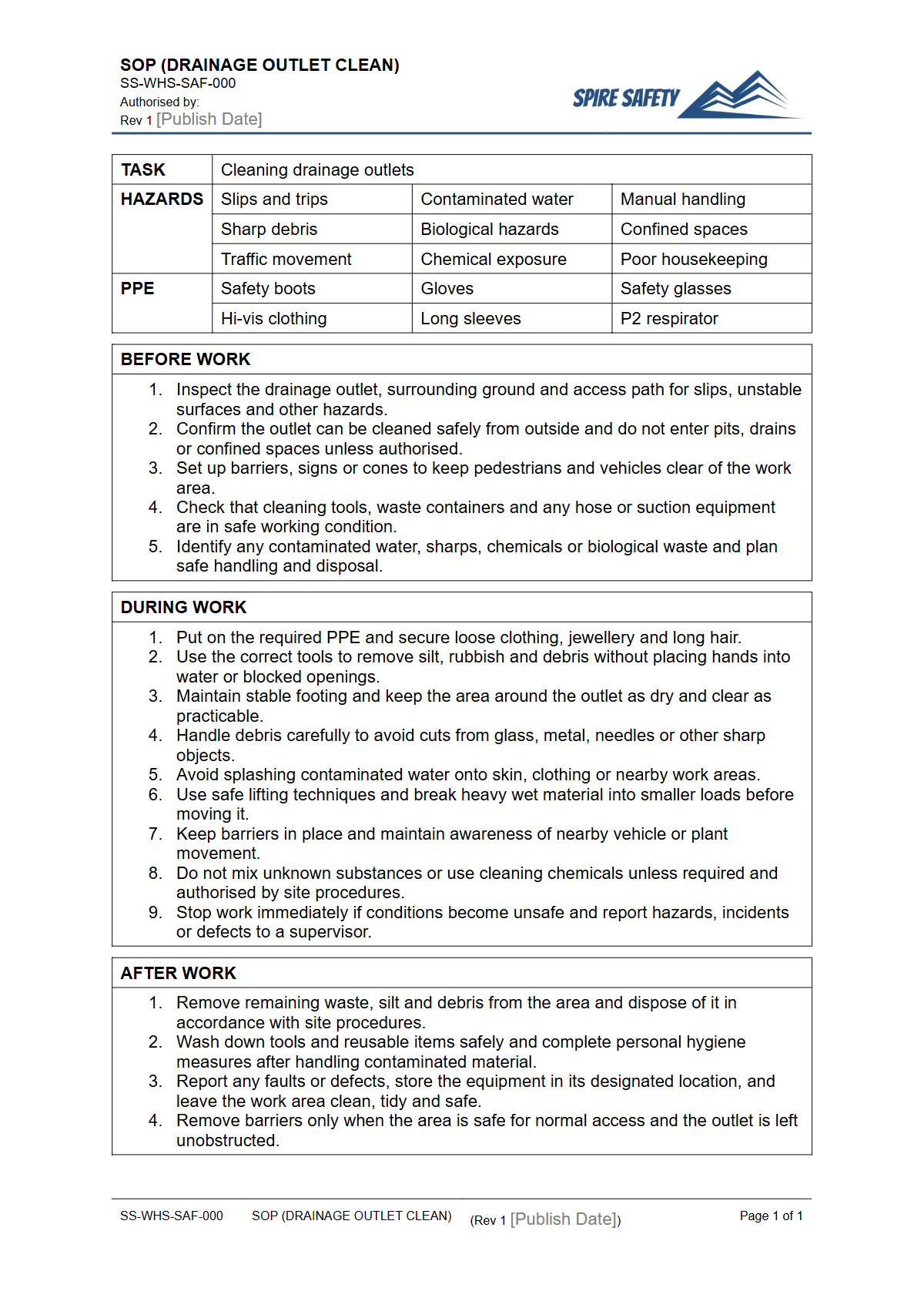
Download our free Safe Operating Procedure (Drainage Outlet Clean) Template. This structured document helps outline step-by-step safety measures for the task.
Free Safe Operating Procedure (Drainage Outlet Clean) Template
DOCX • 126 KB + PDF
Updated Oct 2026
No signup required
Purpose of the Free Safe Operating Procedure (Drainage Outlet Clean) Template
Cleaning drainage outlets, while a common maintenance task, carries significant and often underestimated risks. This Safe Operating Procedure (Drainage Outlet Clean) Template provides a structured framework for organisations to document a safe system of work, helping to manage hazards and meet WHS obligations.
The primary purpose is to provide workers with clear, step-by-step instructions to perform the task safely and consistently. By formalising the process, you can systematically address risks such as biological exposure to bacteria and pathogens in stagnant water, ergonomic injuries from awkward postures, chemical exposure from cleaning agents, and the physical dangers of slips, trips, and falls around wet areas.
A documented SOP is a critical tool for risk management. It prompts a thorough consideration of potential hazards before work begins, ensuring control measures are planned and implemented.
These controls might include isolating water flow, using specific Personal Protective Equipment (PPE), and establishing emergency procedures. For more complex drainage projects that involve excavation, having documented procedures is essential; you may also need a free trencher SOP template to manage those associated risks.
Ultimately, this template helps your business demonstrate its commitment to a safe workplace by providing a practical tool for operational safety.
Video walkthrough
How to use the Free Safe Operating Procedure (Drainage Outlet Clean) Template
Our free template is provided in DOCX and PDF formats to serve as a robust starting point. It is not a finished, document.
To be effective, you must adapt it to the specific context of your workplace. Your customisation should be guided by a site-specific risk assessment, which will identify the unique hazards present in your environment, such as the type of drainage system, the location, and the specific equipment used.
The document includes sections for you to detail pre-operational checks, step-by-step procedures, required PPE, and emergency response actions.
Important: We have developed this template as a guide based on common Australian WHS practices. You must customise this document with your own information, including your company name, logo, and site-specific details.
Review every section and update it to reflect the actual tools (such as high-pressure water jets), chemicals, and work methods used by your team. For example, if compressed air is used for cleaning, your procedures should align with a document like an air compressor SOP. Finalised SOPs should be reviewed and approved by a competent person within your organisation before being issued for use.
When to use it
A Safe Operating Procedure for cleaning drainage outlets should be a core part of your daily operations and safety management cycle. Its primary use is as a practical guide for workers just before and during the task, ensuring they follow the approved safe work method.
It is also an essential resource for training new employees and for refresher training for existing staff, ensuring everyone understands the established safety standards and expectations. The SOP should be referenced during pre-start meetings or toolbox talks to discuss the day's specific task, highlighting key risks and controls.
Beyond daily use, the SOP is a vital document for continuous improvement. It should be reviewed and updated after any incident or near-miss to incorporate learnings and prevent recurrence.
Regular reviews, typically annually, are also necessary to ensure the procedure remains current with any changes in legislation, equipment, or industry best practice. This proactive approach to document management is a cornerstone of effective comprehensive WHS management systems, demonstrating a commitment to more than just paperwork.
Who should use it
This SOP template is designed for a range of personnel within an organisation. The primary users are the workers and maintenance staff who perform the cleaning task.
For them, it is a direct instruction manual on how to work safely. Supervisors and team leaders use the SOP to induct and train their teams, monitor work, and enforce safety standards on-site.
They are responsible for ensuring the procedures are understood and followed correctly.
WHS Managers and Safety Officers will use this template as a key component of the organisation's overall safety framework. They are often responsible for developing, reviewing, and managing the library of SOPs, ensuring they are based on thorough risk assessments.
On larger sites, such as construction or logistics hubs where heavy equipment may be used to access large drainage grates, even equipment operators must be aware of adjacent work; their procedures for the safe operation of a telehandler, for example, must account for personnel working on the ground. Finally, Facility or Building Managers who are responsible for the overall maintenance and safety of a property will use the SOP to ensure their contractors or employees are adhering to safe and documented work methods.
For a complete list of similar documents covering various high-risk tasks and equipment, browse our free WHS resources library.
Common mistakes
Common mistakes to avoid
- Failing to correctly identify if the task involves a confined space, which requires a specific permit.
- Using incorrect or insufficient Personal Protective Equipment (PPE) for the identified hazards.
- Neglecting to isolate water flow, energy sources (for pumps), or vehicle traffic before starting work.
- Not having a documented emergency response plan in place for potential incidents.
Legal references
Legal considerations
The following legal requirements may be relevant to this type of work.
- Work Health and Safety Act (Harmonised) — Provides the primary duties for protecting workers and other people from work health and safety risks.
- Work Health and Safety Regulations (Harmonised) — Sets out requirements supporting the management of workplace hazards and risks.
The following codes may be relevant to this type of work.
- Managing WHS Risks Code of Practice — Provides practical guidance on identifying hazards, assessing risks and applying effective controls.
- Work Health and Safety Consultation, Cooperation and Coordination Code of Practice — Provides practical guidance on consulting workers and coordinating with other duty holders.
- Managing the Work Environment and Facilities Code of Practice — Provides practical guidance on safe work environments, workplace facilities and related controls.
Did you know
Biological Hazards
Stagnant water in drains can harbour harmful microorganisms like Legionella and Leptospira. These can cause serious illnesses if contaminated water is splashed into the eyes or mouth, or if aerosols are inhaled.
Duty of Care
Under Australian WHS law, a Person Conducting a Business or Undertaking (PCBU) has a primary duty of care to ensure worker health and safety, which includes providing safe systems of work like SOPs.
FAQ
Frequently asked questions
01What are the main hazards when cleaning a drainage outlet?
02Does this SOP template cover confined space entry?
03What PPE is required for cleaning drainage outlets?
04How often should a Safe Operating Procedure be reviewed?
Share this resource
Free Safe Operating Procedure (Drainage Outlet Clean) Template
Browse Categories
How To Use It
- 1Download and open in Word or PDF.
- 2Replace the placeholders with your business details.
- 3Get it reviewed by a WHS specialist before rollout.
Need it customised?
Our WHS consultants can adapt this template to your site, run a gap analysis, or audit what you already have in place.
Book a Free Consultation WHS consulting servicesor call 1300 156 382
Related templates
- Free Safe Operating Procedure (Drainage Swale Cleaning) Template
- Free Safe Operating Procedure (Drill Bit Change) Template
- Free Safe Operating Procedure (Drill Mast Setup) Template
- Free Safe Operating Procedure (Drill Rod Breakout) Template
- Free Safe Operating Procedure (Drill Rod Handling) Template
- Free Safe Operating Procedure (Drip Line Flushing) Template