
Free Safe Operating Procedure (Drill Rod Breakout) Template
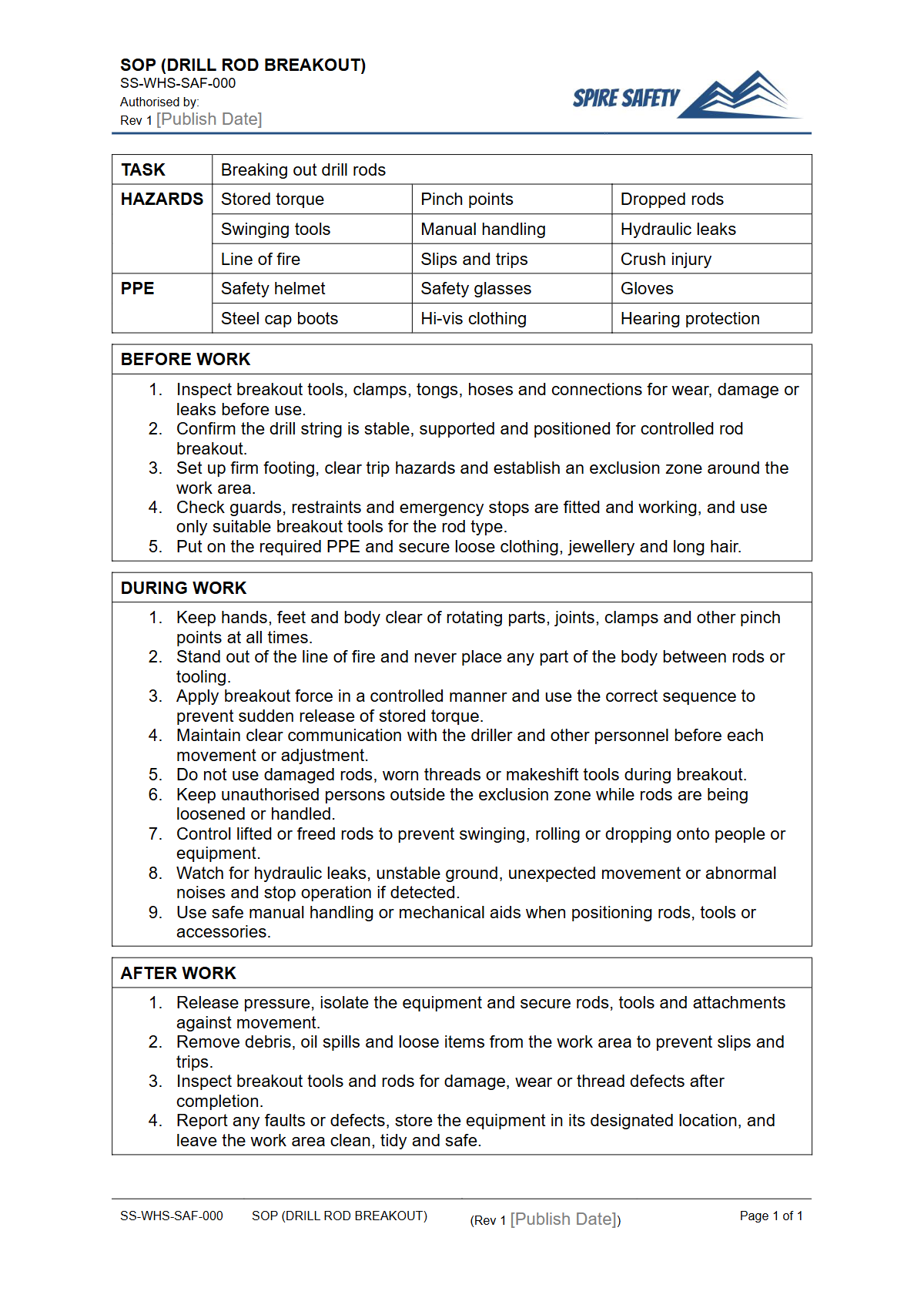
Download our free Safe Operating Procedure for drill rod breakout tasks. This template helps you outline the risks and controls for this hazardous activity.
Free Safe Operating Procedure (Drill Rod Breakout) Template
DOCX • 126 KB + PDF
Updated Oct 2026
No signup required
Purpose of the Free Safe Operating Procedure (Drill Rod Breakout) Template
Breaking out drill rods, whether intentionally during operations or because they have become stuck, is a high-risk activity common in mining, construction, and geotechnical industries. The task involves significant stored energy, either as rotational torque in the drill string or potential energy in raised equipment.
This free Safe Operating Procedure (Drill Rod Breakout) Template provides a structured framework for documenting the specific hazards and control measures required to perform this task safely.
This document helps a Person Conducting a Business or Undertaking (PCBU) meet their primary duty of care by establishing a formal, safe system of work. It prompts consideration of risks such as uncontrolled release of pressure, projectile hazards from failed components, and crush injuries from moving equipment.
By standardising the procedure, you reduce the likelihood of incidents caused by improvisation or procedural shortcuts. Implementing a suite of documented procedures is a cornerstone of any robust WHS management system.
Video walkthrough
How to use the Free Safe Operating Procedure (Drill Rod Breakout) Template
This template is a starting point, aligned with Australian WHS principles, designed for customisation. Download the DOCX or PDF file and adapt it to the specific drilling rigs, tooling (e.g., breakout tongs, chain wrenches), ground conditions, and personnel at your workplace.
A generic procedure is insufficient; effective safety management requires detail.
Consultation is a mandatory part of the process. Work directly with drill rig operators and offsiders—the people who perform the task—to identify the real-world hazards and practical controls.
Their experience is invaluable for creating a procedure that is both safe and workable. Ensure that the final SOP covers all related equipment, such as the power sources for the rig, which may require its own procedure like our Free Air Compressor SOP (Safe Operating Procedure) Template.
Important: This is a template only. You must customise it to reflect the specific hazards, equipment, and operating context of your workplace.
We are not liable for any incidents that may arise from the use of this document. A thorough risk assessment should be conducted before finalising and implementing the SOP.
When to use this Safe Operating Procedure
This Safe Operating Procedure should be developed, implemented, and followed whenever drill rod breakout is required. This includes several common scenarios:
- Stuck Drill String: When the drill string becomes jammed or bogged in the ground, requiring specific techniques and significant force to free.
- Routine Operations: During the normal process of adding or removing drill rods from the drill string.
- Tooling Changes: When breaking joints to change drill bits, subs, or other downhole equipment.
- Maintenance and Repair: When disassembling the drill string for inspection or repair work.
The principles in this SOP are critical for tasks on varied sites, from large-scale mining operations to smaller geotechnical investigations. Similar attention to detail is required for all heavy machinery operations, such as those covered in our FREE Dozer SOP (Safe Operating Procedure) Template, to ensure site-wide safety consistency.
Who should use this document
This SOP is intended for use by all personnel involved in or responsible for drilling operations. Key roles include:
- Drill Rig Operators: The primary person responsible for following the procedure during operations.
- Drillers' Offsiders/Assistants: Personnel who assist the operator and are often in close proximity to the breakout area.
- Supervisors and Site Foremen: Individuals responsible for ensuring that workers are trained, competent, and adhering to the documented SOP.
- WHS Advisors and Managers: Safety professionals who develop, review, and audit the implementation of safe work procedures.
Ensuring that these procedures are consistently followed and remain effective over time can be verified through regular WHS compliance audits. This helps identify any gaps between the documented procedure and actual work practices. Beyond this specific task, our free WHS resources library offers a wide range of templates to support your organisation's safety efforts.
Common mistakes
Common mistakes to avoid
- Underestimating the amount of stored energy in a bogged or torqued-up drill string.
- Using worn, damaged, or incorrect breakout tools (e.g., tongs, chains, wrenches).
- Failing to establish and enforce a clearly marked exclusion zone for all non-essential personnel.
- Poor communication and lack of coordination between the driller and the offsider during the breakout attempt.
Legal references
Legal considerations
The following legal requirements may be relevant to this type of work.
- Work Health and Safety Act (Harmonised) — Provides the primary duties for protecting workers and other people from work health and safety risks.
- Work Health and Safety Regulations (Harmonised) — Sets out requirements supporting the management of workplace hazards and risks.
The following codes may be relevant to this type of work.
- Managing WHS Risks Code of Practice — Provides practical guidance on identifying hazards, assessing risks and applying effective controls.
- Work Health and Safety Consultation, Cooperation and Coordination Code of Practice — Provides practical guidance on consulting workers and coordinating with other duty holders.
- Managing the Work Environment and Facilities Code of Practice — Provides practical guidance on safe work environments, workplace facilities and related controls.
Did you know
Stored Energy
A drill string under torque is like a giant spring. The energy stored can be enormous, and its uncontrolled release has been the cause of numerous serious and fatal incidents in the Australian mining and construction industries.
FAQ
Frequently asked questions
01What are the main hazards of drill rod breakout?
02Why is a specific SOP needed for this task?
03Who is responsible for developing and approving this SOP?
04Can I use this template for any type of drilling rig?
Share this resource
Free Safe Operating Procedure (Drill Rod Breakout) Template
Browse Categories
How To Use It
- 1Download and open in Word or PDF.
- 2Replace the placeholders with your business details.
- 3Get it reviewed by a WHS specialist before rollout.
Need it customised?
Our WHS consultants can adapt this template to your site, run a gap analysis, or audit what you already have in place.
Book a Free Consultation WHS consulting servicesor call 1300 156 382
Related templates
- Free Safe Operating Procedure (Drill Rod Handling) Template
- Free Safe Operating Procedure (Drip Line Flushing) Template
- Free Safe Operating Procedure (Drive Shaft Removal) Template
- Free Safe Operating Procedure (Driver Check In) Template
- Free Safe Operating Procedure (Driver Handover) Template
- Free Safe Operating Procedure (Driver Rest Break) Template