
Free Safe Operating Procedure (Drive Shaft Removal) Template
Download our free Safe Operating Procedure template for drive shaft removal. It provides a structured framework for managing hazards and ensuring safe work.
Free Safe Operating Procedure (Drive Shaft Removal) Template
DOCX • 126 KB + PDF
Updated Oct 2026
No signup required
Purpose of the Free Safe Operating Procedure (Drive Shaft Removal) Template
The primary purpose of a Safe Operating Procedure for drive shaft removal is to provide clear, step-by-step instructions that guide workers through the task safely and efficiently. It formalises a safe system of work by identifying potential hazards and outlining the control measures required to eliminate or minimise them.
Key hazards addressed include crushing from vehicle movement, musculoskeletal injuries from hazardous manual tasks, strikes from stored torsional energy in the driveline, and entanglement with machinery. By documenting the correct procedure, you create a reliable training tool for new employees and a consistent reference for experienced mechanics.
This documentation forms a vital part of broader robust WHS management systems, demonstrating a commitment to proactive risk management.
Video walkthrough
How to use the Free Safe Operating Procedure (Drive Shaft Removal) Template
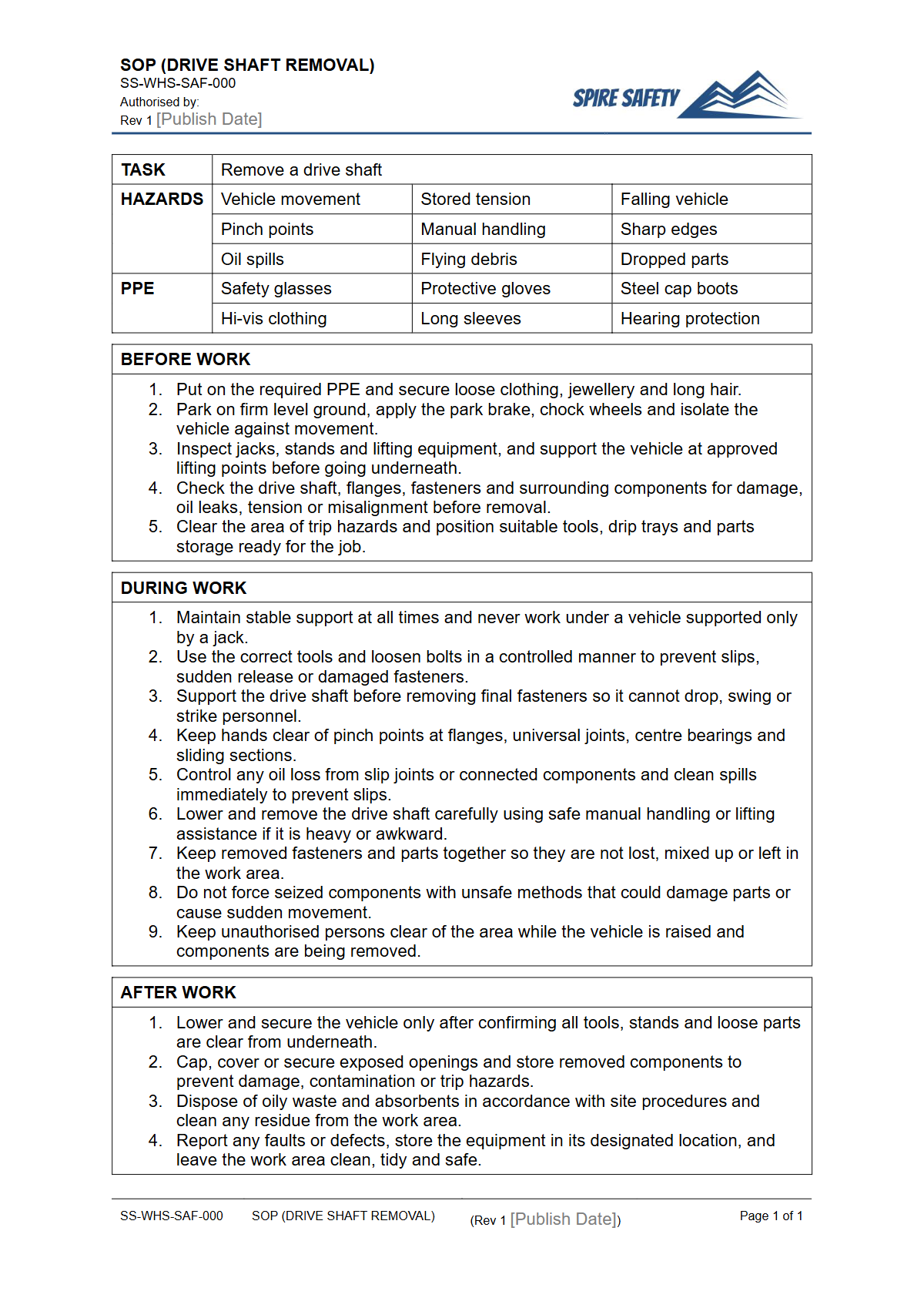
This downloadable document is a starting point, not a finished product. It outlines the typical sections and steps involved in drive shaft removal.
You can download the template as a DOCX file for easy editing or as a PDF for reference. It includes fields for site-specific details, personal protective equipment (PPE), pre-work checks, the sequential removal process, and post-task clean-up.
IMPORTANT: We've created this template as a guide. You must customise it to suit the specific vehicles, machinery, tools, and environmental conditions at your workplace.
Consult with your workers—the mechanics and fitters performing the task—to ensure the final procedure is practical, accurate, and reflects the realities of the job. For instance, the procedure for a light commercial vehicle will differ significantly from that for a heavy haul truck, which may require specific lifting gear and additional safety checks similar to those found in a Dozer SOP template.
When to use it
A drive shaft removal SOP should be used as part of the work planning process before any related maintenance task begins. It is an essential document for toolbox talks, pre-start meetings, and worker training sessions.
It serves as a checklist during the job to ensure no critical safety steps are missed. The SOP can also be used as a source document when developing a Safe Work Method Statement (SWMS) if the task is identified as high-risk construction work.
Furthermore, it should be a reference point during incident investigations or when conducting regular WHS compliance audits to verify that prescribed safety procedures are being followed in practice.
Who should use it
This procedure is intended for use by all personnel involved in vehicle and machinery maintenance. This includes qualified mechanics, heavy vehicle technicians, maintenance fitters, and apprentices under direct supervision.
Supervisors and workshop managers should use the SOP to oversee work, confirm compliance, and deliver training. They are responsible for ensuring the SOP is readily available to workers, understood, and consistently applied.
If your workshop handles a variety of heavy equipment, you might adapt this document alongside others, like our free Scraper SOP, to build a comprehensive set of procedures. For complex operations, seeking specialist WHS consulting can help ensure your documentation is thorough and effective.
Developing SOPs for all key tasks is a best-practice approach to managing risk. For instance, if your workshop also maintains other types of mobile plant, you may find resources like our Grader SOP template useful for standardising procedures across your fleet.
Consistently applying documented procedures helps build a strong safety culture where every worker understands the expected standard for safe work. You can explore our full range of templates in our free WHS resources library to support your safety management program.
Common mistakes
Common mistakes to avoid
- Failing to adequately chock wheels and stabilise the vehicle before starting work.
- Neglecting to mark the orientation of the shaft and yokes before removal, causing vibration issues upon reinstallation.
- Using incorrect tools, such as pry bars instead of pullers, which can damage components or cause sudden slips.
- Working alone without a spotter, especially when manoeuvring the heavy shaft from under a vehicle.
Legal references
Legal considerations
The following legal requirements may be relevant to this type of work.
- Work Health and Safety Act (Harmonised) — Provides the primary duties for protecting workers and other people from work health and safety risks.
- Work Health and Safety Regulations (Harmonised) — Sets out requirements supporting the management of workplace hazards and risks.
The following codes may be relevant to this type of work.
- Managing WHS Risks Code of Practice — Provides practical guidance on identifying hazards, assessing risks and applying effective controls.
- Work Health and Safety Consultation, Cooperation and Coordination Code of Practice — Provides practical guidance on consulting workers and coordinating with other duty holders.
- Managing the Work Environment and Facilities Code of Practice — Provides practical guidance on safe work environments, workplace facilities and related controls.
Did you know
Stored Energy Risk
Drive shafts can hold significant torsional energy even when the engine is off. Uncontrolled release during removal can cause the shaft to spin violently, posing a serious strike hazard.
Manual Handling Hazard
Drive shafts on heavy vehicles can weigh over 50kg. Using mechanical aids and proper lifting techniques is critical to prevent musculoskeletal injuries, a leading cause of workplace injury claims in Australia.
FAQ
Frequently asked questions
01What is the difference between a SOP and a SWMS for drive shaft removal?
02Does this template cover all types of vehicles and machinery?
03Who is responsible for creating and approving the final SOP?
04How often should a Safe Operating Procedure be reviewed?
Share this resource
Free Safe Operating Procedure (Drive Shaft Removal) Template
Browse Categories
How To Use It
- 1Download and open in Word or PDF.
- 2Replace the placeholders with your business details.
- 3Get it reviewed by a WHS specialist before rollout.
Need it customised?
Our WHS consultants can adapt this template to your site, run a gap analysis, or audit what you already have in place.
Book a Free Consultation WHS consulting servicesor call 1300 156 382
Related templates
- Free Safe Operating Procedure (Driver Check In) Template
- Free Safe Operating Procedure (Driver Handover) Template
- Free Safe Operating Procedure (Driver Rest Break) Template
- Free Safe Operating Procedure (Driver Route Briefing) Template
- Free Safe Operating Procedure (Driver Vehicle Handover) Template
- Free Safe Operating Procedure (Drone Ground Handling) Template