
Free Safe Operating Procedure (Driver Route Briefing) Template
Formalise your transport safety with our Free Safe Operating Procedure (Driver Route Briefing) Template. Download your free DOCX and PDF template today.
Free Safe Operating Procedure (Driver Route Briefing) Template
DOCX • 126 KB + PDF
Updated Oct 2026
No signup required
Purpose of the Free Safe Operating Procedure (Driver Route Briefing) Template
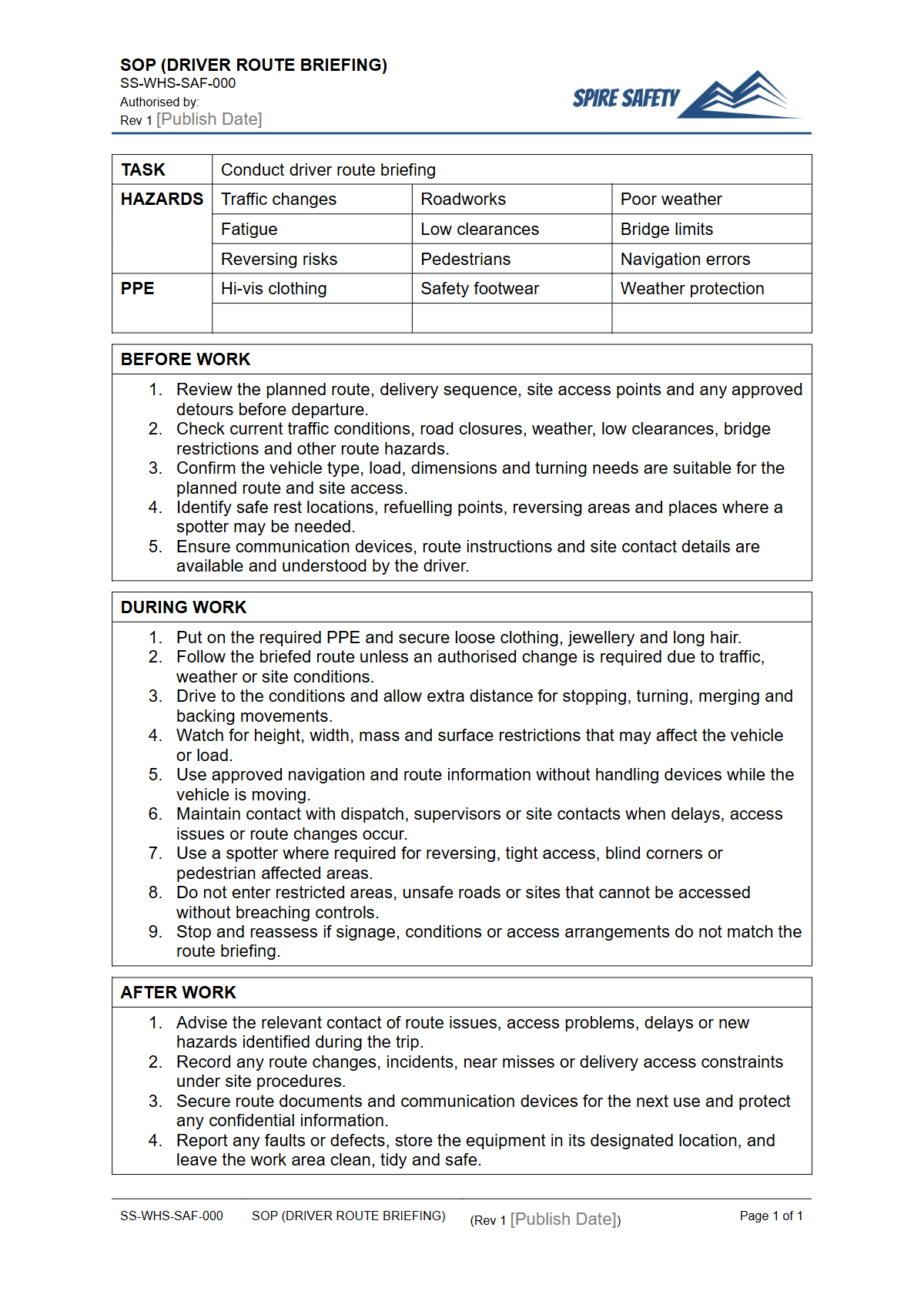
This Free Safe Operating Procedure (Driver Route Briefing) Template provides a structured framework for communicating critical safety information to drivers before they begin a journey. Its primary purpose is to systematically identify and control risks associated with a specific route, ensuring drivers are aware of known hazards, traffic conditions, site-specific rules, and emergency procedures.
By formalising this process, organisations can significantly reduce the likelihood of vehicle incidents, manage their duty of care, and improve overall transport safety. Using a documented briefing helps integrate road transport safety into your broader WHS management systems.
Video walkthrough
How to use the Free Safe Operating Procedure (Driver Route Briefing) Template
To effectively use this Safe Operating Procedure, download the DOCX or PDF file and begin by customising it with your company’s details and logo. The template is designed as a starting point and includes sections for route details, communication schedules, known hazards (like road closures, school zones, or black spots), and specific instructions for delivery or pickup sites.
When customising, it's vital to gather input from experienced drivers and supervisors who know the routes well. A briefing might also include information about hazards at a destination, such as interactions with other equipment like those outlined in a FREE Telehandler SOP Template.
Important: This is a template only. You must customise it to reflect the specific hazards, equipment, and operational context of your workplace.
We are not responsible for the outcomes of any actions taken based on the information provided in this document. You must ensure that any person using this procedure is adequately trained and competent.
When to use it
A Driver Route Briefing should be conducted before any journey that carries an elevated level of risk. This includes, but is not limited to, new or unfamiliar routes, travel during adverse weather conditions, night driving, or transporting oversized or hazardous loads.
It is also best practice to use a briefing for deliveries to complex or high-traffic sites, such as construction zones or busy distribution centres. The principles of formal hazard assessment outlined in this SOP are transferable to other high-risk tasks, such as those covered in a FREE Dozer SOP Template, where understanding the operating environment is critical.
Who should use it
This Safe Operating Procedure should be used by anyone responsible for managing vehicle operations and driver safety. This typically includes Transport Managers, Fleet Supervisors, Logistics Coordinators, and WHS Advisors.
They are responsible for preparing the briefing content based on current information and risk assessments. The drivers themselves are the end-users who receive, review, and acknowledge the briefing.
It serves as a tool for consultation, ensuring workers are actively involved in managing the risks associated with their work. For complex transport operations, engaging external experts through WHS consulting can help refine and integrate these procedures effectively.
A well-documented briefing can also be used as a training tool for new drivers or as a refresher for experienced staff. The briefing might cover site-specific hazards that drivers must navigate upon arrival, such as open excavations detailed in a FREE Trencher SOP Template. Standardising your pre-journey communication demonstrates a proactive approach to safety management.
Explore our entire free WHS resources library for more templates to support your safety systems.
Common mistakes
Common mistakes to avoid
- Using a generic briefing for all routes without customising for specific hazards.
- Failing to update the briefing to reflect real-time changes like road works or weather.
- Not obtaining a driver's signature or confirmation that they understand the briefing.
- Treating the briefing as a 'tick-and-flick' exercise rather than a meaningful safety conversation.
Legal references
Legal considerations
The following legal requirements may be relevant to this type of work.
- Work Health and Safety Act (Harmonised) — Provides the primary duties for protecting workers and other people from work health and safety risks.
- Work Health and Safety Regulations (Harmonised) — Sets out requirements supporting the management of workplace hazards and risks.
The following codes may be relevant to this type of work.
- Managing WHS Risks Code of Practice — Provides practical guidance on identifying hazards, assessing risks and applying effective controls.
- Work Health and Safety Consultation, Cooperation and Coordination Code of Practice — Provides practical guidance on consulting workers and coordinating with other duty holders.
- Managing the Work Environment and Facilities Code of Practice — Provides practical guidance on safe work environments, workplace facilities and related controls.
Did you know
Transport Risks
Vehicle incidents consistently rank as one of the leading causes of traumatic workplace fatalities in Australia.
The Unfamiliar Factor
A significant percentage of work-related road crashes occur when drivers are operating on unfamiliar roads, which underscores the value of detailed pre-journey briefings.
FAQ
Frequently asked questions
01Is a Driver Route Briefing legally required in Australia?
02What is the difference between a route briefing and a Journey Management Plan (JMP)?
03How often should I update a driver route briefing?
04Can this template be used for light vehicle drivers?
Share this resource
Free Safe Operating Procedure (Driver Route Briefing) Template
Browse Categories
How To Use It
- 1Download and open in Word or PDF.
- 2Replace the placeholders with your business details.
- 3Get it reviewed by a WHS specialist before rollout.
Need it customised?
Our WHS consultants can adapt this template to your site, run a gap analysis, or audit what you already have in place.
Book a Free Consultation WHS consulting servicesor call 1300 156 382
Related templates
- Free Safe Operating Procedure (Driver Vehicle Handover) Template
- Free Safe Operating Procedure (Drone Ground Handling) Template
- Free Safe Operating Procedure (Drone Takeoff and Landing) Template
- Free Safe Operating Procedure (Drop Saw Mitre Saw Operation) Template
- Free Safe Operating Procedure (Drum Decanting) Template
- Free Safe Operating Procedure (Drum Handler) Template